- Home
- Learning in public
- Sense-making notes
- Taking a Walk In Quinn's Mind
- I Thought All Our Senses Sent Information to the Same Place. I Was Wrong.
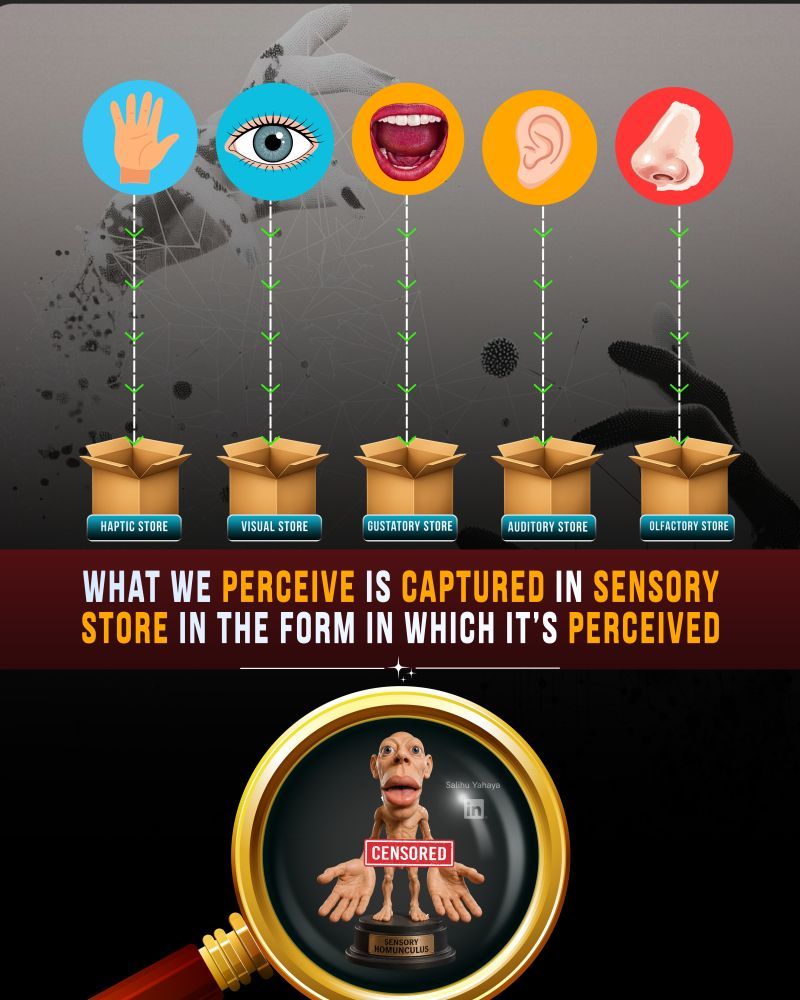
So, do our senses all take in the same amount of information?
Not really.
For example, our hands take in much more detailed touch information than most other parts of our body. That's why they're so large on the sensory homunculus diagram.
Knowing this, and seeing the sensory homunculus, completely changed how I think about our senses and the kind of information each one can take in before it's stored.
But that's not even the reason why I'm penning this post down....
After learning about how our senses are our gateway to the outside world, I assumed everything we perceive goes to one place for processing.
Only for Clark Quinn to say otherwise.
Hmmm...
Interesting...
Everything became clear with one statement he made in his book:
"What we perceive is captured in sensory store in the form in which it's perceived."
And that took the trophy home yet again.
So here's what that meant to me...
Our visual (iconic) store keeps visual information—in other words, what we see👀.
Our auditory (echoic) store keeps sound information—in other words, what we hear👂.
Our olfactory store keeps smell information—in other words, what we smell👃.
Our haptic store keeps touch information like pressure, texture, temperature, and pain—in other words, what we feel ✋.
Our gustatory store keeps taste information—in other words, what we taste 👅.
Well...
You get the point now.
Our senses are our connection to the outside world, just like Clark Quinn mentioned.
Everything we see, hear, smell, feel, and taste first enters sensory memory in the same form in which it was perceived, making it available for further processing.
Day 28 of Instructional Design
#InstructionalDesign#InstructionalDesigner#LearningAndDevelopment#LearningDesign#LearningExperienceDesign#LXD#Elearning#ELearningDesign#CurriculumDesign#CurriculumDeveloper#LearningJourney#Day1#Day2#LearningInPublic#BuildInPublic#SenseMakingNotes#MentalModels#TAWIQM
Where this comes from
- Learning Science by Clark Quinn — If you design learning, teach, or train people, you need to understand what is actually happening when someone learns. Learning happens at the neural level, but we design for it at the cognitive level. There’s a lot more in Clark Quinn’s book that I can’t share because of **intellectual property**. Get the book and experience the learning yourself. 📚You Would Love It!
- To Learn More Join the "Learning Development Accelerator" — Click the link to join the Amazing Learning Development Accelerator Group Where practice meets evidence