- Home
- Learning in public
- Sense-making notes
- Taking a Walk In Quinn's Mind
- Maybe Performance Was Never the Starting Point.
Earlier today, I mentioned a conversation from Motivation Talks! that completely changed how one of the speakers in person of Jacques Forest thought about performance.
Here's the part that stuck with me.
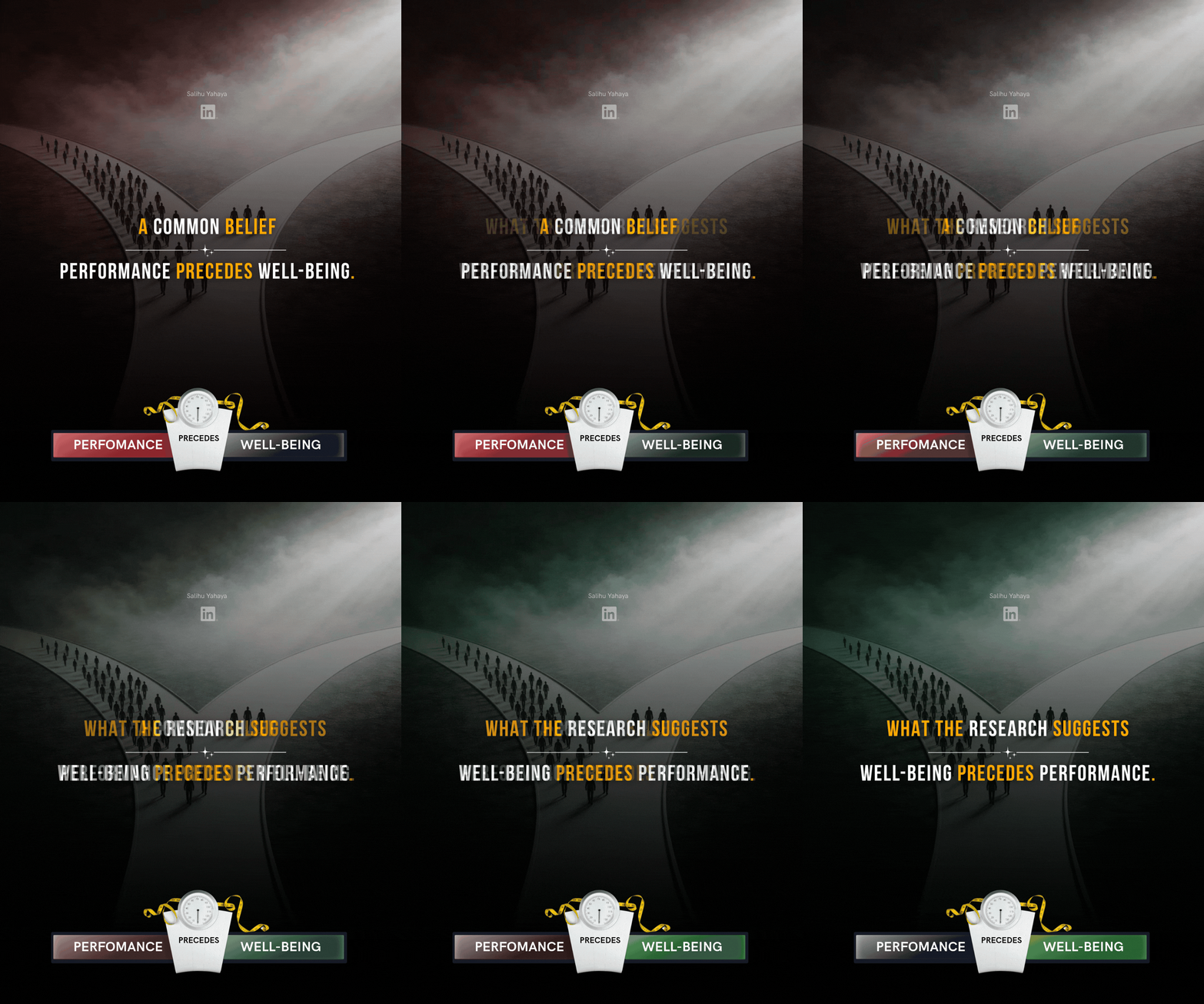
For years, many of us have assumed the relationship between performance and well-being looked like this:
Performance → Well-being
Work hard.
Perform well.
Then you'll be happy.
Jacques Forest referenced a paper published in 2023 that argued almost the exact opposite.
Now guess what It's central idea was revolving around ...
"Well-being should be the ultimate criterion."
Coming from a sports psychology background, Jacques Forest admitted he'd always viewed performance and well-being as two separate outcomes organizations try to achieve.
But this paper completely flipped that thinking.
It argued—quite convincingly—that well-being precedes performance.
Not the other way around.
That feels counterintuitive.
Organizations often think:
"Let's improve performance, then people will be happier."
The research suggests:
"Take care of people's well-being first... and performance is more likely to follow."
The analogy Jacques Forest used made it click instantly.
✈️ On an airplane, when the oxygen masks drop, you're told to put on your own mask first before helping someone else.
Not because you're selfish.
But because you're far more capable of helping others when you're able to breathe yourself.
The same applies to our psychological needs.
Take care of them first.
Ironically...
Helping others also contributes to your own well-being.
Then Matthew Richter added another fascinating point that Jacques Forest had shared with him earlier before that day i guess.
Research consistently shows that countries with higher levels of well-being also tend to have more productive, financially healthier, and more sustainable workforces.
Countries with lower well-being tend to show the opposite.
That made me stop and think.
Maybe psychology and economics aren't competing ideas after all.
Maybe organizations don't have to choose between caring about people and caring about performance.
Maybe caring about people...
is one of the most practical ways to improve performance.
Until I become a man on a mission...
I won't stop studying.
Every day I learn something new.
Every conversation shifts my perspective.
Every book, session or even video challenges another assumption I didn't even know I had.
But none of this would make sense without a mission.
And it can't be about my pockets.
It has to be about people.
Unfortunately i lost the link to the research work, hopefully if anyone has an idea of what research papers he read or has a link to it, please share.
Jacques Forest really mentioned it being a good investment of time to read
Day 23 of Instructional Design.
#InstructionalDesign #InstructionalDesigner #LearningAndDevelopment #LearningExperienceDesign #LearningJourney #Day1 #Day2 #LearningInPublic #BuildInPublic #SenseMakingNotes #MentalModels
Where this comes from
- Learning Science by Clark Quinn — If you design learning, teach, or train people, you need to understand what is actually happening when someone learns. Learning happens at the neural level, but we design for it at the cognitive level. There’s a lot more in Clark Quinn’s book that I can’t share because of **intellectual property**. Get the book and experience the learning yourself. 📚You Would Love It!
- To Learn More Join the LDA Motivation Talks in the Learning Development Accelerator — Click the link to join the Amazing Learning Development Accelerator Group Where practice meets evidence