- Home
- Learning in public
- Sense-making notes
- Taking a Walk In Quinn's Mind
- The Most Useful Framework I’d Need to Remember as an Instructional Designer
The Most Useful Framework I’d Need to Remember as an Instructional Designer If I Want to Stay Relevant
Here's The Most Useful Framework I'd Need To Remember As An Instructional Designer If I Want To Stay Relevant
"I need to develop a solid foundation for understanding."
Clark Quinn reminds me not to jump to advanced ideas before understanding the fundamentals.
Just as we don't learn to run before we learn to walk, we shouldn't rush into learning design techniques before understanding how learning actually works.
Then I came across this sentence in his book:
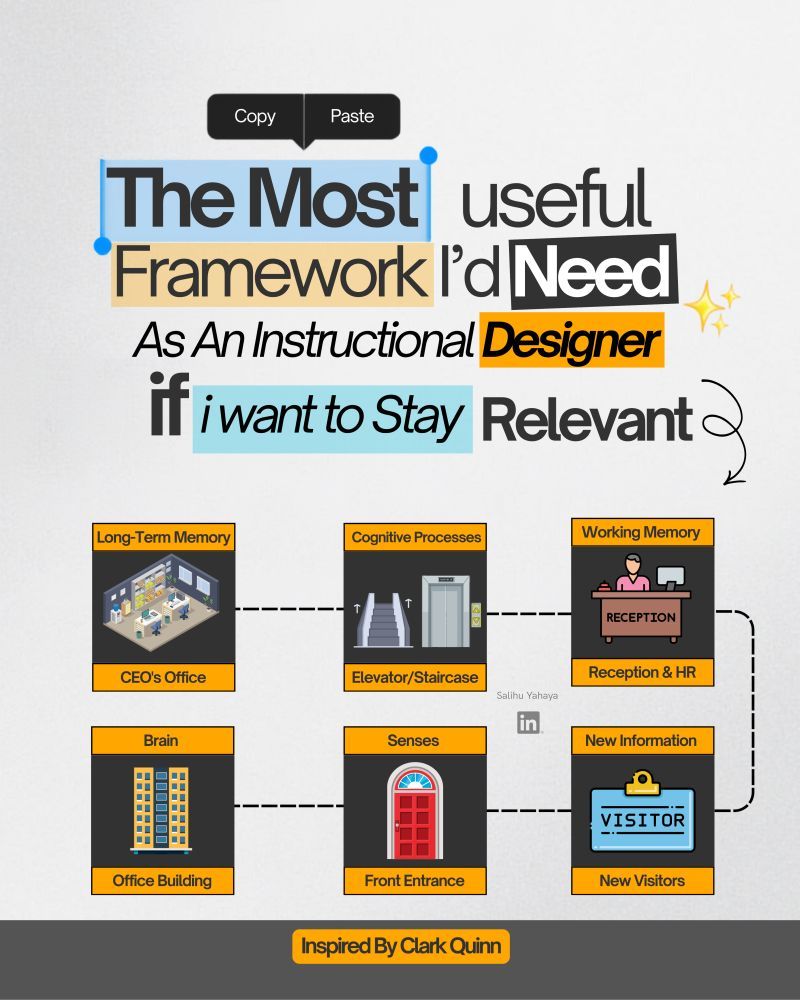
"The most useful framework is to think about information passing from knowledge store to knowledge store via cognitive processes."
At first, it sounded complicated.
Arrgggh...
But after sitting with it, I realized this might be one of the most important ideas in the entire book. If I understood this, many of the chapters that follow would only make much more sense to me.
So I reframed it into something more familiar.
Imagine your brain is a large office building, and you're the CEO on the top floor.
Every day, new visitors arrive, Some are job applicants.
Some are salespeople. Some simply walked into the wrong building.
Now let me ask you...
Does every new visitor automatically get to meet the CEO?
Of course not.
They're first received at the reception, assessed, and directed to the appropriate department.
Many leave, Some are redirected.
Most just never reach the CEO.
But every now and then, someone arrives carrying an opportunity that could transform the company.
That visitor is escorted upstairs.
The CEO sits with them, asks questions, connects what they're're saying with what he already knows, and decides whether it's important enough to become part of the company's permanent records.
Months later, if someone mentions that organization again, the CEO remembers them because that meeting was documented and stored.
Learning pretty much works the same way.
Every second, our senses bring new information into our brain.
But just because information enters doesn't mean it becomes knowledge.
Some information is ignored. Some disappears after a few moments.
Only the information we pay attention to, think about, connect to what we already know, and make sense of continues its journey.
But unlike an important visitor being escorted to the CEO's office, New information is processed more deeply if it's understood and considered valuable. It then becomes, part of our long-term memory—ready to be recalled when we need it.
That's how I now think about it.
Learning is information moving through an office building.
Not every visitor reaches the CEO.
Only those that gets attended to, processed, and recognized as valuable become part of the company's permanent records.
And maybe that's a good reminder for me as an instructional designer:
My job isn't simply to present information. It's to design learning experiences that help the right information reach the CEO (Long Term Memory).
#InstructionalDesign#LearningDesign#LearningInPublic#SenseMakingNotes#MentalModels#TAWIQM
Where this comes from
- Learning Science by Clark Quinn — If you design learning, teach, or train people, you need to understand what is actually happening when someone learns. Learning happens at the neural level, but we design for it at the cognitive level. There’s a lot more in Clark Quinn’s book that I can’t share because of **intellectual property**. Get the book and experience the learning yourself. 📚You Would Love It!