- Home
- Learning in public
- Sense-making notes
- Taking a Walk In Quinn's Mind
- Quinn Seeds
- We Don't Design for Neurons. We Design for the Thinking That Activates Them.
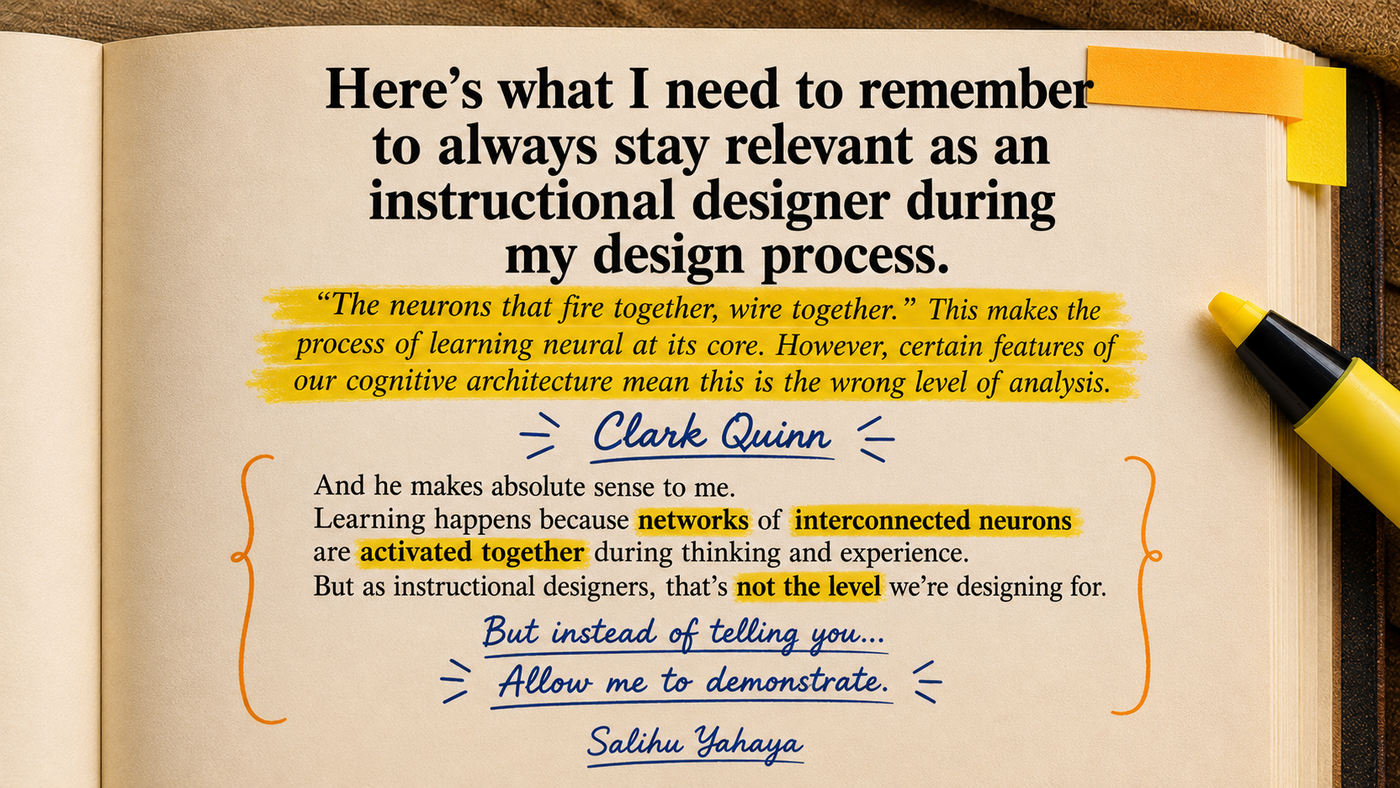
" As the saying goes: The neurons that fire together, wire together." This makes the process of learning neural at its core. However, certain features of our cognitive architecture mean this is the wrong level of analysis."
— Clark Quinn And he makes absolute sense to me.
Learning happens because networks of interconnected neurons are activated together during thinking and experience.
But as instructional designers, that's not the level we're designing for.
Back to our office…

Clark Quinn is saying that if we want to deliver information to the CEO (Long-Term Memory) of our office (the brain), we can't wake up (activate) just one employee (neuron) and expect them to do all the work.
Every employee brings different knowledge, experience, and expertise to the company.
One employee can't work in Reception, HR, Finance, Marketing, and Operations all at the same time.

Similarly, we can't activate just one neuron and expect learning to happen.
Every neuron contributes something different based on the connections it has already built.
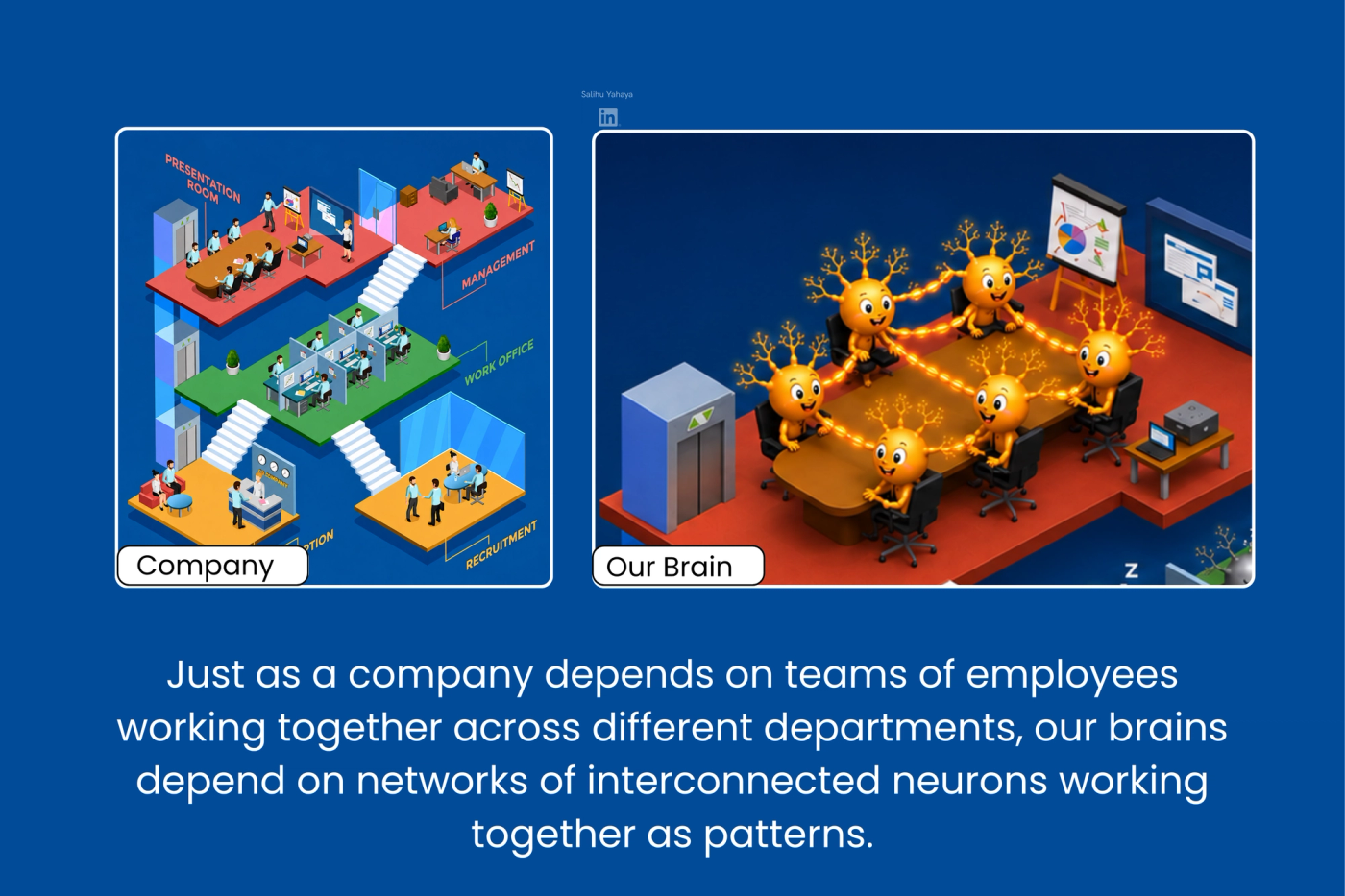
Just as a company depends on teams of employees working together across different departments, our brains depend on networks of interconnected neurons working together as patterns.

It's the coordinated work of many neurons—not the effort of a single neuron—that creates a thought. And when those same neurons continue working together in meaningful ways, their connections become stronger.
That's exactly what Clark Quinn means when he says:
"The neurons that fire together, wire together."
Or, in the language of our office analogy:
"The employees that work together, build stronger working relationships together."
Clark Quinn further went on to write a series of sentences that made me see a degree of artistry in instructional design, even while learning the science.
And ever since, I haven't been able to unsee instructional designers as artists—not because we paint learning experiences, but because we paint experiences on the canvas of the learner's brain.
This is what he said:
It’s similar to the way an individual pixel on a screen isn’t the whole picture. Examining, or activating, one pixel won’t create the scene. It’s the relative activation of one with another across the whole screen that makes a picture. Similarly, the excitation of neurons in patterns is the thought. A different set of patterns represents different concepts, and shared elements are activated together. Again, we strengthen relationships by triggering the patterns together. And we don’t address individual pixels; we provide input that gets processed on top of our existing knowledge to advance our understanding. You and I may store our representation of the word house differently, but the word itself will trigger each of our representations.
-Clark Quinn
We provide input that gets processed on top of our existing knowledge to advance our understanding…
But instead of telling you...
Allow me to demonstrate...
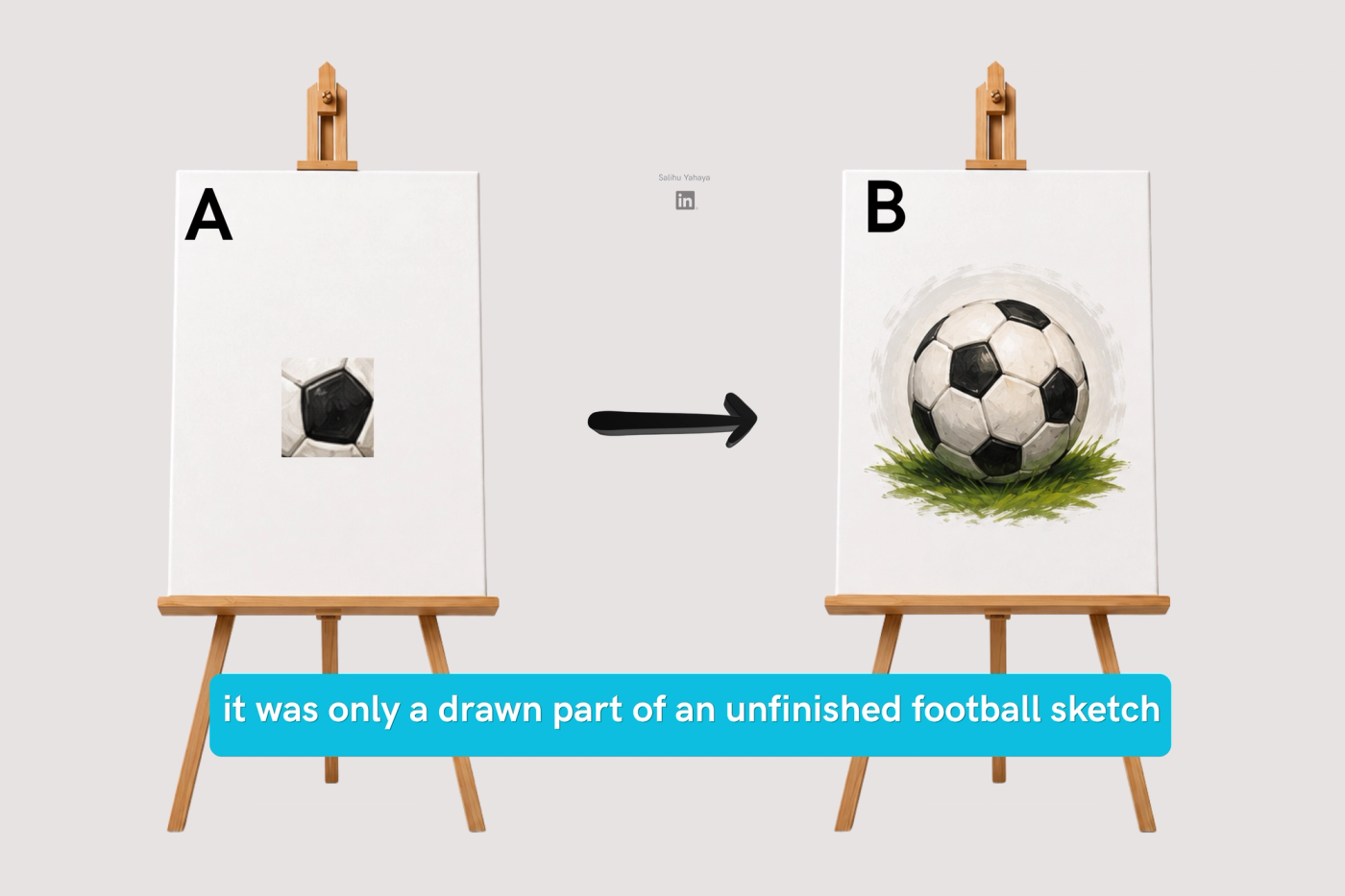
Imagine I only showed you Canvas A—an empty canvas with a few black brush strokes forming what looked like a hexagon—and asked you what it was.
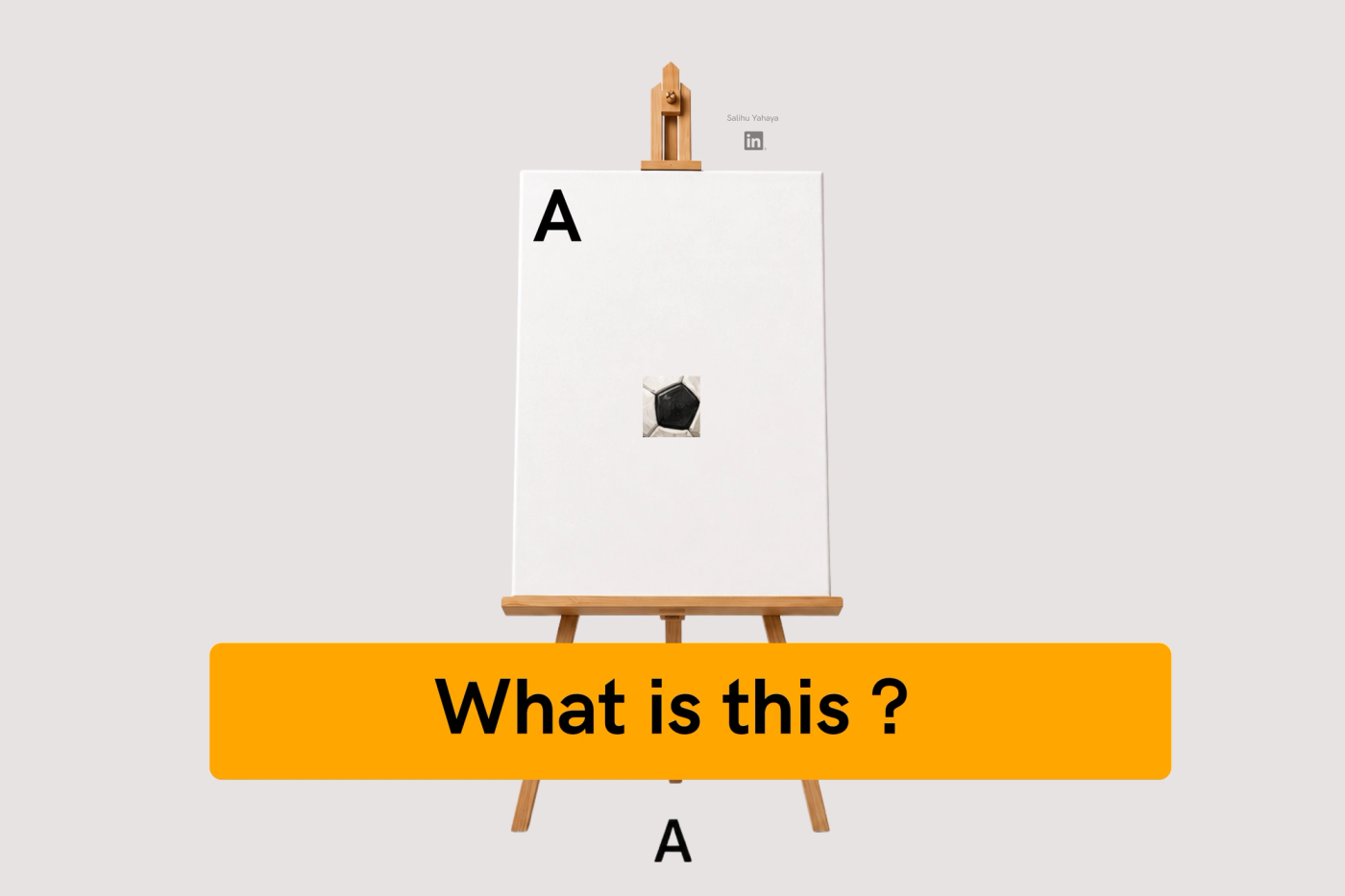
How would you have known it was only a tiny part of the complete illustration on Canvas B—a football?
Or imagine I showed you only a bell pepper on the canvas below during a restaurant training session. And asked you why we had it on the canvas today.

Would you have gotten it right?
Probably not...
How could you possibly know it was just one of many ingredient in the finished pasta dish shown on Canvas B below?

And lastly...
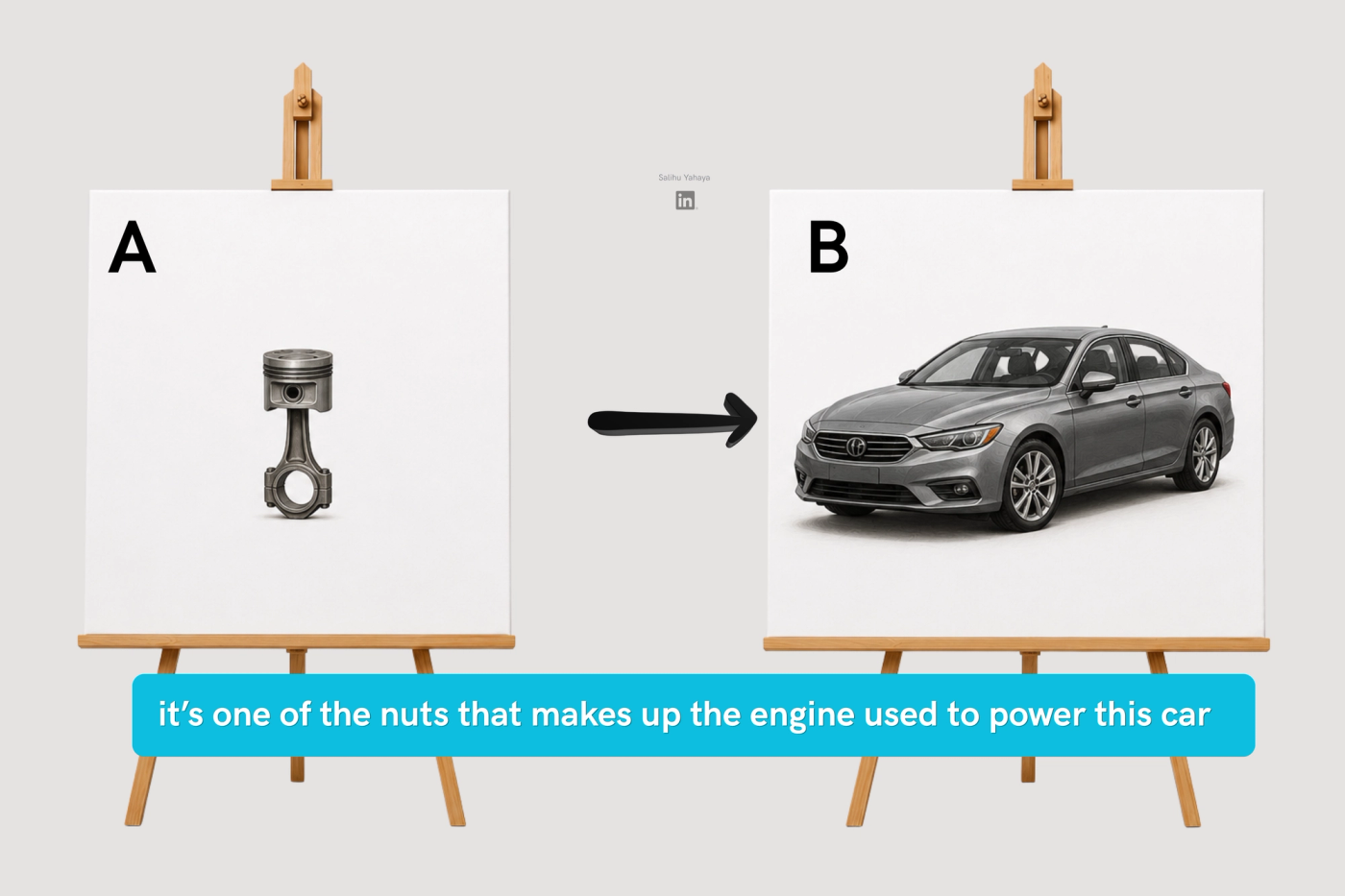
If I handed you a single nut, as shown on Canvas A below and asked what it belonged to,

How would you know it was only one of many components that make up the engine powering the car shown on Canvas B below?
Similarly...


So, what did I just do?
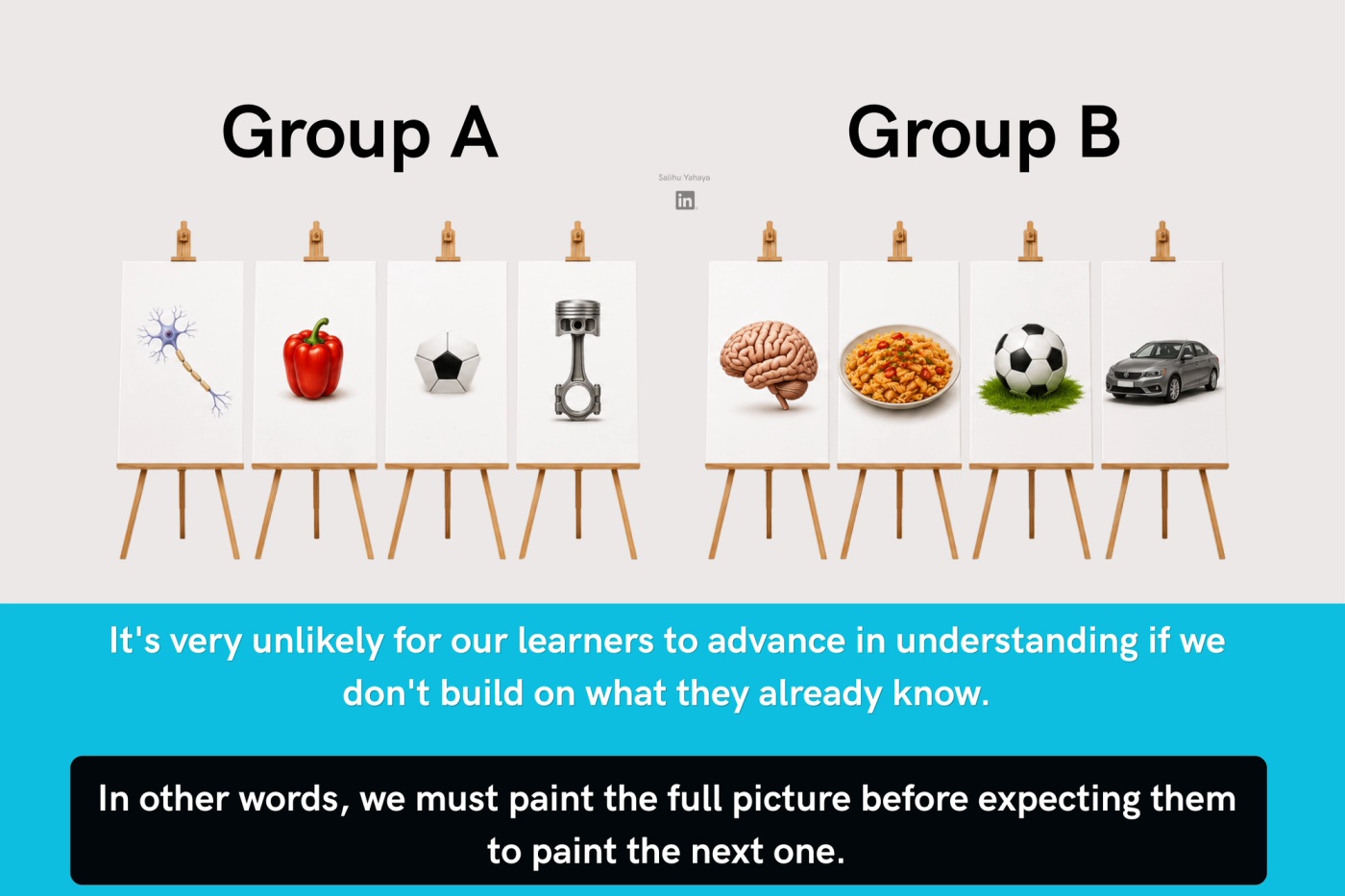
I demonstrated how existing knowledge can be built upon when the canvas has been painted in a way that learners can recognize and relate to.
In other words, I demonstrated what Clark meant when he wrote:
"We provide input that gets processed on top of our existing knowledge to advance our understanding."
One key thing to note is what he later says:
"You and I may store our representation of the word house differently, but the word itself will trigger each of our representations."
That means our canvases won't all hold the same painting.
The word house may trigger a different mental representation in you than it does in me because our existing knowledge and experiences are different. The same input activates different existing canvases.
That's why I see the canvas as our learners' existing knowledge, the paintbrush as the learning experiences we craft as instructional designers, and the artist, of course, as us—the instructional designers.
And finally, this helped me understand another point Clark makes:
"Note that accessing individual neurons is an incredibly invasive process. To address an entire concept, you'd have to have access to most of the neurons, with the ability to selectively activate them."
Take you and me, for example.
I didn't have to open your brain or selectively activate individual neurons to paint the picture I've been describing, did I? 🙂
Learning still happened at the neural level, but I never had to work at the neural level.
Instead, I worked at what Clark Quinn refers to as the cognitive level—designing experiences that prompted your existing knowledge to do the work.

We'll get to that later.
Understanding this changed how I see instructional designers.
We're not designing for individual neurons.
We're designing learning experiences that encourage the right patterns of thinking—patterns that repeatedly activate networks of neurons until those connections become stronger.
That's why Clark Quinn says the neural level is the wrong level of analysis.
The neurons are doing the work.
But instructional designers influence that work by designing the thinking that activates them.
But before then, I stumbled across something called the sensory homunculus, and I have to admit...
That absolutely amazed me.
Quite interesting.
See you in the next one...
Day 27 of Instructional Design.
#InstructionalDesign #InstructionalDesigner #LearningAndDevelopment #LearningDesign #LearningExperienceDesign #LXD #Elearning #ELearningDesign #CurriculumDesign #CurriculumDeveloper #LearningJourney #Day1 #Day2 #LearningInPublic #BuildInPublic #SenseMakingNotes #MentalModels #TAWIQM
Where this comes from
- Learning Science by Clark Quinn — If you design learning, teach, or train people, you need to understand what is actually happening when someone learns. Learning happens at the neural level, but we design for it at the cognitive level. There’s a lot more in Clark Quinn’s book that I can’t share because of **intellectual property**. Get the book and experience the learning yourself. 📚You Would Love It!
- To Learn More Join the "Learning Development Accelerator" — Click the link to join the Amazing Learning Development Accelerator Group Where practice meets evidence