- Home
- Learning in public
- Sense-making notes
- Taking a Walk In Quinn's Mind
- Quinn Seeds
- My Learners Can’t Remember What They Never Perceived
As an instructional designer, once analysis has shown that learning is the right solution, I remind myself of one fundamental truth before designing the learning experience:
My learners can never remember what they never perceived.
One sentence from Clark Quinn Quinn's Learning Science completely changed the way I think about designing learning experiences.
"Ensure that any information you want learners to perceive is detectable."
At first glance, it seems obvious.
But the more I sat with it, the more I realized just how foundational this idea is.
Here's why I completely agree.
So Imagine this…


Or imagine there's a fire outbreak in your office.
The emergency alarm is ringing loudly throughout the building.

Probably not.
Not because the alarm wasn't working...
...but because it never reached his perception.
One more example.
Imagine walking into a garage and immediately noticing a strong smell .

The moment you detect that smell, your brain immediately begins interpreting what it might mean and deciding what to do next.
These simple situations all point to the same principle.
And if we can't perceive something, nothing else in the learning process can happen, not attention, not working memory, not understanding, and certainly not long-term memory.
That was my biggest takeaway from Clark Quinn 's Quinn's first seed.
As instructional designers, one of our first responsibilities is making sure the information we want learners to perceive is actually detectable.
Because before learning can happen...
...information first has to make it through the learner's senses.
The usually analogy immediately came to mind again…
Yes the office analogy is back again.

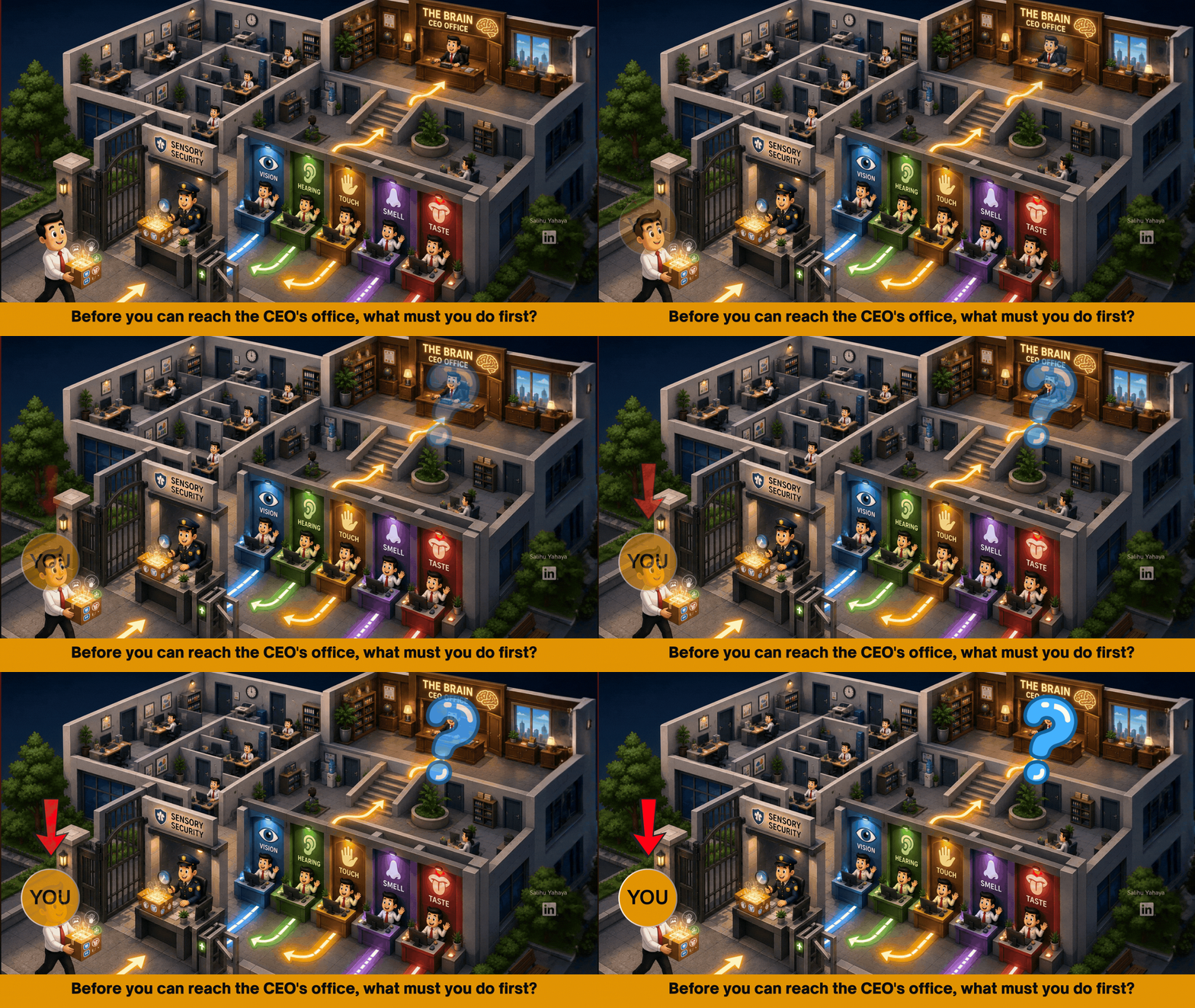
You have to enter through the building's entrance.
Without entering the building, you'll never reach the CEO.
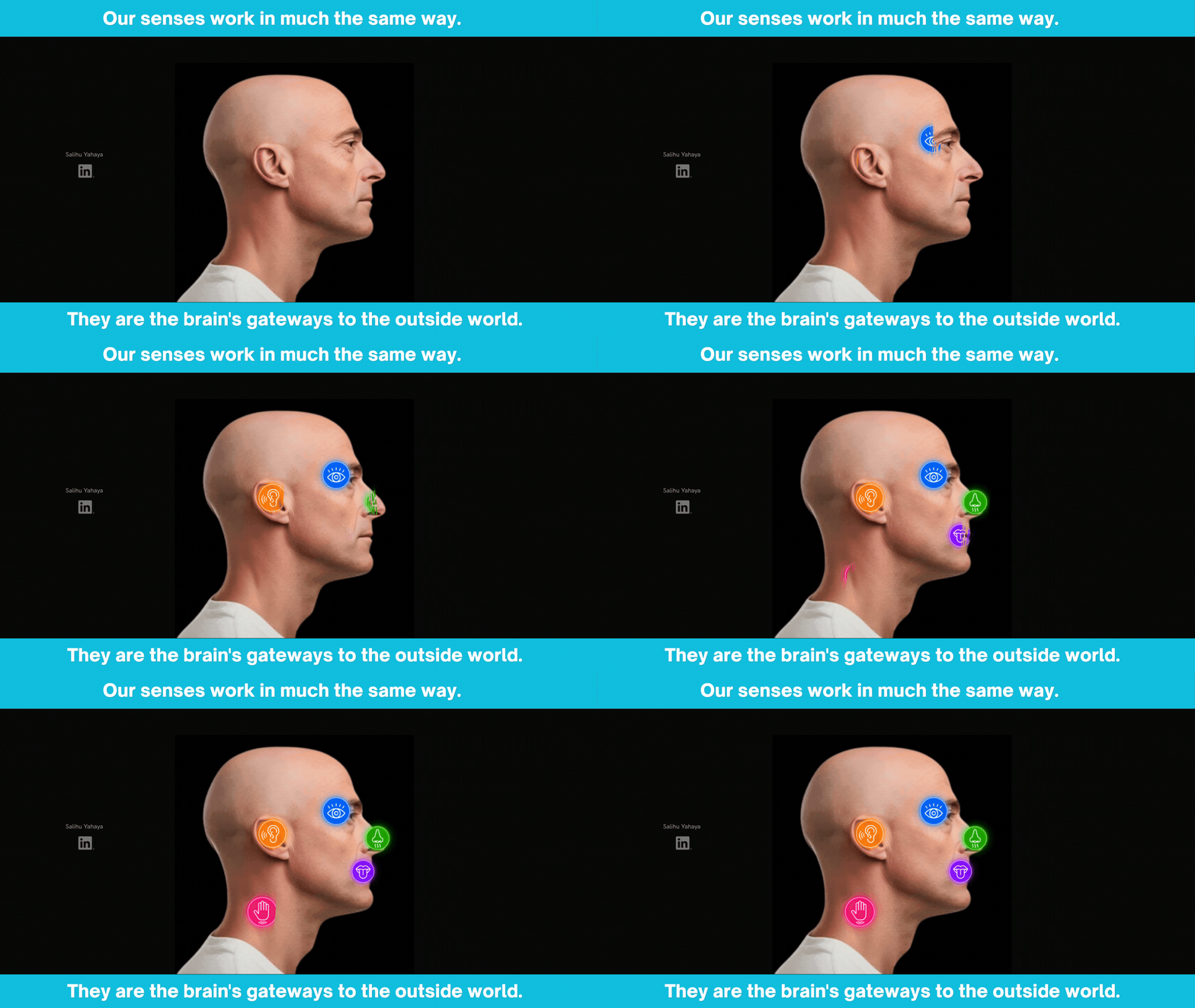
Every new piece of information, whether it's something we see, hear, smell, taste, or touch, must first pass through one of these gateways before the brain can process it.
If information never makes it through those gateways...
...the brain has nothing to work with.
That realization completely changed how I think about instructional design.
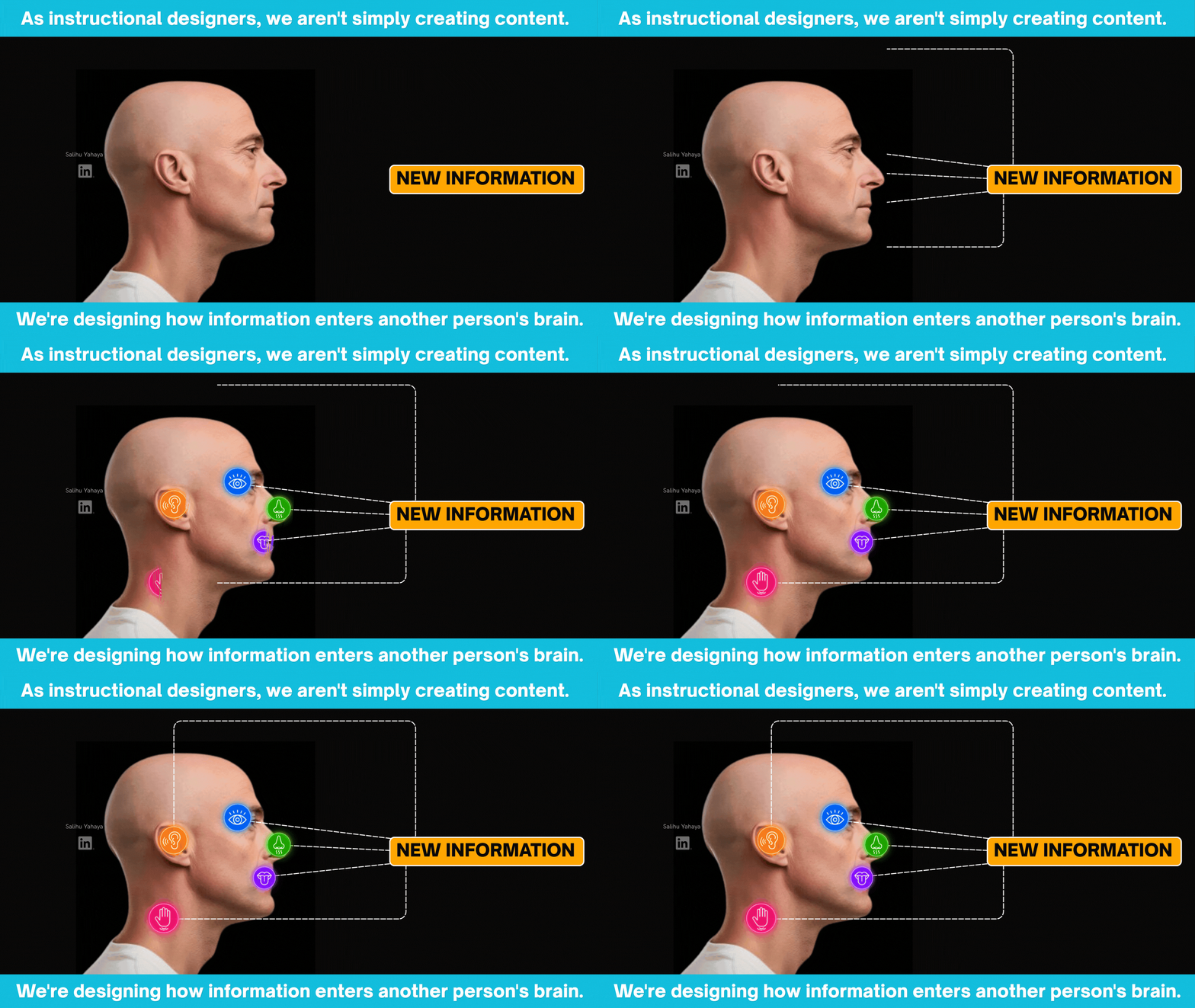
And that means making detectability one of our highest priorities.
One Sentence That Made Me Think
After introducing this principle, Clark Quinn writes:
"Using appropriate channels for information and providing sufficient duration is important. For instance, give learners control over dynamic media so they can pause or restart it; otherwise, information could be lost."
I paused there.
Why would he specifically mention appropriate channels and sufficient duration?
The more I reflected on it, the more I realized he wasn't defining detectability.
Instead, he was pointing us toward two practical design decisions that help make information detectable.
- Using the appropriate channel.
- Providing sufficient duration.
The way I finally understood these two ideas surprised even me.
So...
Let's Go to the Science Lab
Imagine you're back in a chemistry laboratory.

Your goal is simple:
Transfer the liquid from the beaker into the test tube without spilling it.
Now imagine two different scientists performing the same task.
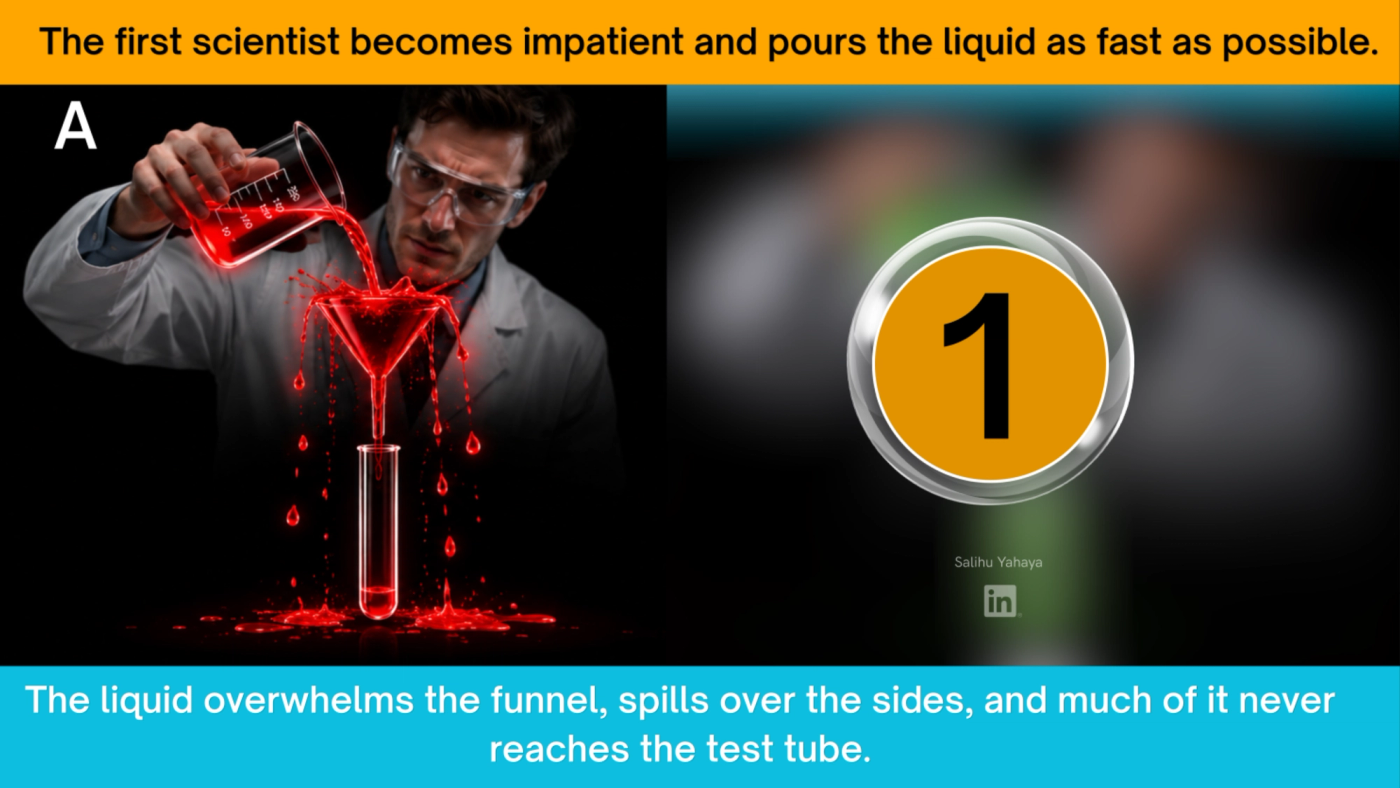
And
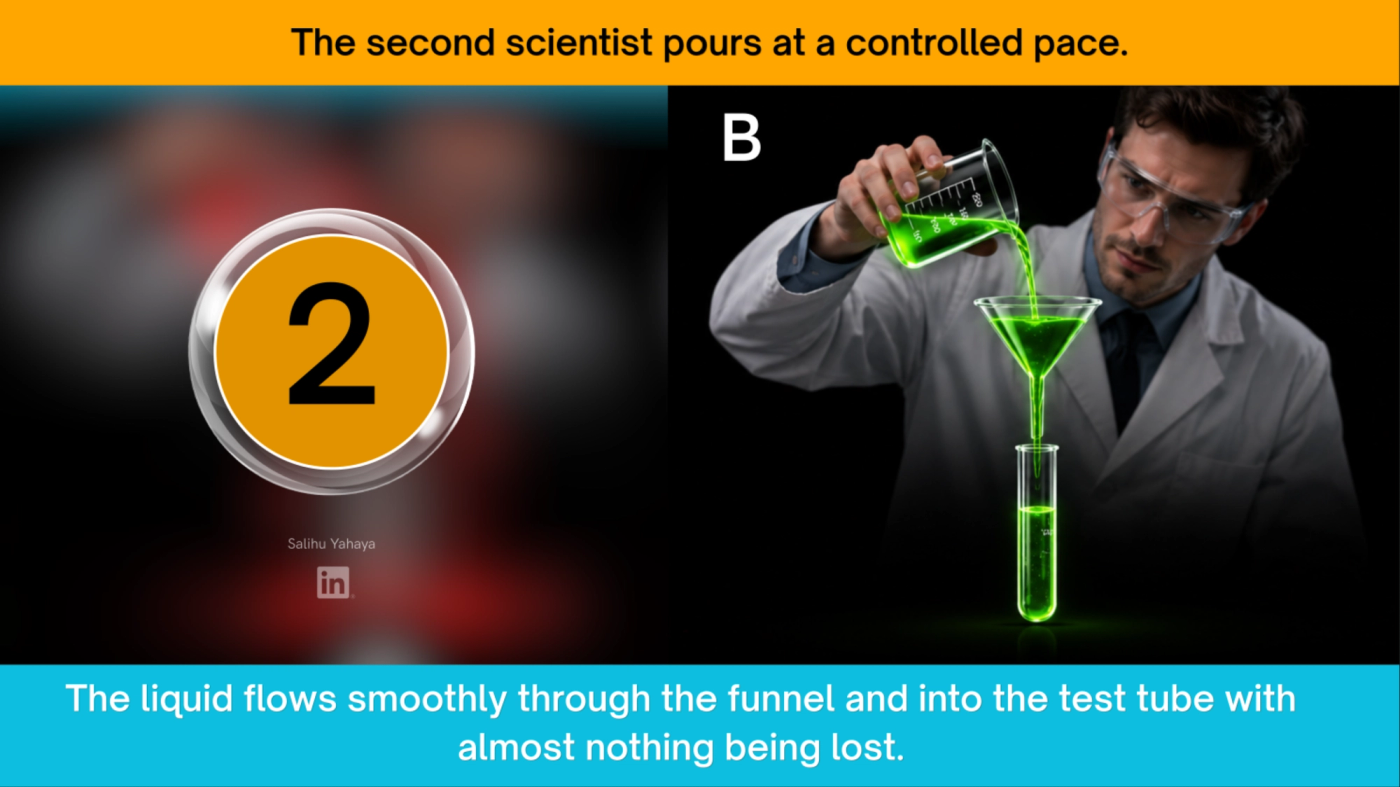
So now

I know which one I'd choose.
Now here's where my instructional designer brain kicked in.
As instructional designers, we're really doing something very similar.

What about the test tube ?
What would it represent in our instructional design world ?...

And the funnel ?…

This analogy helped me better understand what Clark Quinn meant when he highlighted two practical ways of making information detectable.
Let's look at them one at a time.
1. Using the Appropriate Channel
When Clark Quinn talks about using the appropriate channel, here's how I currently understand it.
Every type of information enters the brain through one of our sensory systems.
Each sense serves as a gateway for a different kind of information.
- 👀 Eyes receive visual information.
- 👂 Ears receive auditory information.
- 👃 Nose receives smells.
- 👅 Tongue receives tastes.
- ✋ Skin receives touch.
As instructional designers, one of our responsibilities is choosing the sensory channel that best matches the information we're trying to communicate.

Can it be done?
To some extent, yes.
But would using audio be a far more appropriate channel?
Absolutely.

Likewise, if we're teaching learners to recognize colours, shapes, facial expressions, or diagrams, relying primarily on visuals makes much more sense than describing everything verbally.
Choosing the wrong channel doesn't necessarily mean learners won't detect the information at all.
It simply makes detection, and therefore perception much more difficult.
The better the match between the information and the sensory channel, the more likely learners are to notice what matters.
One interesting point Clark Quinn also mentions is that vision occupies more cortical processing than any other sensory modality.
That wasn't surprising to me.
In fact, it opened an entirely new rabbit hole that I'll be sharing in my next post, In shā' Allāh.
2. Providing Sufficient Duration
The second point fascinated me even more.
Clark Quinn writes:
"Give learners control over dynamic media so they can pause or restart it; otherwise, information could be lost."
When I first read that sentence, I wondered,
"Why would duration matter so much?"
Then I thought back to our scientist.
Notice that the successful scientist didn't simply have the right funnel.
He also poured at the right pace.
If he poured too quickly, the liquid overflowed before it could successfully pass through the funnel.
The problem wasn't the funnel.
The problem was the speed.
I think that's very similar to what Clark Quinn is encouraging us to think about.
Sometimes learners don't struggle because the content is difficult.
They struggle because we move through the content faster than they can perceive and process it.
Think about how often we've all experienced this.
But you know all talk without test is just not so me so
Here let me demonstrate
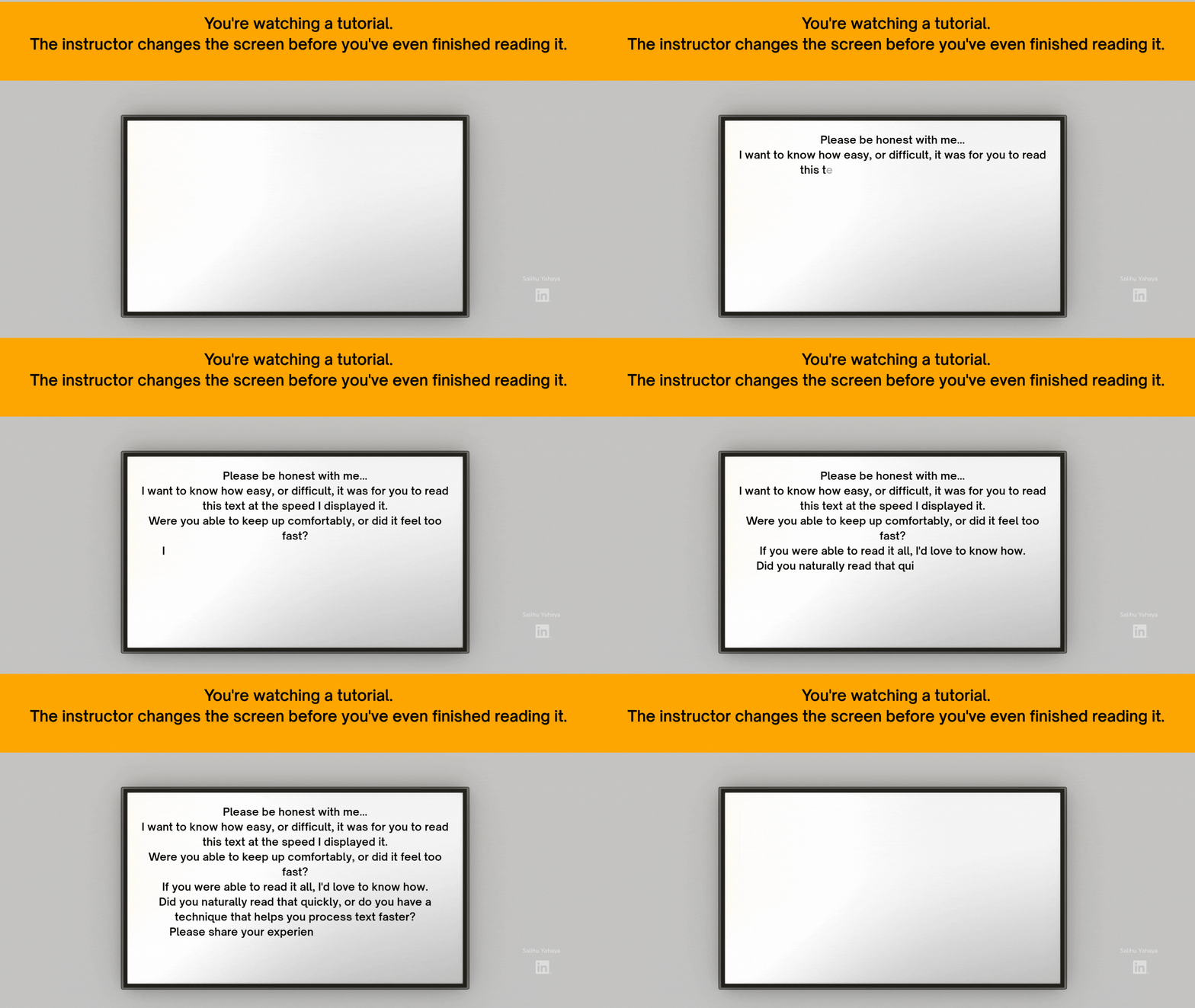
And that’s how an animation appears and disappears so quickly that our learners miss an important step.
A presenter rushes through a diagram before you've had time to understand what you're looking at.
The information was technically presented...
...but not for long enough to be properly perceived.
The goal isn't simply to leave information on the screen longer.
The goal is to provide learners with enough time and enough control to perceive and process what matters.
My Biggest Takeaway
One thing I love about learning science is that it often reveals how much happens before learning even begins.
We often spend a lot of time thinking about engagement, memory, practice, feedback, and transfer.
But Quinn's very first seed reminded me that none of those matter if learners never detect the information in the first place.
Detectability isn't the whole learning process.
It's simply the first doorway into it.
And if that doorway isn't open...
nothing else can happen.
That's probably the biggest lesson I took away from Quinn Seed #1.
Something I've been enjoying throughout this journey is trying to apply what I'm learning while I'm still learning it.
Instead of simply reading a concept and moving on, I try to translate it into analogies, visuals, and explanations that help me, and hopefully others, understand it more deeply.
That's exactly what this post is.
Not because I think I've mastered the topic...
...but because teaching what I'm learning forces me to think more carefully about it.
And honestly, that's one of the things I'm enjoying most about this journey into instructional design
What's Next?
One sentence from this chapter also sent me down another fascinating rabbit hole.
Clark Quinn mentions that vision occupies more cortical processing than any other sensory modality.
That immediately made me wonder:
If vision has so much of the brain's processing power dedicated to it, what does that teach us about designing visuals and animations for learning?
I've been digging into that question, and I can't wait to share what I've discovered next, In shā' Allāh.
I hope I've represented this idea accurately.
This is simply how I've understood it from what I've read so far, and I'm very open to being corrected if I've misunderstood anything.
I'd genuinely appreciate your thoughts, Clark Quinn
Thank you for writing a book that doesn't just explain learning science, but encourages readers like me to stop, think deeply, and connect the science to practice.
Your work is appreciated far more than you probably realize, and I'm grateful that you've taken the time to encourage and guide those of us who are just beginning this journey.
Thank you, Sir.
Until the next Quinn Seed…
📝 Learning in Public Note One of the reasons I share my learning publicly is because it invites thoughtful discussion from people who see things I may have overlooked.
After publishing this article, Darren McNeill left a detailed comment challenging one of my statements. He pointed out that while Clark Quinn's principle about perception is fundamentally correct, I had unintentionally made a much broader claim by writing:
"My learners can never remember what they never perceived. That's where my instructional design process begins."
He explained that Clark Quinn was describing one part of the cognitive processing chain, not the starting point of the overall instructional design process. He also highlighted something I hadn't fully considered: if we're designing for workplace performance, transfer isn't something we think about after perception, it influences our thinking from the very beginning, alongside questions about performance, context, and desired outcomes.
Hmmm... That's profound.
Clark Quinn himself then added an important clarification:
"Yes, the overall process properly begins with the analysis, including whether a course is what's needed at all."
Together, those two comments helped me recognize that I had unintentionally blurred the line between the instructional design process and the cognitive learning process.
The instructional design process begins with analysis:
- What performance problem are we trying to solve?
- Why does it exist?
- Is learning actually the right solution?
- Or is another intervention more appropriate?
Only after that analysis do we begin designing the learning experience itself.
And that is where Quinn's principle becomes essential.
Once we've established that learning is the appropriate intervention and we're designing the experience, the first cognitive reminder I now carry with me is this:
Learners cannot remember what they never perceived.
In hindsight, a simple edit to the thumbnail would have hidden this mistake.
Instead, I've chosen to leave this clarification here because I think the learning process is just as valuable as the polished outcome.
If someone else early in their instructional design journey reads this and comes away understanding that the instructional design process and the cognitive learning process are related but distinct concepts, then sharing this correction has been worthwhile.
as so the actual thumbnail for this article should be

A sincere thank you to Darren McNeill for taking the time to thoughtfully challenge my framing, and to Clark Quinn for reinforcing the distinction. Conversations like these are exactly why I enjoy learning in public.
#QuinnSeeds #InstructionalDesign #InstructionalDesigner #LearningAndDevelopment #LearningDesign #LearningExperienceDesign #LXD #Elearning #ELearningDesign #CurriculumDesign #CurriculumDeveloper #LearningJourney #Day1 #Day2 #LearningInPublic #BuildInPublic #SenseMakingNotes #MentalModels #TAWIQM
Where this comes from
- Learning Science by Clark Quinn — If you design learning, teach, or train people, you need to understand what is actually happening when someone learns. Learning happens at the neural level, but we design for it at the cognitive level. There’s a lot more in Clark Quinn’s book that I can’t share because of **intellectual property**. Get the book and experience the learning yourself. 📚You Would Love It!
- To Learn More Join the "Learning Development Accelerator" — Click the link to join the Amazing Learning Development Accelerator Group Where practice meets evidence
- Join The Conversation On Linkedin — **Enjoyed the blog?** The conversation doesn’t have to end here. Join me on LinkedIn, share your thoughts, challenge an idea, or repost it to help the conversation reach more people. **Let’s learn in public. Let’s make the ideas travel.**