- Home
- Learning in public
- Sense-making notes
- Taking a Walk In Quinn's Mind
- Your Senses Are the Gatekeepers of Learning.
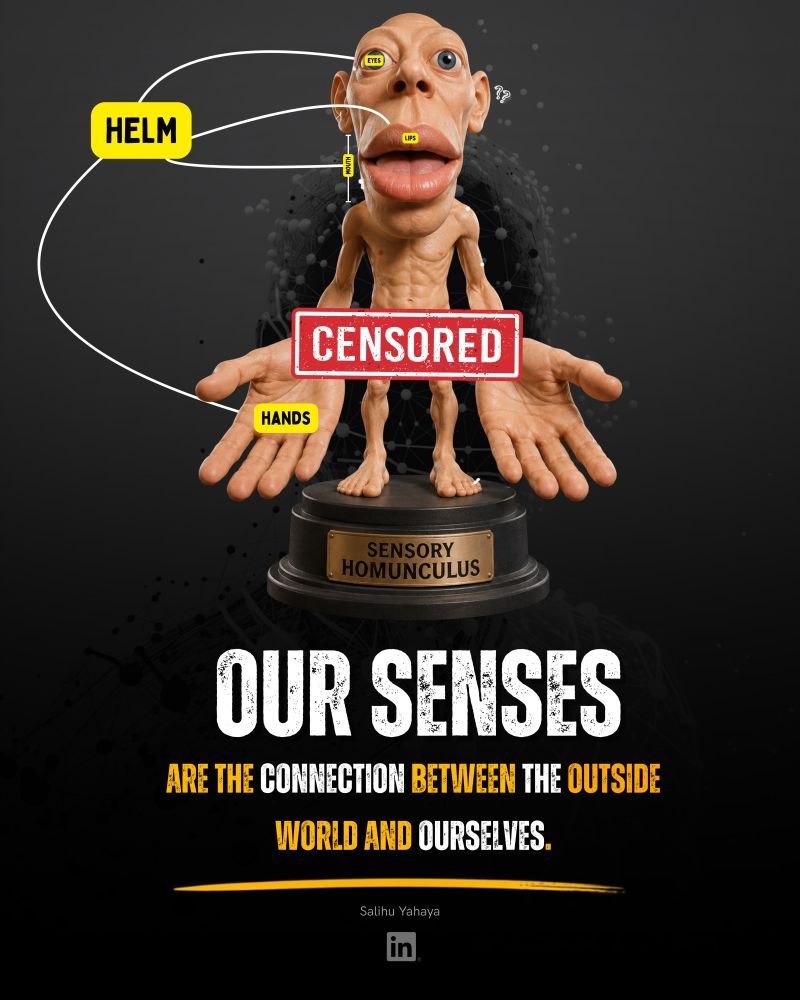
Our senses are the connection between the outside world and ourselves.
Using our company analogy, the gate is the bridge between our visitors (new information) and us, the CEO (Long-Term Memory).
This is where the learning journey usually begins.
A visitor (new information) arrives at the company gate (our senses).
Although modern neuroscience recognizes more than the traditional five senses—including systems involved in balance, movement (proprioception), temperature, pain, and others—the five core senses are still the most familiar:
👁️ Seeing → Eyes
👂 Hearing → Ears
👃 Smell → Nose
👅 Taste → Mouth
✋ Touch → Skin
For most instructional design situations, however, Clark Quinn explains that the senses we primarily work with are sight and sound (our eyes and ears). That's because most learning experiences are delivered visually, auditorily, or through a combination of both.
Interestingly, our brain does not allocate the same amount of processing power to every sensory system.
There is a well-known diagram that illustrates how much of the brain's cortex is devoted to processing information from different parts of the body. This representation is called the Sensory Homunculus.
As you can see in the image attached to this post, our hands, eyes, lips, and mouth occupy disproportionately large areas compared with many other body parts.
That tells us something important:
Not every sensory input is represented equally in the brain.
Here's the mnemonic I'll use to remember it (at least until it reaches my Long-Term Memory 😉):
H — Hands ✋
E — Eyes 👁️
L — Lips 👄
M — Mouth 👅
HELM
A fitting mnemonic, because these body parts are some of the "drivers" through which we experience and interact with the world.
📝 Clarification Note
If you noticed that I first said Clark mentioned we mainly work with sight and sound (eyes and ears), but later pointed out that the hands, eyes, lips, and mouth occupy more of our brain's cortex, that's because they're two different ideas.
Think of it like having a garage full of cars.
The fastest car or the biggest car isn't necessarily the one you drive every day.
In the same way, the body parts with the largest representation in our brain's cortex aren't necessarily the ones learners use the most for learning.
As Clark Quinn points out, we mostly design for sight and sound because that's how most learning experiences are delivered. The sensory homunculus is simply showing how much of the brain is devoted to different body parts, not which ones learners rely on most when learning.
Day 27 of Instructional Design
#InstructionalDesign#InstructionalDesigner#LearningAndDevelopment#LearningDesign#LearningExperienceDesign#LXD#Elearning#ELearningDesign#CurriculumDesign#CurriculumDeveloper#LearningJourney#Day1#Day2#LearningInPublic#BuildInPublic#SenseMakingNotes#MentalModels#TAWIQM
Where this comes from
- Learning Science by Clark Quinn — If you design learning, teach, or train people, you need to understand what is actually happening when someone learns. Learning happens at the neural level, but we design for it at the cognitive level. There’s a lot more in Clark Quinn’s book that I can’t share because of **intellectual property**. Get the book and experience the learning yourself. 📚You Would Love It!
- To Learn More Join the "Learning Development Accelerator" — Click the link to join the Amazing Learning Development Accelerator Group Where practice meets evidence
Download This PDF Graphic To Help Digest This Understanding