- Home
- Learning in public
- Sense-making notes
- Taking a Walk In Quinn's Mind
- Don’t Design for More Senses. Design for the Sensory Information Performance Requires.
After going through all the senses, the role they play in learning, and how our design choices affect each of them while reading Clark Quinn 's Learning Science, I came to a conclusion:
Sight and sound are usually our most practical channels for information input because they’re relatively easy to deliver consistently through controlled design choices.

For the Sight Gate, the closer we match our learning experiences to how vision actually works, especially our detailed central vision and our highly sensitive ability to detect motion through peripheral vision—the more effectively visual information can pass through the gateway.
Anything that unnecessarily distracts the eye can compete with the information we actually want learners to perceive.
The same principle applies to sound.

But with sound, I’m looking at three things:
Message. Status. Direction/location.
The closer we design the learning experience around how sound communicates these things, the more likely the intended auditory information is to be detected and interpreted as intended, provided the signal is sufficiently audible and distinguishable from competing sounds.
And then we have smell and taste in learning design.

They aren't useless.
They can create context, trigger memories, and make an experience more immersive.
But they're also highly individual, difficult to reproduce reliably, harder to make accessible, expensive, and logistically awkward.
And sometimes...
they simply aren't necessary for the learning objective.

Then there’s touch, which I’ve realised is much more complex than I initially thought.
Our bodily sensory systems can provide information about:
Contact, pressure, temperature, balance, proprioception, vibration, and movement.
So knowing this exposed me to something I think is extremely important:
Sensory decoration doesn’t equal sensory fidelity.
This is the distinction I want to keep from now on.
Imagine you're designing a flight simulator.
Adding realistic engine sounds, cockpit vibrations, visual scenery, etc. might make it feel immersive.
But the question isn't usually:
“How many senses can I engage?”
But :
“Which sensory information will the learner actually need to perceive and act on in the real task?”
That's sensory fidelity.
If the learner needs to detect a particular engine sound → reproduce that sound.
If vibration is critical to operating the aircraft → reproduce the relevant vibration.
If smell has nothing to do with competent performance → don't spend thousands trying to make the simulator smell like jet fuel.
In other words, I think Clark Quinn is pointing us toward something important:
We shouldn't design for more senses.
We should design for the sensory information the performance requires.
🎯 And As An Instructional Designer, What Should I Do Differently?
Before adding an immersive sensory element, I should ask “What does the learner actually need to perceive in the performance environment?” Then work backward.
For example:
When the learning goal is to handle customer complaints:
Adding ambient restaurant smells because they make the simulation more immersive would be unnecessary.
Why?
Because smell isn't part of the required performance.
When the learning goal is to identify food spoilage then Smell may become important.
When the learning goal is to perform emergency maintenance on machinery then Specific sounds, vibrations, temperature, or physical feedback may matter if workers use them as cues in the real environment.
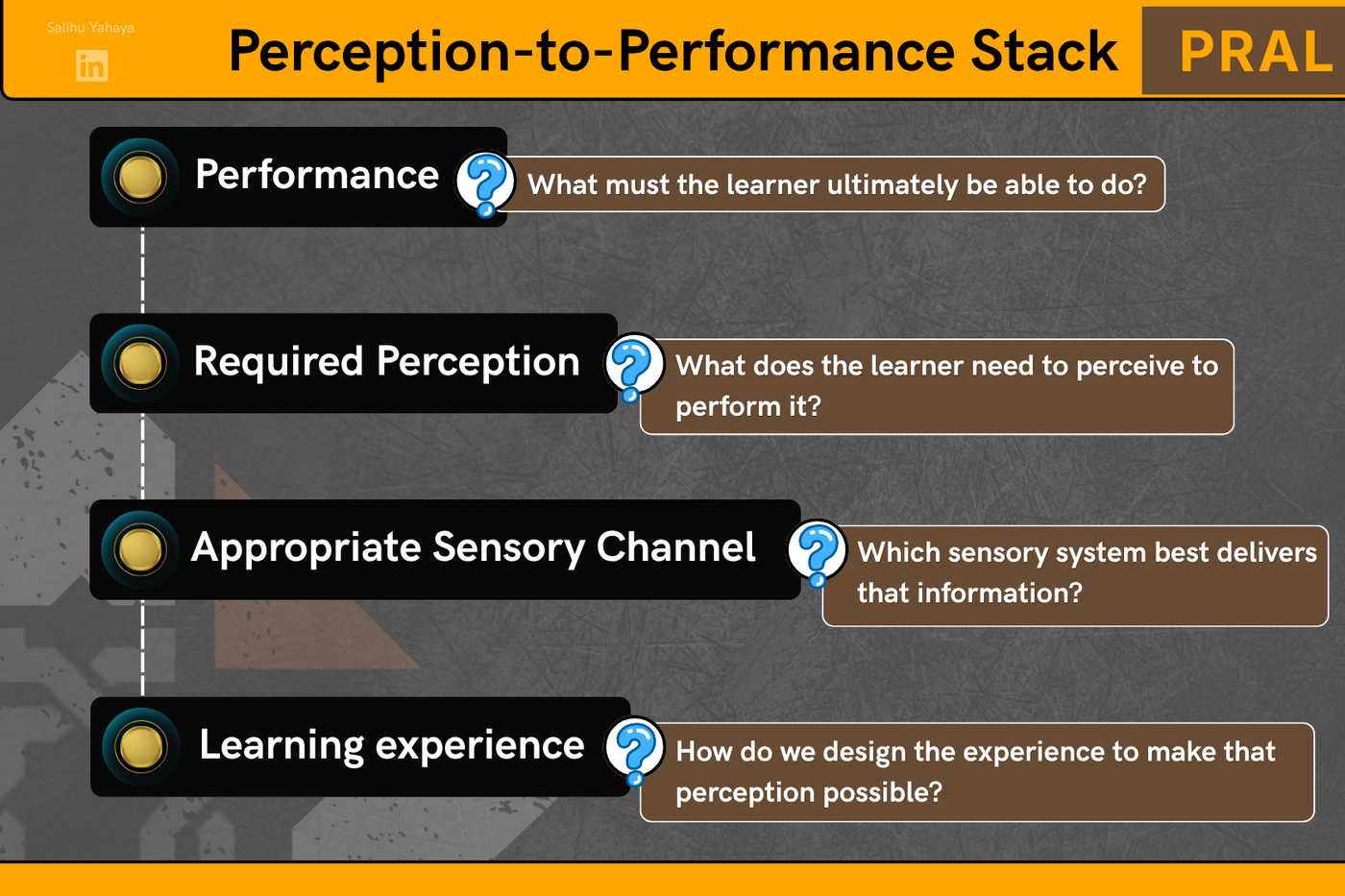
And this led me to my own perception-to-performance stack:
PRAL
Performance → Required perception → Appropriate sensory channel → Learning experience
Not:
Cool technology → More senses → Hope learning improves.
So the question isn't:
“Can I use smell, taste, sight, sound, or touch?”
But:
“Does using this sensory channel help me achieve the learning objective reliably?”
Because as instructional designers, we're not trying to use every tool available to us.
We're trying to choose the right tool for the job.
My summary from this entire sensory-gates exploration:
1. Different sensory systems provide different kinds of information.
Vision provides visual information. Hearing provides auditory information. Smell provides olfactory information. Taste provides gustatory information. And our bodily sensory systems provide information about contact, pressure, temperature, balance, proprioception, vibration, and movement.
2. Smell and taste aren't inherently irrelevant to learning. They're relevant when the performance actually depends on the information they provide.
3. Touch isn't simply one sense. The body provides multiple forms of sensory and positional information that can matter for performance.
4. Learning is an action-perception loop. It's not merely information entering the brain.
5. Sensory fidelity should follow performance requirements. Not our desire for maximum immersion.
And this brings me to one final implication. from what Clark Quinn mentioned
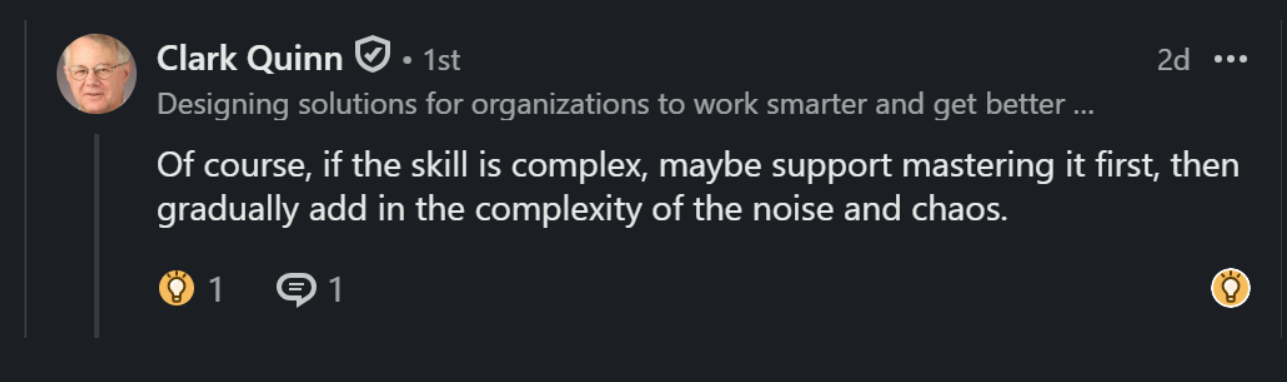
If sensory fidelity should follow performance, then mastering the required performance should come before trying to replicate the complexity of the real-world environment.
I can’t just throw learners into a highly realistic environment and expect them to figure everything out because the simulation is “immersive.”
Instead, I can think about this progressively.
First: establish the skill the learner needs to master.
Then: introduce the sensory signals that matter to that performance.
Then: introduce competing signals that require the learner to filter and distinguish relevant information.
Then: increase environmental complexity.
Finally: test whether the learner can integrate those signals and perform under conditions that increasingly resemble the real world.
That makes the spiral curriculum particularly interesting to me here.
Because perhaps the goal isn't to reproduce reality from the beginning.
It's to progressively build the learner's ability to perceive, interpret, and act within the reality of the task.
And that brings me back to the principle I want to carry forward:
First establish what competent performance requires.
That's where sensory fidelity begins.
Day 39 of Instructional Design
#InstructionalDesign #InstructionalDesigner #LearningAndDevelopment #LearningDesign #LearningExperienceDesign #LXD #Elearning #ELearningDesign #CurriculumDesign #CurriculumDeveloper #LearningJourney #Day1 #Day2 #LearningInPublic #BuildInPublic #SenseMakingNotes #MentalModels #TAWIQM #QuinnSeeds
In case you missed the Quinn Seed articles 👇
Quinn Seed #1- CLICK ME
Where this comes from
- Check out "Learning Science" by Clark Quinn — If you design learning, teach, or train people, you need to understand what is actually happening when someone learns. Learning happens at the neural level, but we design for it at the cognitive level. There’s a lot more in Clark Quinn’s book that I can’t share because of **intellectual property**. Get the book and experience the learning yourself. 📚You Would Love It!
- Check out "40 L&D Stakeholder Challenges: Of L&D Leaders, Practitioners, Clients, and Learners" by Guy W. Wallace — This book shares the answers I got from my EPPI-PACT Guidance Bot. The free EPPI-PACT Guidance Bot is a digital, interactive knowledge-transfer resource designed to help Learning and Development (L&D) practitioners, performance consultants, and business leaders master and apply Guy W. Wallace’s Performance Improvement and Performance Based L&D methodologies.
- To Learn More Join the "Learning Development Accelerator" — Click the link to join the Amazing Learning Development Accelerator Group Where practice meets evidence