- Home
- Learning in public
- Sense-making notes
- Taking a Walk In Quinn's Mind
- Maybe We Shouldn’t Just Add Audio to Learning. Maybe We Should Design Learning With Sound.
Sound 🎧!
This one is really important for instructional design because Clark is showing that sound behaves differently from sight. So we shouldn't design audio as if learners process it the same way they process a picture.
Sound is a very different system from sight.
For one thing, sound isn't perceived all at once.
It unfolds over time.


Unlike sight, where we can look at something and potentially recognize the whole thing almost instantly, audio has to arrive bit by bit.
And so you'd have to listen...
Hold onto what was said...
Wait for the next piece...
And connect it with what came before.

And then there's volume.
Just because we've included audio doesn't mean the learner can actually perceive it.
Imagine someone standing at the other end of the office, whispering important information to the CEO.

Which brings to mind what Clark Quinn reminds us:
Not everyone's hearing system works the same way.
Some people may struggle with quiet sounds.
Others may have difficulty with particular frequencies.
And some may not hear sound at all.
So, as instructional designers, we shouldn't assume:
"If I can hear it, everyone can hear it."
And this is why providing alternatives, such as text for spoken audio, can be so important, as Clark Quinn mentioned.
And to me, it doesn't just support learners who may not be able to access the audio. It can also help when an accent, pronunciation, or audio quality makes the spoken content difficult to understand. Instead of struggling to decode what was said, learners can simply read the text and keep learning. (Hopefully I make sense.)
But then Clark makes another really interesting point.
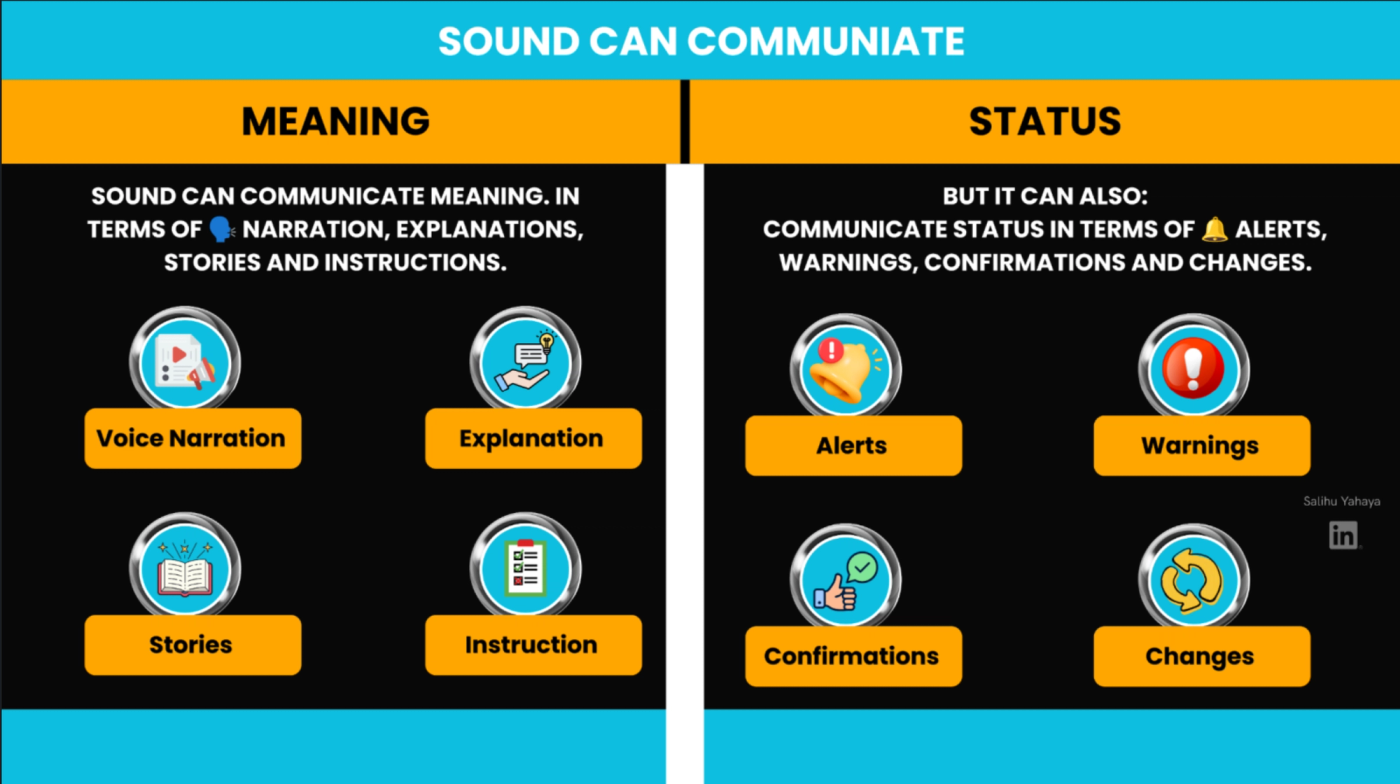
A small amount of sound can carry a lot of meaning.
But sound isn't only useful for words.
Just as Clark Quinn mentioned:
“The semantics of audio go beyond speech. Noises can cue us in if things are going well or not.”
Sounds themselves can communicate information.
You can almost immediately tell that something's not right because:
"Hmm... that doesn't sound right."
The sound itself is communicating status.
And that's where this gets really interesting for me as an instructional designer when designing learning experiences.
We may often think:
Audio = narration.
But Clark Quinn is showing us that sound can do much more than that.
And then I started thinking...
What if, with my audio engineering skills, I use sound to also communicate location or, even better, train the ear for real-world, high-stakes environment mirroring?
I actually thought about this from a high-stakes environment use case where audio can actually be a part of the curriculum rather than audio being furniture like in most training’s.
High-stakes performance may rarely fail because people lack knowledge. It may fail because real environments are noisy, divided, and unforgiving.
A dispatcher processing a caller in one ear while a radio crackles in the other, or an interpreter holding two languages in tension, or even a professional who must attend to one voice while deliberately filtering another.
The skill I feel can be tested with this will not only be what you know but what you can hold onto under competing demands.
This is why training that uses One-Ear Audio will matter in high-stakes environments.
And then I looked it up and found something tangible.
It is a research paradigm with over seventy years of history: since Donald Broadbent's selective attention experiments in the 1950s, dichotic listening has been the standard laboratory method for measuring how the mind selects, filters, and holds information under auditory competition. We are borrowing a validated instrument, not inventing a novelty.
Three design principles govern its use here:
First, the split is the simulation. Learners don't read about divided attention, they experience it, in conditions that mirror the pressure of the real role. Fidelity of conditions produces fidelity of transfer.
Secondly, the experience is gated, not assumed. Before anything that counts, every learner passes a calibration check confirming their equipment delivers true single-ear audio. No one is assessed on a broken setup. In a high-stakes context, technical failure must never masquerade as learner failure.
And lastly, the gate filters setups, not people. Learners who rely on mono audio or hear primarily from one ear are routed to an equivalent alternative pathway. Rigor and inclusion are not in tension. A measurement is only valid when every learner can genuinely take it.
The result is an assessment environment where the pressure is real, the measurement is clean, and the outcome reflects the one thing we actually want to know: can this person perform when both ears are telling them different stories?
Of course, all this will have to be discussed with the organization. In other word what Clark Quinn refers to astute analysis.
But then I didn't want to just write about it without consulting experts I trust in the space, and so I curiously asked a question on LinkedIn to verify my findings.
“As an expert, will you consider the use of spatial audio as good practice for high-stakes environment mirroring in learning experience design?”
I just had to ask a profound question that bugged me because, for me, I just didn't want to simply apply my audio engineering skills to a learning experience for one of these two:
First it just couldn’t be for aesthetics especially with what I know now about our design decisions being derived from evidence over opinions and so, i couldn't just spend all this time doing the sound design and building a simulation like this without firstly having a reason to justify the investment or without authorization.
Secondly, the fear that would then mean I've designed a training experience around auditory recognition without adequately considering accessibility.
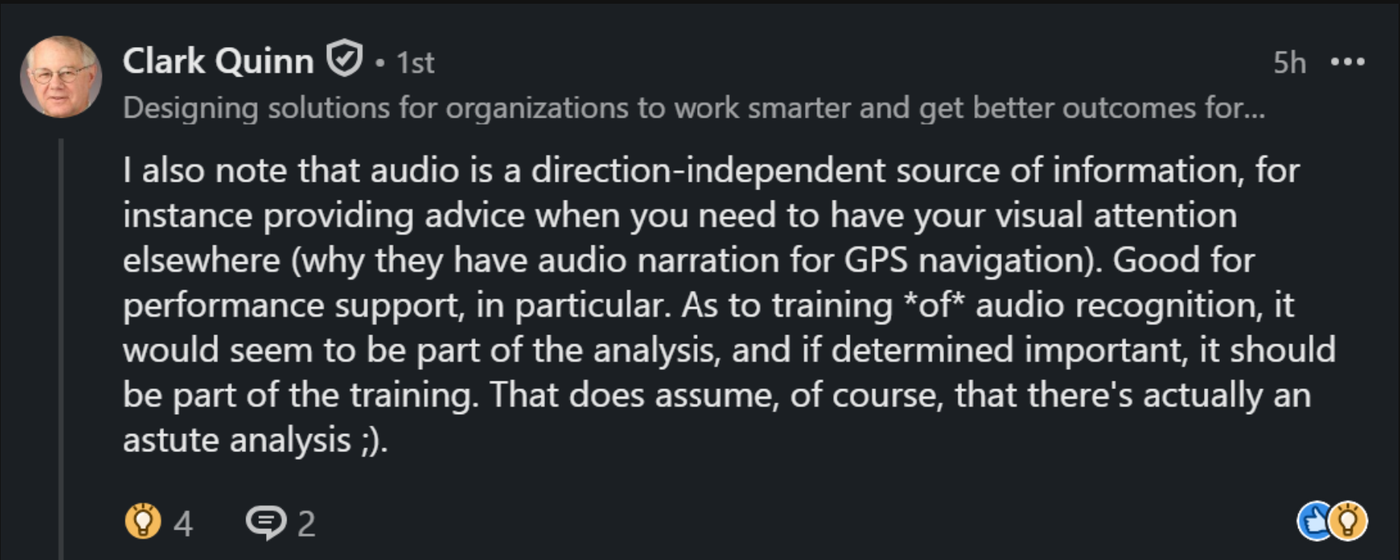
And not too long after posting, Clark Quinn helped me seal the nectar for this article when he responded by saying
And oh my days...
It was at this point that I had a Eureka moment ;)
I had just realized the distinction between using audio to communicate information and training someone to recognize information through audio.
One may or may not need that level of justification.
But the other does.
And if we think about it, it makes so much sense because I shouldn't just spend all our time doing sound design and building a simulation without first having a reason to justify the investment.
There has to be a real performance need for the learner to detect, distinguish, filter, integrate, or respond to those sounds.
And now I'm realizing...
The analysis itself is the authorization. ;) just like Clark Quinn mentioned.
If the analysis tells me that auditory recognition is critical to performing the task, then that gives me the reason to invest the time in designing the experience.
Otherwise, I'd only be building something interesting because I have the ability to build it.
And just as Clark Quinn mentioned in his book:
Similar to sight, sound processing can be interfered with too.
Some folks have trouble with quiet sounds, others with particular frequencies, and some may have little or no hearing capability at all.
It also really had me thinking about the use case of audio in learning design.
And because I started wondering:
What if I design this experience, and there happens to be a learner with hearing loss in one ear amongst the learners?
Would that then mean I've designed training around auditory recognition without adequately considering accessibility?
But then again, Clark Quinn response reinforces something for me:
This is why these are exactly the kinds of things that need to be ironed out in the analysis phase.
What does the task actually require?
Who are the learners?
What auditory demands are genuinely essential to performance?
And what alternatives or accommodations might be needed?
So, once the boxes have been checked in the analysis phase, only then can I look in this direction.
Here are some High-Stakes Environments where I think this could potentially be applied(it could be more, it could be less, but will be worth exploring in the future)
In other words, Environments That Demand a Divided Ear:
This approach can be used anywhere a professional's real working conditions involve two audio streams competing for one mind :

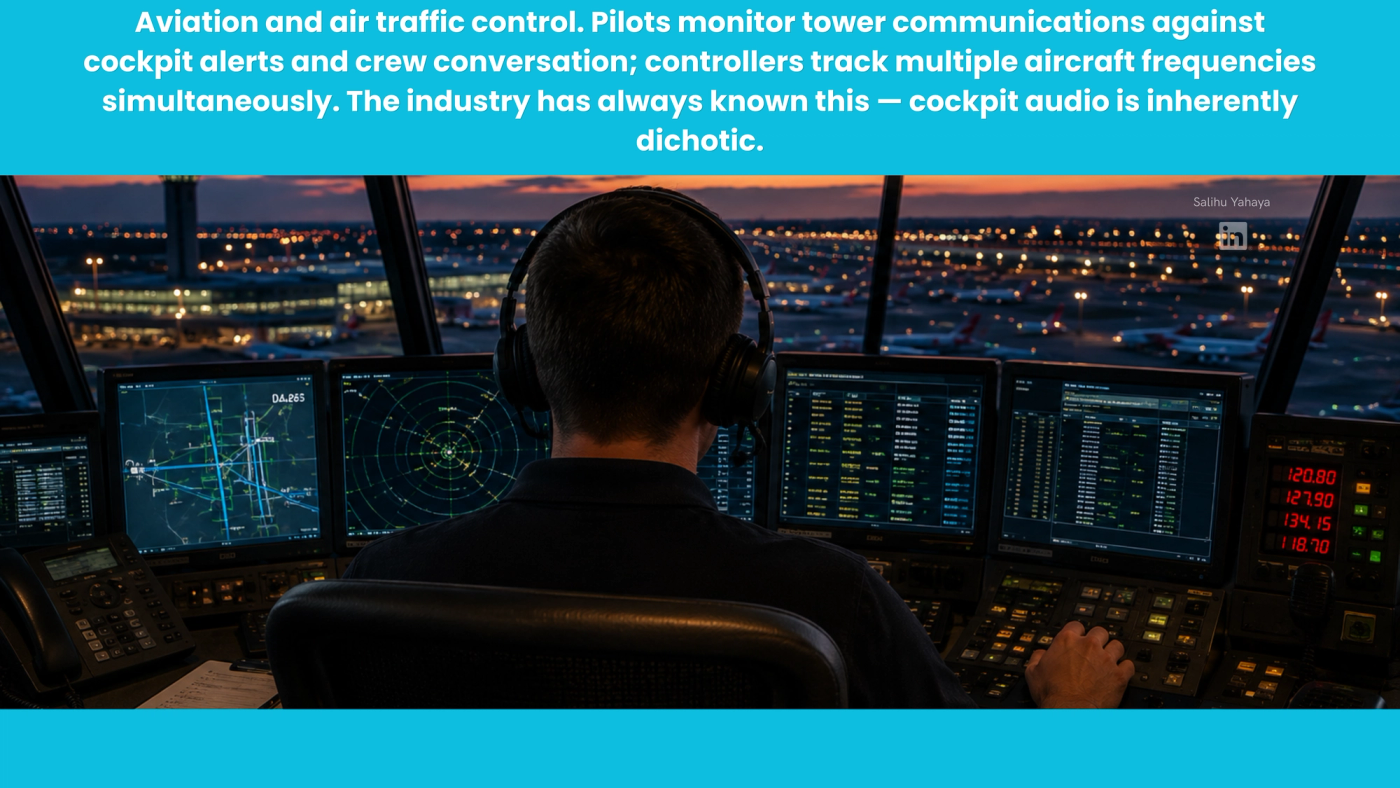


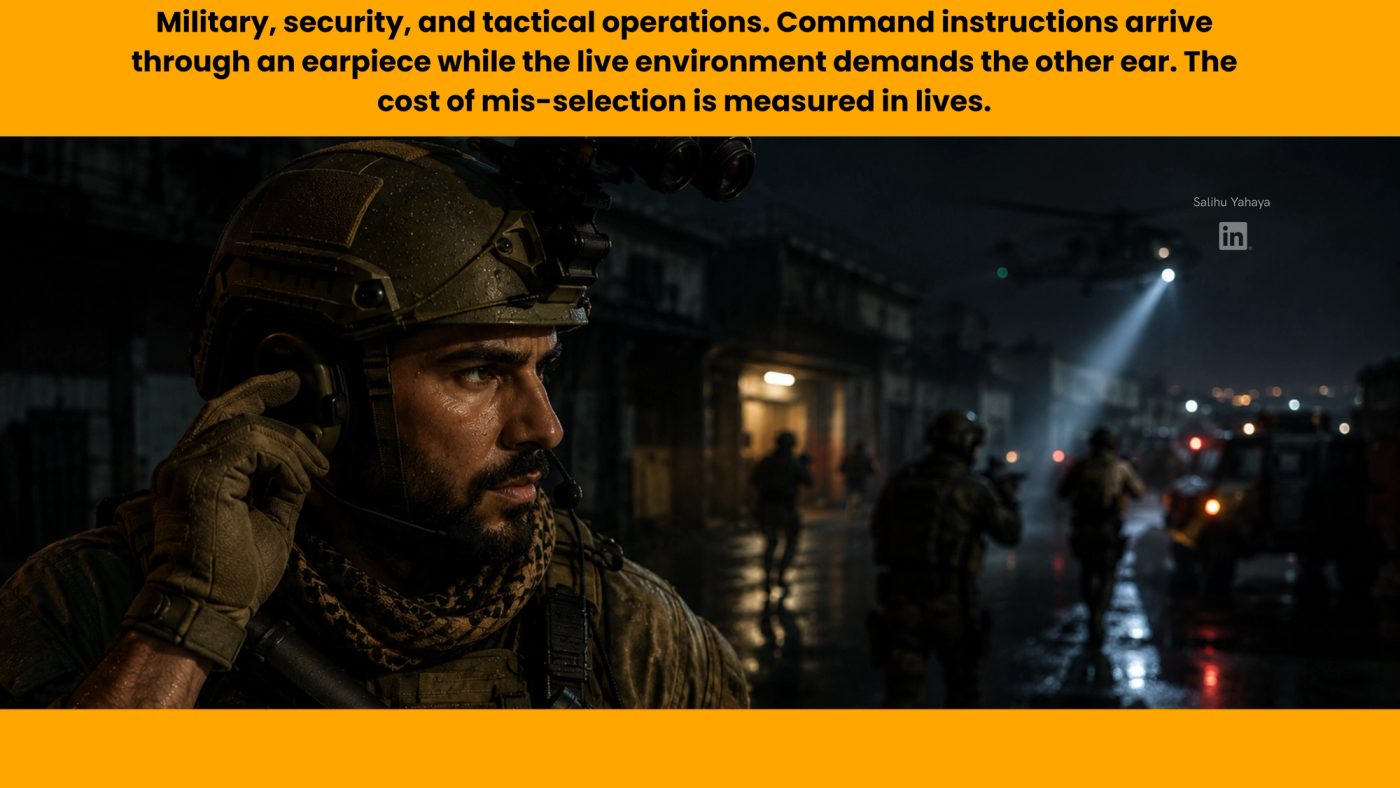


The common architecture across all of the above use case is that one stream must be held, one must be filtered, or both must be integrated, and failure under pressure is expensive. If a role fits that description, this method can simulate it, train it, and hopefully even measure it.
Here’s a practical example.
Note: To truly experience this, you'd have to turn off Mono Audio on your Windows system by clicking “Ctrl + U”, going to Audio, then Mono Audio, and toggling it off. And voilà! 🎧
If you don't, you may just end up hearing everything in the centre.
This is also one of the reasons why this needs to be ironed out during the analysis phase — so the trainees' systems are checked, properly configured, and experience-ready for the best results. Imagine an aviation simulation, for example.
I demonstrated a pilot simulation where a lot of information is competing for the pilot's attention.
There's already a lot of information competing for their attention.
Instead of a warning simply playing from the center...
It plays from the actual direction the relevant threat is coming from.
Also, the pilot is hearing the sound of the pressure, his co-pilot talking, and air traffic officers communicating with him, forcing him to filter out what he needs to pay attention to, like in real-world situations.
TYPE 2 USE CASE will be an Emergency Dispatch and Crisis Lines.
A 911 or crisis hotline operator who holds a distressed caller in one ear while radio traffic, notifications pop, supervisor prompts, or a second line presses into the other.
Again, training that happens in silence prepares people for a job that never happens in silence.
Like I mentioned above, the same idea could be explored in military simulations, emergency training, navigation exercises, or even something as simple as teaching spatial relationships which I suppose is already in use and not only explored especially with Clark Quinn's response to my question.
In high-stakes environments, spatial audio shouldn't be treated as the only source of critical information. It would need proper human-factors testing, validation, and redundancy.
But the idea itself is fascinating.
Because it changes the question I'd ask as an instructional designer when designing learning experiences…
And so, instead of asking:
"Where can I add some audio aside from narration, or explanations only?"
I'd be asking:
"What information can the auditory channel communicate that the visual channel isn't communicating efficiently?"
Again, of course, like Clark Quinn's mentioned:
“That does assume, of course, that there's actually an astute analysis ;).”
And this is where I think audio can become more than decoration.
So, when something animates from left to right, I'm not just thinking:
"What sound effect should I add?"
I'm thinking:
"What can the learner hear that helps them understand what they're seeing?"
Because maybe the goal isn't simply to add sound to learning.
Maybe it's to design learning with sound.
And that's one of the things I'm taking away from Clark Quinn's section on sound:
Don't just use a sensory channel. Design for what that channel is good at.
I mean, it'll take quite some time to do all of this positioning (even though I'd use DaVinci Resolve's Fairlight page to achieve this faster)...
But I believe if the essence of training is to increase the performance of the learner in the real world in knowledge & skills, then mirroring the real-world experience with sound in a high-stakes environment can add an extra layer of preparedness for our learners using spatial audio to train the ears under competing demands.
Day 34 of Instructional Design…
I hope this lights a match for any instructional designer out there.
It’ll mean a lot to me, as I put my heart into every piece of writing.
A huge thank you to the shoulders I’m standing on from the LDA community and eLearning Academy.
The more I read and explore this field, the more I respect the research translators like Clark Quinn', Matthew Richter , Will Thalheimer, Patti Shank, PhD , Ruth Colvin -Clark , Julie Dirksen, Michael Allen, Jane Bozarth, Guy W Wallace , Mirjam Neelen & Paul A. Kirschner, Connie Malamed, Karl Kapp, Tom McDowall, and Christy Tucker.
And Tim Slade and the The eLearning Designer's Academy community for the light and guidance I’ve also been receiving from there.(my handbook is yet to come… Still counting down ;)
I won’t also forget to mention Sarah Samuelson, a very kind, caring, and motivating woman who I’ve learnt a lot from and am still learning from, she’s also been a motivating pillar.
Thank You
Finally, if you’re a recent connection or follower, thank you, because I’d be lying if I said the feedback I get from you all isn’t supporting me on this journey.
Thank you.
See you in the Smell & Taste Article In Sha ALLAH… 👃👅
#InstructionalDesign #InstructionalDesigner #LearningAndDevelopment #LearningDesign #LearningExperienceDesign #LXD #Elearning #ELearningDesign #CurriculumDesign #CurriculumDeveloper #LearningJourney #Day1 #Day2 #LearningInPublic #BuildInPublic #SenseMakingNotes #MentalModels #TAWIQM #QuinnSeeds
In case you missed the Quinn Seed articles 👇
Quinn Seed #1- CLICK ME
Where this comes from
- Check out "Learning Science" by Clark Quinn — If you design learning, teach, or train people, you need to understand what is actually happening when someone learns. Learning happens at the neural level, but we design for it at the cognitive level. There’s a lot more in Clark Quinn’s book that I can’t share because of **intellectual property**. Get the book and experience the learning yourself. 📚You Would Love It!
- Check out "40 L&D Stakeholder Challenges: Of L&D Leaders, Practitioners, Clients, and Learners" by Guy W. Wallace — This book shares the answers I got from my EPPI-PACT Guidance Bot. The free EPPI-PACT Guidance Bot is a digital, interactive knowledge-transfer resource designed to help Learning and Development (L&D) practitioners, performance consultants, and business leaders master and apply Guy W. Wallace’s Performance Improvement and Performance Based L&D methodologies.
- To Learn More Join the "Learning Development Accelerator" — Click the link to join the Amazing Learning Development Accelerator Group Where practice meets evidence