- Home
- Learning in public
- Sense-making notes
- Taking a Walk In Quinn's Mind
- I Used to Think Sensory Gates and Channels Were the Same Thing. I Was Wrong.
Amazing how I used to refer to input channels and gates as the same thing.
From now on, reading the Channel section of Clark Quinn’s Learning Science changes everything and gives me a distinction.
So I’d keep the sensory inputs as gates and then channels as different types of incoming information that get into our sensory store from a sensory gate.
Because i've just learnt that Channels are like interpreters, they're how different kinds of information are processed or represented once they enter through a sensory gate.
And so my distinction will now be:
Sensory gates = where information enters.
Channels = how different kinds of information are processed/represented once they enter.
Take, for example:
The Sight gate has information processed through different channels, like a text processing channel and an image processing channel.
All are visual information, but as soon as we lay our eyes on a visual, our brain has multiple interpreters working simultaneously to process what is being seen because our cognitive system does not treat all incoming information as one undifferentiated stream.
Different kinds of information can be processed through different channels.
Clark Quinn uses the Stroop effect to make that visible in his book.
And what this means is:
If I show you:
🐱 CAT
You can process at least two things at the same time:
The picture → “cat”
The written word → “cat”
And because they agree, there will be little conflict for you.
But if I show you:
🐦 CAT
Your system automatically processes both:
Image → bird
Word → cat
Now the two channels will be sending two different messages, and because we’re not consciously deciding whether to read the word first and then inspect the picture, but actually processing both automatically at the same time, the mismatch will create interference.
Clark Quinn notes that this makes our response slower, which you should experience when you look at the next animal illustration on the GIF.
And so the world can subject different information at us through our various sensory input gates (eyes, ears, etc.), but different representation channels like text and image for visuals, verbal and auditory for sound, etc.
And the closer these representations carry the same information, the more they can support one another, while conflicting information can create more interference.
And so these representations can either support one another or interfere with one another.
We can subject a learning experience to our learners with even one sensory input, and that input alone can carry more than one channel, i.e., text and image.
And if not well designed, instead of having Channel Cooperation (the image matching or complementing the text), we’d be having Channel Competition, where the channels compete for processing, making the intended cognition harder.
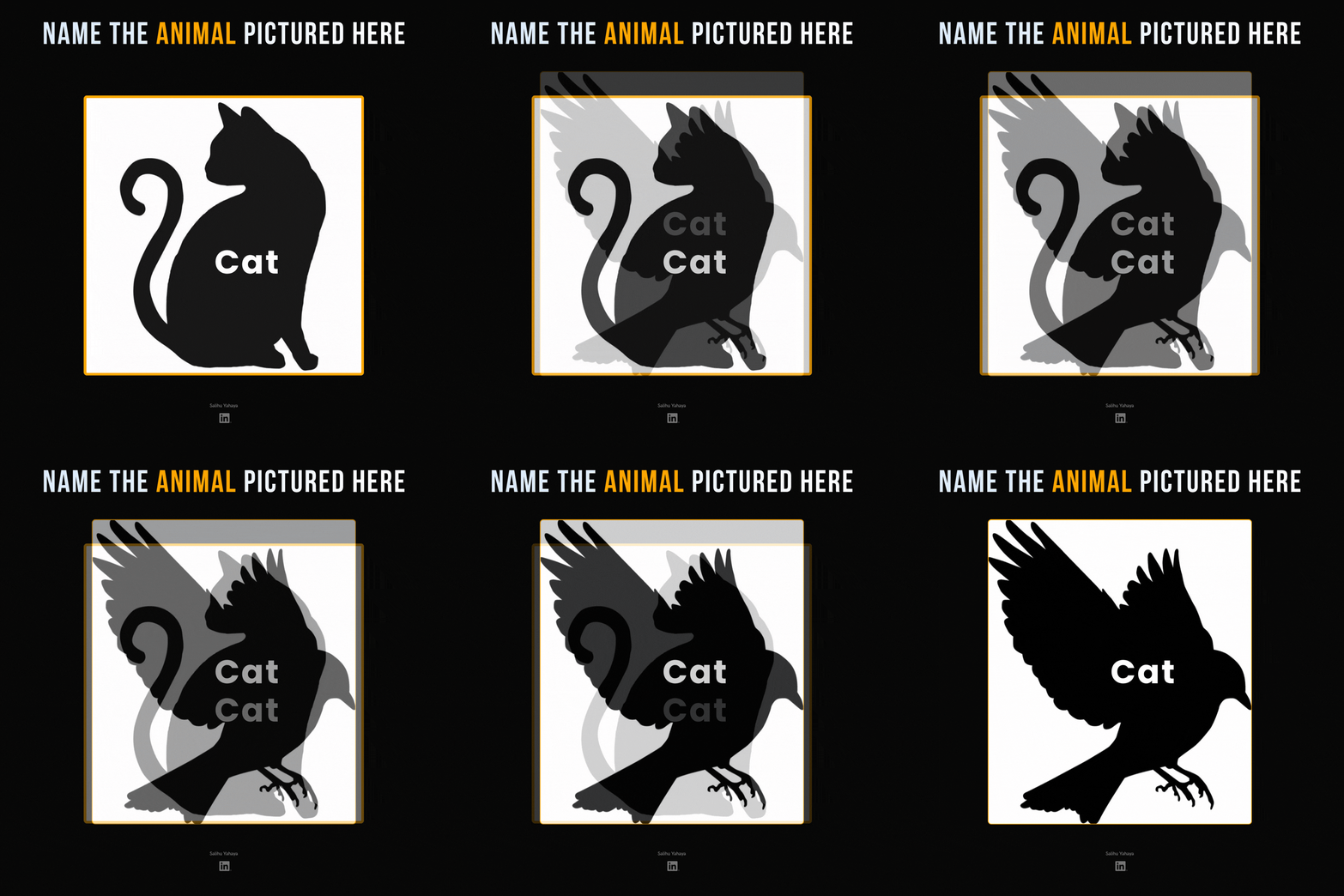
Day 43 of Instructional Design.
#InstructionalDesigner#LearningExperienceDesign#LearningInPublic#BuildInPublic#SenseMakingNotes#MentalModels#TAWIQM
In case you missed the Quinn Seed articles 👇
Quinn Seed #1- CLICK ME
Quinn Seed #2- CLICK ME
Where this comes from
- Check out "Learning Science" by Clark Quinn — If you design learning, teach, or train people, you need to understand what is actually happening when someone learns. Learning happens at the neural level, but we design for it at the cognitive level. There’s a lot more in Clark Quinn’s book that I can’t share because of **intellectual property**. Get the book and experience the learning yourself. 📚You Would Love It!
- Check out "40 L&D Stakeholder Challenges: Of L&D Leaders, Practitioners, Clients, and Learners" by Guy W. Wallace — This book shares the answers I got from my EPPI-PACT Guidance Bot. The free EPPI-PACT Guidance Bot is a digital, interactive knowledge-transfer resource designed to help Learning and Development (L&D) practitioners, performance consultants, and business leaders master and apply Guy W. Wallace’s Performance Improvement and Performance Based L&D methodologies.
- To Learn More Join the "Learning Development Accelerator" — Click the link to join the Amazing Learning Development Accelerator Group Where practice meets evidence