- Home
- Learning in public
- Sense-making notes
- Taking a Walk In Quinn's Mind
- Our Senses Don’t Ask for Permission Before They Start Processing
You See..
Our Sensory registration process is automatic but then some go in one time and others over time. This is what Clark Quinn is saying and after sitting with it. i relate now.
And because we don’t have to think about processing the information we're presented with because it’s automatic, we can facilitate, or hinder comprehension by the choices we make as Clark Quinn tells us.
You see our sensory information arrives automatically, rather than us consciously deciding to receive it. It capture what it can detect, and so our eyes receive visuals, our ears receive sound. And we don’t have to think about processing sound or visuals. It happens automatically.
And so unless something physically interferes with them, such as an earplug blocking sound from going into the ear or an eye patch blocking vision, Clark Quinn tells us information processing happens automatically.
And he makes absolute sense to me. Because I don’t remember ever choosing to process what I see, or hear, especially if it’s something I’m already familiar with.
But to simply demonstrate how automatic this is, when you’re driving on the road and getting closer to a traffic light showing the colour red, do you choose to process it, or do you automatically tell that you’re meant to stop?
Also, when you hear someone call your name, do you automatically turn to see who, or do you choose to process that sound before doing so?
How interesting is it that our sensory input registration needs not our permission to register and start processing it.
Clark Quinn previously describes our sensory store as retaining what has been perceived temporarily: visual information as retinal images and auditory information as sound changes. Which i explained in one of my previous posts.
The most interesting part is what Clark Quinn built on what he taught me about audio when he said:
“Audio is slightly different, because it is more linear (by nature). It’s slower, but it’s similarly of relatively short duration without some extra work.”
This is where sensory specificity becomes useful.
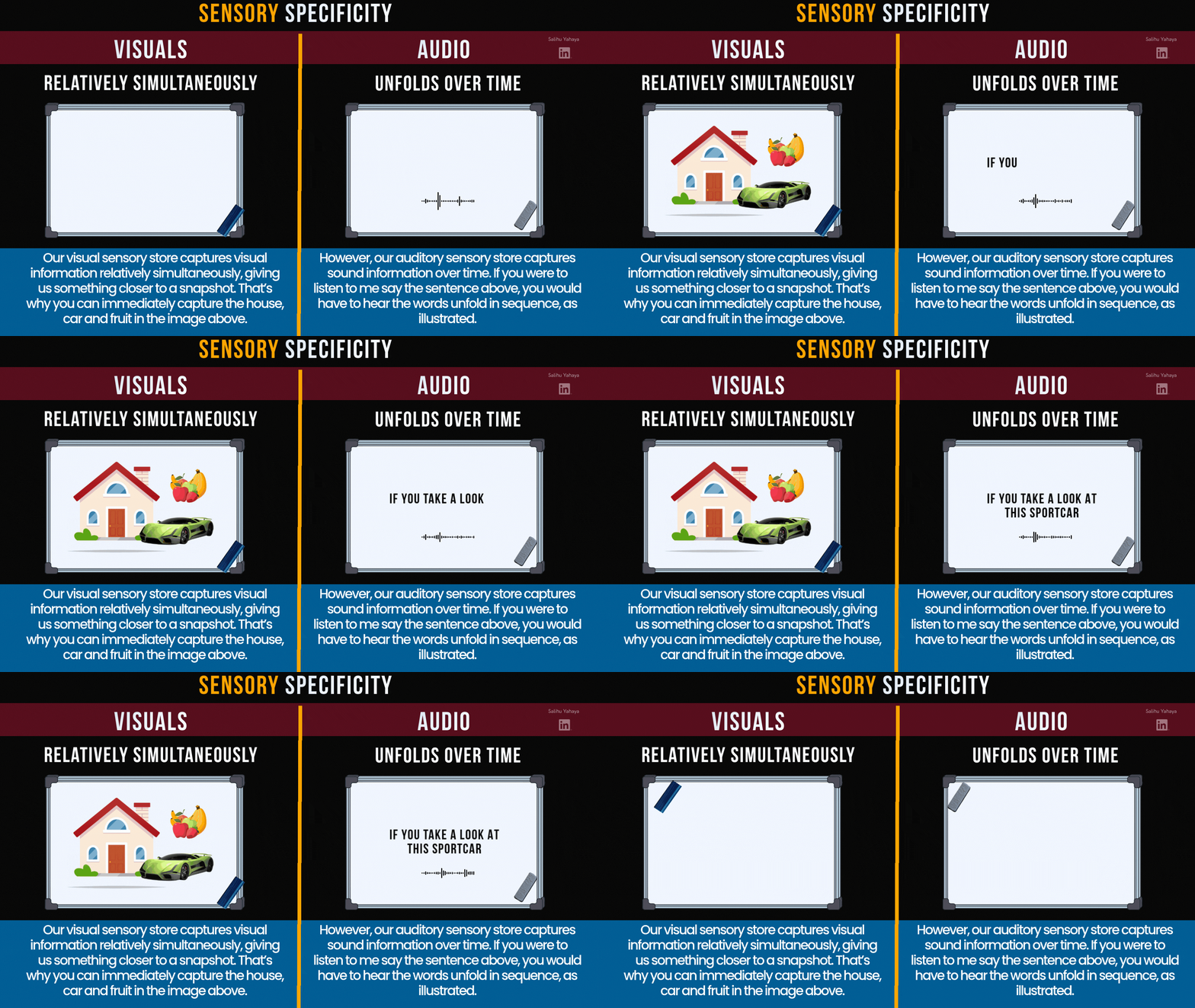
Sight can potentially give us a relatively immediate snapshot.
We can see something and quickly recognize it almost immediately🔴.
But sound doesn’t arrive as a complete object in the same way, as it unfolds over time.
Spoken words unfolds
word 1 → word 2 → word 3 → ... → meaning
Clark Quinn therefore describes audio as more linear by nature and slower because auditory information unfolds over time.
This connects directly to something we’ve already been noticing about audio if you’ve been following.
"Audio has a temporal dependency."
We can’t simply “look at” an entire spoken sentence at once.
If I say:
“IF YOU TAKE A LOOK AT THIS SPORTCAR.”
You need the words to unfold before the complete linguistic message can be processed.
Day 45 of Instructional Design
#InstructionalDesign#InstructionalDesigner#LearningAndDevelopment#SenseMakingNotes#MentalModels#TAWIQM#QuinnSeeds
In case you missed the Quinn Seed articles 👇
Quinn Seed #1- CLICK ME
Quinn Seed #2- CLICK ME
Where this comes from
- Check out "Learning Science" by Clark Quinn — If you design learning, teach, or train people, you need to understand what is actually happening when someone learns. Learning happens at the neural level, but we design for it at the cognitive level. There’s a lot more in Clark Quinn’s book that I can’t share because of **intellectual property**. Get the book and experience the learning yourself. 📚You Would Love It!
- Check out "40 L&D Stakeholder Challenges: Of L&D Leaders, Practitioners, Clients, and Learners" by Guy W. Wallace — This book shares the answers I got from my EPPI-PACT Guidance Bot. The free EPPI-PACT Guidance Bot is a digital, interactive knowledge-transfer resource designed to help Learning and Development (L&D) practitioners, performance consultants, and business leaders master and apply Guy W. Wallace’s Performance Improvement and Performance Based L&D methodologies.
- To Learn More Join the "Learning Development Accelerator" — Click the link to join the Amazing Learning Development Accelerator Group Where practice meets evidence