- Home
- Learning in public
- Sense-making notes
- Taking a Walk In Quinn's Mind
- Your Learner Can Choose Where to Look, But Can’t Control Anything Attention Grabbing
From my last post, I spoke about how information flows into our sensory store in their specific ways.
But then one thing to note is that because of the large amount of information present in our various sensory stores,
Attention then becomes the bridge between what’s in our sensory store and working memory.

It moves selected information from our rich but fleeting sensory store into our conscious processing/working memory.
Our learners’ attention is way more controlled than we think, but then they don’t have full sovereignty over what they can pay attention to.
But if you know me well, you know I love to demonstrate rather than talk.
So, to better understand this, let’s go to the office.
As employees in our various offices, we have conversations with our colleagues about different topics.
Sometimes it’s about how to complete a certain ongoing project.
Sometimes it’s about current affairs going on in the country.
And other times, it’s either about movies, football, gist and gossip.
And when we’re having those conversations, we’re usually focused, especially on the ones that interest us.
We listen to every detail of that gossip to get the full gist.
That in itself is a demonstration of how we can control what we attend to.
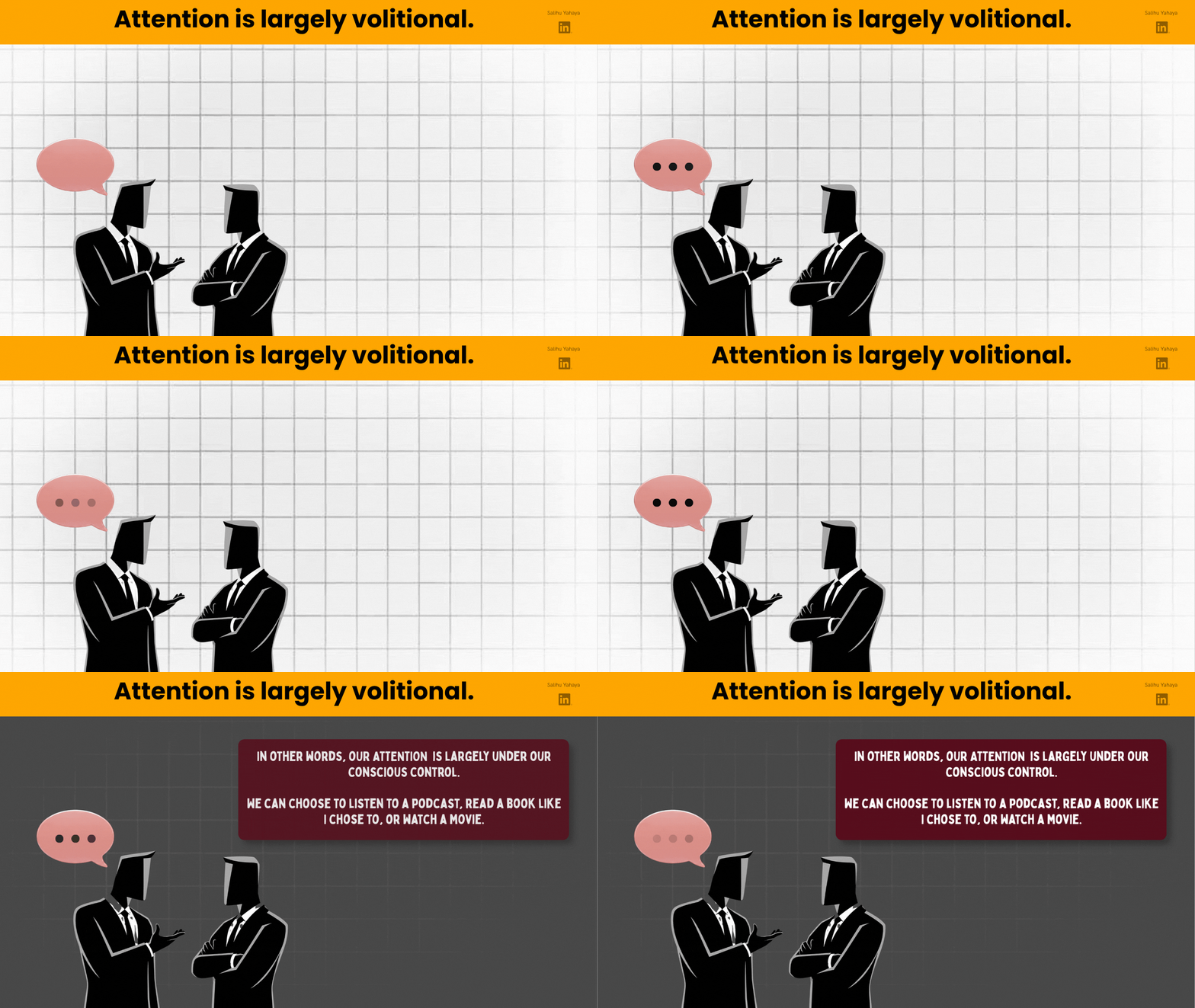
And as Clark Quinn says: attention is largely volitional.
In other words, it is largely under our conscious control.
We can choose to listen to a podcast, read a book like I chose to :) , or watch a movie.
We can also switch our attention from one thing to another, with some headspace.
And so, I’d argue that what we call multitasking is often just a rapid sequence of switching our attention.
So there you go, a large part of our attention explained through your own environment.
But then, because attention is not fully under our control…
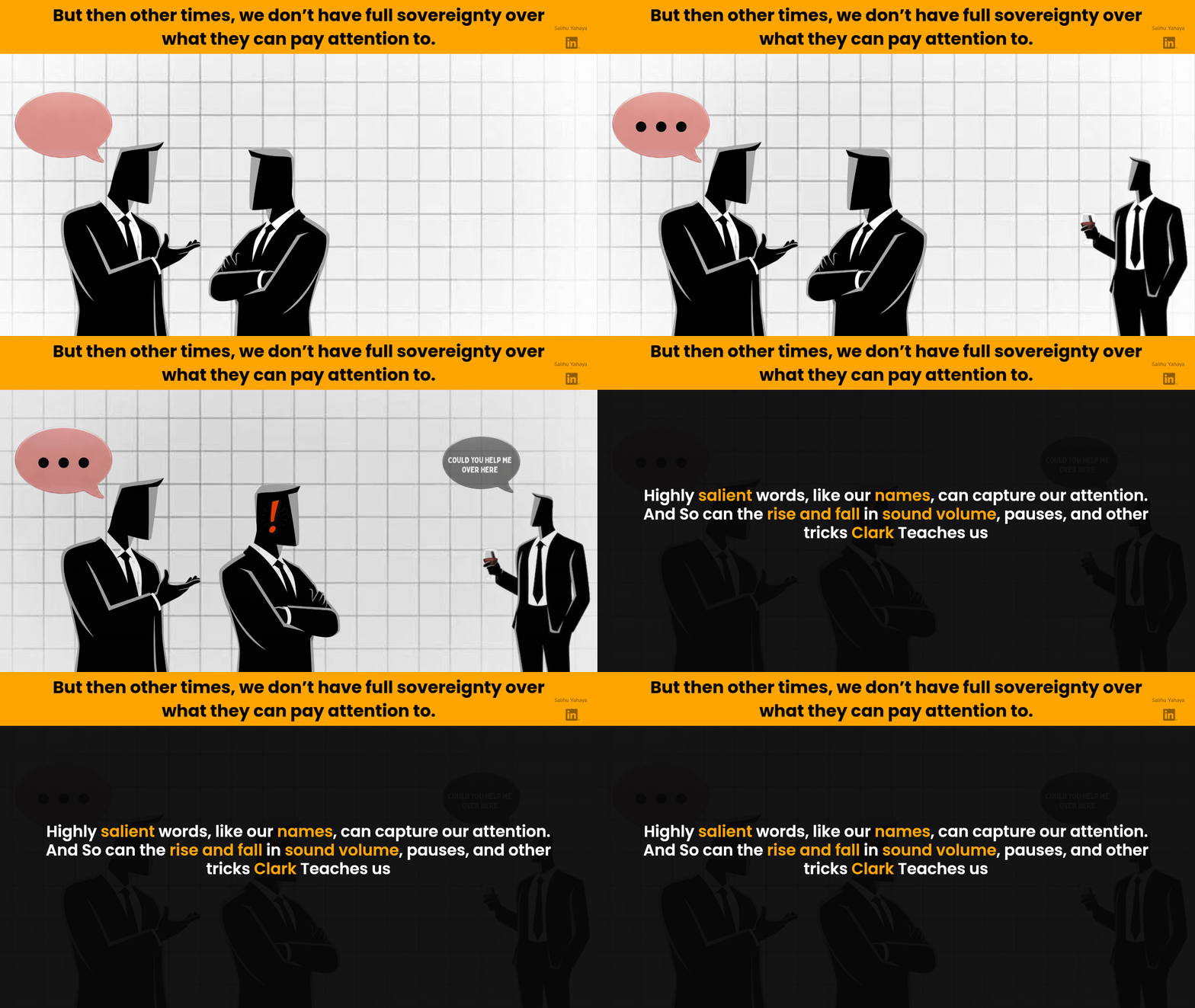
There will be a situation where someone in the office calls out your name in the middle of the conversation you’re having with your colleagues.
Maybe it’s your boss, manager or even another friend.
And without even consciously deciding to, you’d find yourself tilting your head to locate and find who’s calling your name.
Your attention gets pulled away from the initial conversation to finding who’s calling you.
This is practically a demonstration of non-volitional attention.
Clark Quinn , in his book, referenced the famous “Cocktail Party Phenomenon.”
Clark Quinn mentions how this illustrates how rich our sensory store can be.
Highly salient words, like our names, can capture our attention.
So can the rise and fall in sound volume, pauses, and other tricks.
The advertising industry has spent considerable effort understanding this, and there’s no doubt why those who benefit from this understanding find it easier to capture and retain our attention with the ads they throw at us.
Think about it.
How many ads have you watched without actually willing to?
And although I’m just hearing this for the very first time, I’m glad this was debunked for me at a very early stage:
“Attention is not limited to eight or any other number of seconds.”
And that “The original ‘attention span of a goldfish’ meme can be traced back to a misinterpretation of other data.” as Clark Quinn mentioned.
I mean, have you ever sat to think about when playing a game or reading a book, time was running out and you didn’t even notice?
Our attention is part of our cognitive architecture, which has evolved over thousands of years.
It’s not going to change that fast!
This also means for us as learning experience designers that our learners will need support in guiding their attention.
Because as much as they can try to focus and consciously pay attention to the learning experience content, they’re still prone to lots of distractions.
If you remember in one of my last posts, we talked about how multiple channels for even the same sensory input, like media, text, images and more, that the eyes take in can get processed simultaneously, relatively at the same time.
Knowing this gives me a strong edge in also knowing how to distract people, for better or worse, like Clark Quinn mentioned.
As marketers use more sophisticated programming to capture our attention with notifications and updates,
I, as an instructional designer, during the process of designing my learners’ experience, should help sieve out unnecessary distractions and guide my learner to where their attention is needed most.
Because now that I know, even when my learners volitionally pay attention, an input from a contrasting channel, a competing cue, or a redundant cue may only tear apart the experience rather than build it.
Day 47 of Instructional Design
Next Up Quinn Seed 3...
In case you missed the Quinn Seed articles 👇
Quinn Seed #1- CLICK ME
Quinn Seed #2- CLICK ME
Where this comes from
- Check out "Learning Science" by Clark Quinn — If you design learning, teach, or train people, you need to understand what is actually happening when someone learns. Learning happens at the neural level, but we design for it at the cognitive level. There’s a lot more in Clark Quinn’s book that I can’t share because of **intellectual property**. Get the book and experience the learning yourself. 📚You Would Love It!
- Check out "40 L&D Stakeholder Challenges: Of L&D Leaders, Practitioners, Clients, and Learners" by Guy W. Wallace — This book shares the answers I got from my EPPI-PACT Guidance Bot. The free EPPI-PACT Guidance Bot is a digital, interactive knowledge-transfer resource designed to help Learning and Development (L&D) practitioners, performance consultants, and business leaders master and apply Guy W. Wallace’s Performance Improvement and Performance Based L&D methodologies.
- To Learn More Join the "Learning Development Accelerator" — Click the link to join the Amazing Learning Development Accelerator Group Where practice meets evidence