- Home
- Learning in public
- Sense-making notes
- Taking a Walk In Quinn's Mind
- Your Learner Saw It. So Why Did It Disappear?
From my last post, building on our sensory store being big but temporary, Clark Quinn gave one example.
I experienced it, sat with it, thought through it, and then challenged myself to reframe it and give a different example.
And if you know me, then you know I love to demonstrate.
⚠️ Quick caveat: If you still see the big question mark “?”, please wait 20 seconds before continuing. The experience will restart automatically, and waiting will give you the best demonstration experience.
So allow me to demonstrate how I think about the human sensory store:
A whiteboard that gets written on… and then wiped clean.
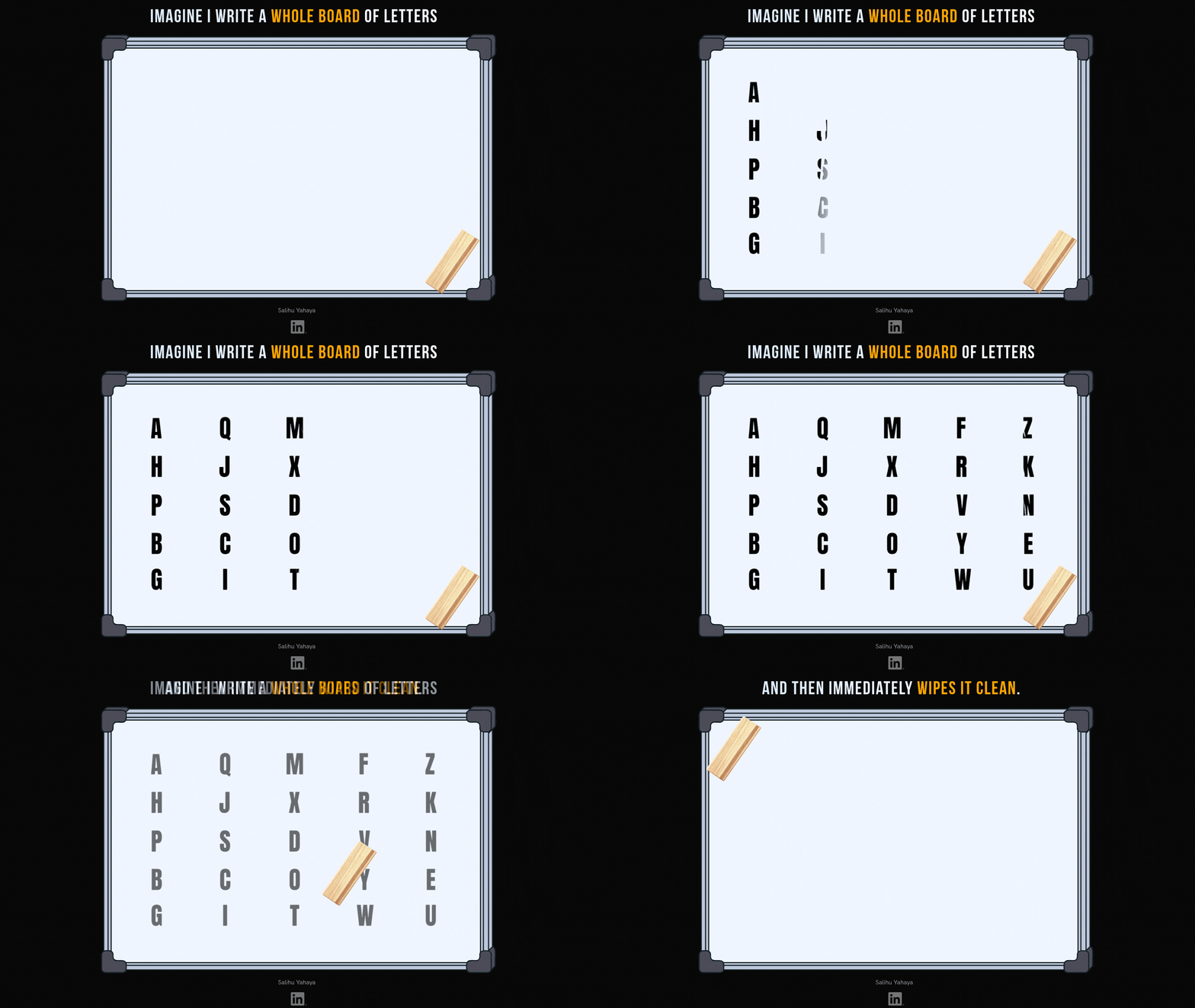
For that brief moment when the letters were on the whiteboard,the information was there.
The problem wasn't necessarily that you couldn't see it.
The problem was:
You see it → it enters your sensory store → and shortly afterward, the information fades.
And why does this happen?
Let me demonstrate how I experienced it.
Now, let's begin, shall we?
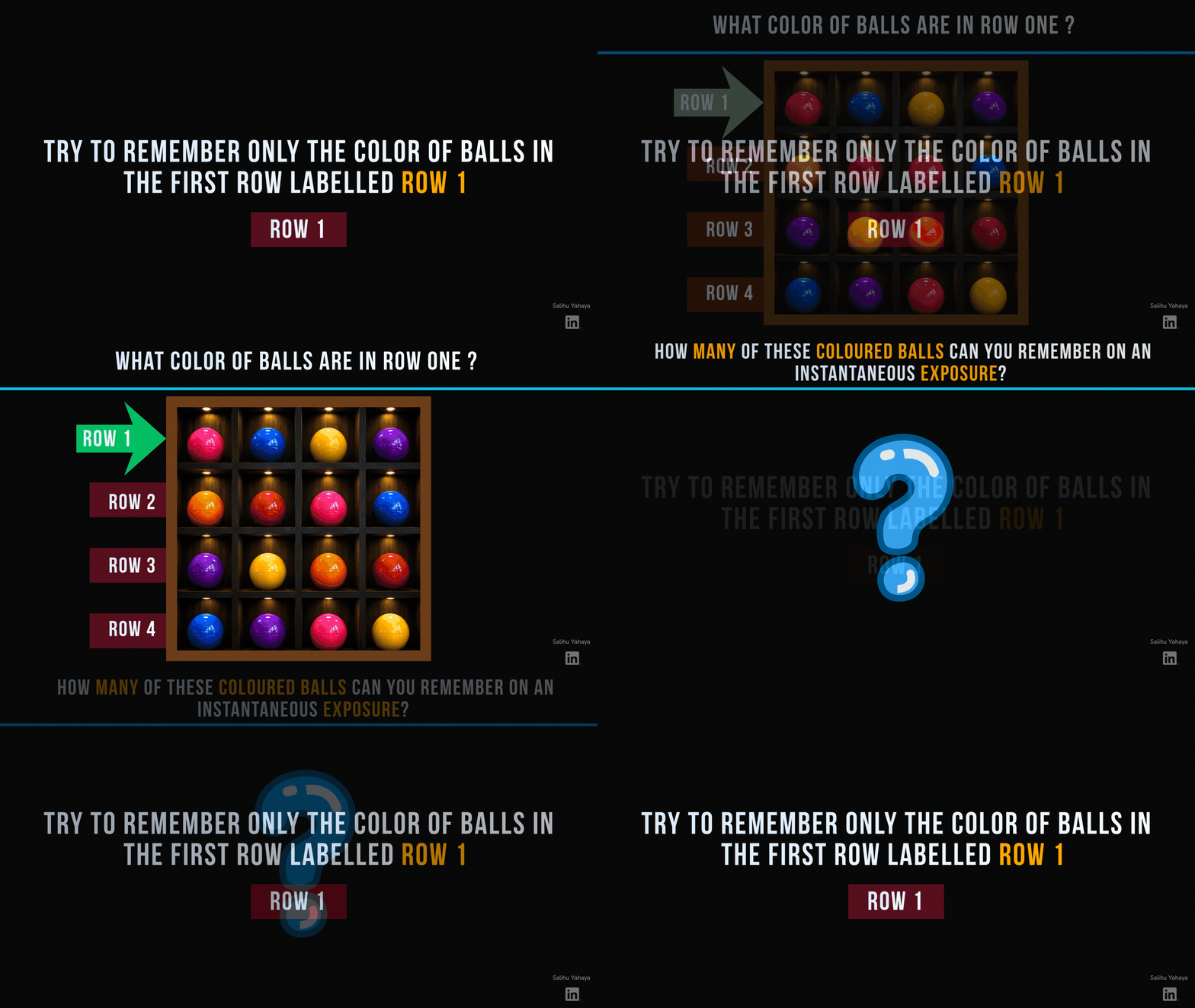
First, I'm going to present you with an empty wooden cabinet.

And now I'm going to put a coloured ball in each of these empty compartments.
All I need you to tell me is:
How many of these coloured balls can you remember after an instantaneous exposure?

Bingo.
Because I flashed it up really quickly and then hid it, you'd be hard-pressed to recall them all before they were forgotten.
Perhaps you could remember three or four, maybe even their approximate locations.
But let's try again.
Maybe it felt like I wasn't being fair to you the first time.
This time, I'm going to present the same cabinet, but I want you to remember only the colours in the first row.
Aha…
See what happened?
You'd likely be able to remember three or four accurately in that row, regardless of which row you were given.
When I asked you to report one particular row back to me, you could identify several balls from that cabinet in that row.
The rest of the visual information may have been available, but it disappeared before you could consciously access it and report all of it.
Which brings me back to Clark Quinn statement:
“It’s not that we can’t access it; it’s just that it disappears so quickly.”
And this, for me, highlighted the power of attentional guidance.
This anwsers the question to the problem why we
We Percieve an information → it then enters our sensory store → and shortly afterward, the information fades.
its Simply a lack of attention.
We consume a lot of information into our sensory store.
Our sensory store therefore gives us access to a surprisingly rich snapshot of the world or, in our learners case, a surprisingly rich snapshot of a learning experience.
This was an illustrated example Clark gave us in his book using letters.
I simply sat with it.
I experienced it.
I thought through it.
And then I challenged myself to reframe it and give a different example.
Because, if you know me, you know I love to demonstrate.
I hope this helped ,or at least reminded you , to see the power of guiding the attention of our learners.
Because if we don't guide attention toward what matters, important information can disappear before the learner ever gets the opportunity to process it.
So the new flow for me will be roughly:

Day 43 of Instructional Design
#InstructionalDesign#InstructionalDesigner#LearningAndDevelopment#LearningDesign#LearningExperienceDesign#LXD#Elearning#ELearningDesign#CurriculumDesign#CurriculumDeveloper#LearningJourney#Day1#Day2#LearningInPublic#BuildInPublic#SenseMakingNotes#MentalModels#TAWIQM
In case you missed the Quinn Seed articles 👇
Quinn Seed #1- CLICK ME
Quinn Seed #2- CLICK ME
Where this comes from
- Check out "Learning Science" by Clark Quinn — If you design learning, teach, or train people, you need to understand what is actually happening when someone learns. Learning happens at the neural level, but we design for it at the cognitive level. There’s a lot more in Clark Quinn’s book that I can’t share because of **intellectual property**. Get the book and experience the learning yourself. 📚You Would Love It!
- Check out "40 L&D Stakeholder Challenges: Of L&D Leaders, Practitioners, Clients, and Learners" by Guy W. Wallace — This book shares the answers I got from my EPPI-PACT Guidance Bot. The free EPPI-PACT Guidance Bot is a digital, interactive knowledge-transfer resource designed to help Learning and Development (L&D) practitioners, performance consultants, and business leaders master and apply Guy W. Wallace’s Performance Improvement and Performance Based L&D methodologies.
- To Learn More Join the "Learning Development Accelerator" — Click the link to join the Amazing Learning Development Accelerator Group Where practice meets evidence