- Home
- Learning in public
- Sense-making notes
- Taking a Walk In Quinn's Mind
- How Much Information Can We Actually Ask a Learner to Hold at Once?
It's the process of attention that takes information from our "sensory store" into what’s called our “working memory,” as Clark Quinn mentioned.
It’s also known as short-term memory, or STM.
And Yessss…
I have just arrived at a new station. Let’s see what this unfolds this time around.
Clark Quinn explained our Working Memory as being what we’re attending to and holding consciously in our mind.
In my own words, if new information is like new visitors who come into our office from our learning environment, then we, as instructional designers, will play the role of being the guards that protect and direct our new visitors to the reception.
And our receptionist will be none other than
“Mr. Working Memory.”
Because it is our working memory (STM) that will be attending to our new visitors (new knowledge or skill).
And oh my, what Clark Quinn said about our Working Memory gave me a hint I paid attention to, to practically internalise it.
Clark Quinn mentioned our working memory is where our conscious awareness resides.
What this implies to me is two things.
Perception of information from the world into our sensory store happens unconsciously, unlike the transfer of information from sensory store into our working memory.
And because attention is the bridge between our sensory store and working memory,
Given that we can direct our attention voluntarily, but our attention can also be captured by our environment,
Attention comes at the cost of distraction.
And so I see it as a trade-off.
And I learnt that our working memory has some interesting features.
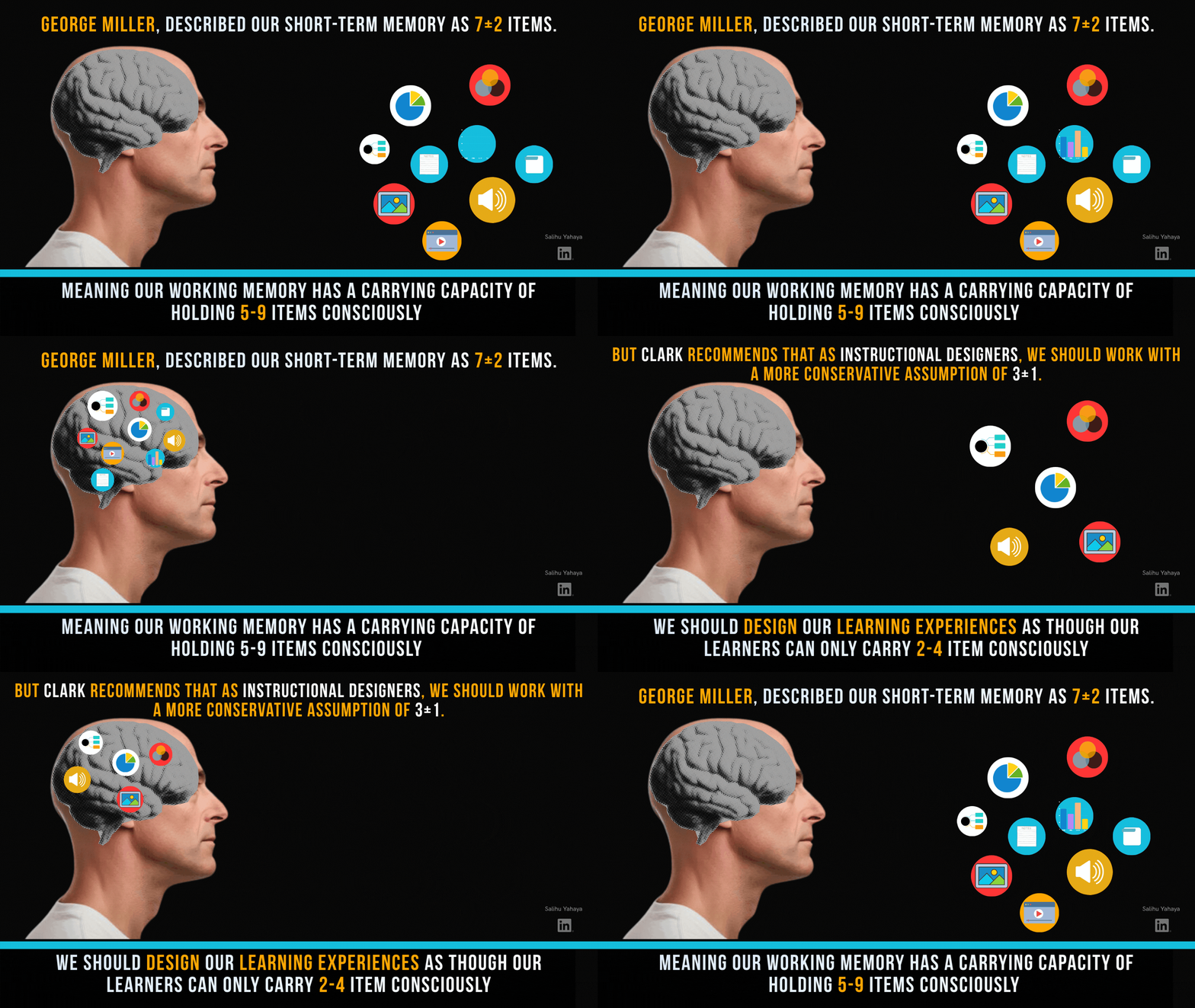
One of which was famously shared by George Miller, where he described short-term memory as 7±2 items.
Translating to us being able to hold roughly 5–9 items in our working memory.
Meaning our working memory has a carrying capacity of holding 5-9 conscious information in it.
But Clark Quinn recommends that as instructional designers, we should work with a more conservative assumption of 3±1. And for younger children, capacity may be even smaller.
So an important design lesson this is teaching me is not to ask “How much information I can fit onto a slide?”
but asking “How much information am I asking my learners to actively process at a moment?”
Think that’s a much better instructional-design question for myself.
#InstructionalDesign#InstructionalDesigner#LearningAndDevelopment#LearningDesign#LearningExperienceDesign#LXD#Elearning#ELearningDesign#CurriculumDesign#CurriculumDeveloper#LearningJourney#Day1#Day2#LearningInPublic#BuildInPublic#SenseMakingNotes#MentalModels#TAWIQM#QuinnSeeds
In case you missed the Quinn Seed articles 👇
Quinn Seed #1- CLICK ME
Quinn Seed #2- CLICK ME
Quinn Seed #3- CLICK ME
Where this comes from
- Check out "Learning Science" by Clark Quinn — If you design learning, teach, or train people, you need to understand what is actually happening when someone learns. Learning happens at the neural level, but we design for it at the cognitive level. There’s a lot more in Clark Quinn’s book that I can’t share because of **intellectual property**. Get the book and experience the learning yourself. 📚You Would Love It!
- Check out "40 L&D Stakeholder Challenges: Of L&D Leaders, Practitioners, Clients, and Learners" by Guy W. Wallace — This book shares the answers I got from my EPPI-PACT Guidance Bot. The free EPPI-PACT Guidance Bot is a digital, interactive knowledge-transfer resource designed to help Learning and Development (L&D) practitioners, performance consultants, and business leaders master and apply Guy W. Wallace’s Performance Improvement and Performance Based L&D methodologies.
- To Learn More Join the "Learning Development Accelerator" — Click the link to join the Amazing Learning Development Accelerator Group Where practice meets evidence