- Home
- Learning in public
- Sense-making notes
- Taking a Walk In Quinn's Mind
- Our Sensory Store Can Hold Almost Everything, But Only for a Moment
Now that I've understood and digested how our various senses/input channels work and how to go about designing learning experiences for all learner strata,
Having applied Quinn Seed 1, which taught me to make information detectable and controllable by the learner, and Quinn Seed 2, which taught me to not only make the information detectable but accessible to all learners,
Let's go to our sensory store, where they firstly reside.
Clark Quinn mentioned in his Everything Available at the Sensory Store section:
Our eyes and ears process input into a “sensory store.” (So, too, do our other senses.) There are unique ones for each sense, but here we’re going to largely focus on vision and, to a lesser degree, auditory signals.
And so, all senses process information input into their various stores.
I once captured this in one of my previous posts when Clark Quinn made it clear with one statement in his book:
"What we perceive is captured in our sensory store in the form in which it's perceived."
You can check the post out if you'd love to go through it:
But then Clark Quinn mentions his focus being largely on vision and, to a lesser degree, auditory signals.
And I won't be surprised. In fact, I'd say his selected focus is almost obvious, especially when I think about it through the lens of two things:
- Our sensory homunculus giving our eyes and ears a significantly large perception capacity and
- The ear being a powerful channel for information communication, especially because auditory information can carry substantial information and speech is arguably the highest-bandwidth medium we have.
Knowing these two things on my journey made me smirk when Clark Quinn focused on these two for now.
I say this because I don't know if he'd surprise me with something else too... but anyways, let's see how it goes, In Sha Allah.
Clark Quinn then further said:
The existence of a sensory store is determined by experimentation, but it has been demonstrated to have particular features. It has capacity equal to our perception; that is, you pretty much capture everything that comes in, but it’s gone very quickly.
Reading this now reinforces how I think of our sensory store like being a very large but extremely temporary inbox with capacity equal to our respective senses’ perception.
You see, our senses are constantly receiving information from the world and, in our case, learning experiences, and much more of it is captured than we can consciously remember.
Clark Quinn describes it as having a capacity roughly equal to what we can perceive, which I demonstrated with the box sizes in the gif.
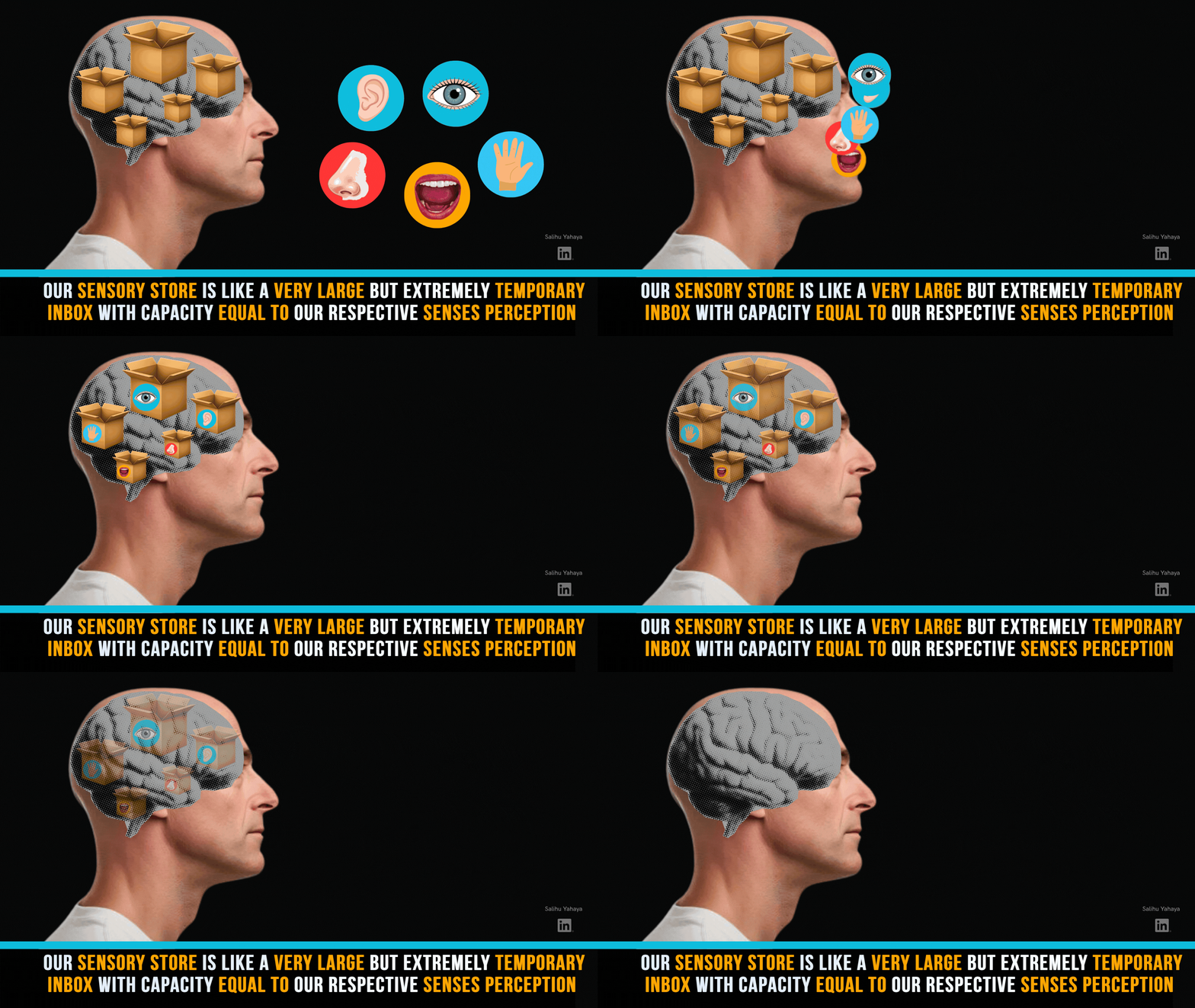
So, the input is available, but only very briefly. 👌
So the flow for me will be roughly:
LEARNING EXPERIENCE → SENSES → SENSORY STORE → ? → ?
And this distinction is crucial for me because this means our
Sensory store ≠ working memory.
In full words, our sensory store doesn’t equate to our working memory.
Our Sensory store can hold a lot of incoming information, but only for a very short time. Working memory holds much less, but it is what we're consciously working with.
More on this when I get there.
Might put everything into an article once done.
Day 42 of Instructional Design
#InstructionalDesign#InstructionalDesigner#LearningAndDevelopment#LearningDesign#LearningExperienceDesign#LXD#Elearning#ELearningDesign#CurriculumDesign#CurriculumDeveloper#LearningJourney#Day1#Day2#LearningInPublic#BuildInPublic#SenseMakingNotes#MentalModels#TAWIQM
In case you missed the Quinn Seed articles 👇
Quinn Seed #1- CLICK ME
Quinn Seed #2- CLICK ME
Where this comes from
- Check out "Learning Science" by Clark Quinn — If you design learning, teach, or train people, you need to understand what is actually happening when someone learns. Learning happens at the neural level, but we design for it at the cognitive level. There’s a lot more in Clark Quinn’s book that I can’t share because of **intellectual property**. Get the book and experience the learning yourself. 📚You Would Love It!
- Check out "40 L&D Stakeholder Challenges: Of L&D Leaders, Practitioners, Clients, and Learners" by Guy W. Wallace — This book shares the answers I got from my EPPI-PACT Guidance Bot. The free EPPI-PACT Guidance Bot is a digital, interactive knowledge-transfer resource designed to help Learning and Development (L&D) practitioners, performance consultants, and business leaders master and apply Guy W. Wallace’s Performance Improvement and Performance Based L&D methodologies.
- To Learn More Join the "Learning Development Accelerator" — Click the link to join the Amazing Learning Development Accelerator Group Where practice meets evidence