- Home
- Learning in public
- Sense-making notes
- Taking a Walk In Quinn's Mind
- Quinn Seeds
- Your Learner’s Working Memory Is a Desk. Stop Putting Everything on It at Once.
Don’t overload the office desk

Building on the Quinn Seed 3 which was centered around helping our learners focus by protecting them from distractions and directing their attention.
Quinn seed 4 is centered around our working memory, how its similitude is like that of our office desk and the effect of overloading it
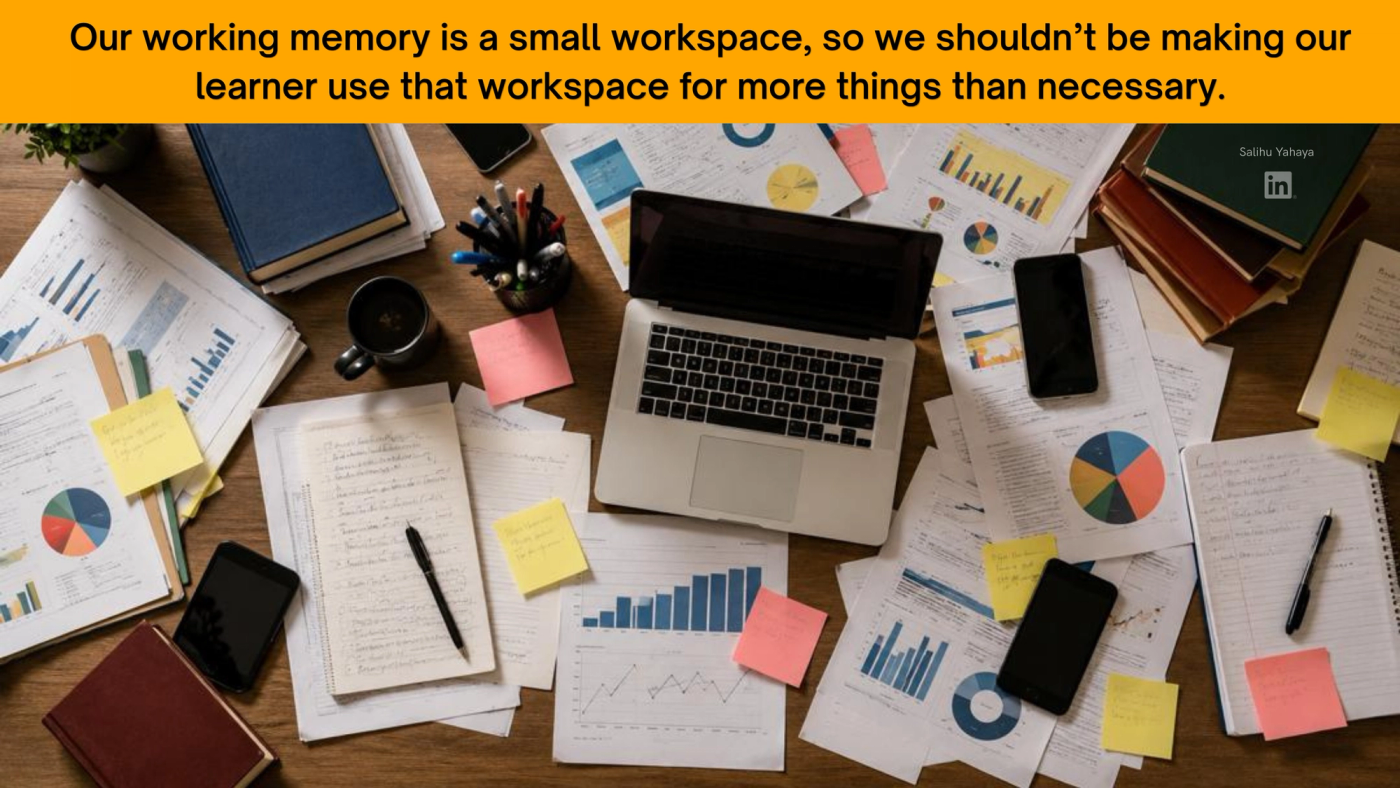
You see, our working memory is a small workspace, so we shouldn’t be making our learner use that workspace for more things than necessary.
As recommended by Clark Quinn , assuming roughly 3 ± 1 meaningful elements for learning purposes as instructional designers to be more conservative , rather than overloading our learners with a lot of meaningful elements and worrying where the problem originated from
But let's go back to the office again.
If every new visitor coming into our office , is like a new information coming into our brain
And just as guards protect and direct our visitors from getting distracted by the aesthetics of our Office environment to head to where they will be properly attended to at the reception.
So do we instructional designers are to also protect and guard our learners attention to the needed information to take it into our working memory
Our working memory then becomes our office desk.
And so, we can have a few important documents on the desk and actively work with them.
But imagine someone walks in and puts:
- 8 documents
- 4 books
- 3 phones
- a laptop
- sticky notes
- several charts

On your desk while you're trying to solve one problem.
The problem isn't that the information is necessarily bad.
It’s that our workspace would simply become crowded.
That's working-memory overload.
And Clark makes an important addition: the load isn't only the information being presented.
It also includes the contextual and conceptual knowledge the learner has to process.
This could be a misconception for some instructional designers, because Overloading working memory isn't simply:
"There is too much text on the slide."
It can also be:
"The learner has too many things they must mentally coordinate at the same time."
For example, imagine teaching a novice how to operate a piece of equipment.
You might simultaneously explain:
- What every button does
- Why each button works
- The safety rules
- The sequence of operation
- The terminologies
- A complicated diagram
- A scenario
Every individual piece might be useful.
But useful + useful + useful can still become unusable when everything competes for working memory.
This is where I’d throw back to Clark Quinn advice where he recommends that we be more conservative with what we feed our learners working memory, which equates to 3 ± 1 meaningful items for learning purposes.
But because our working memory is so volatile like steam rising from an open pot and quickly dispersing into the air…
Our remedy will be conscious rehearsal, simply because
What we don't actively maintain can fade, or be displaced by what comes next.
Personally speaking, Iv’e lost alot of very good important information on this journey of documentation, primarily because during my process of articulation my thoughts, an unexpected event happens that distracts my attention making me to completely forget what it was that i was thinking about.
🎯 What should i do differently haven learnt this ?
Before adding something to a learning experience, an important question I’d ask would be:
"Does the learner need to process this right now?"
If not:
I’d either remove it, delay it, simplify it (chunk it), reveal it progressively, or put it somewhere the learner can access when needed.
And be especially careful with novices, because they don't yet have the rich chunks that experts have.
A practical heuristic
And so it’s not about “How much information can I fit” but, "How little my learner needs to process at this moment to accomplish the next meaningful thing?"
This, to me, is the heart of Seed 4 #
And perhaps another way I’d think about working-memory overload is by imagining myself at the gym.

Imagine going for a workout session and trying to perform several demanding exercises simultaneously.
Running on the treadmill while doing dumbbell curls, squatting, counting your reps, keeping track of your form, and trying to follow the trainer’s next instruction all at the same time.
You’d probably have a really hard time keeping up.
Not because running, curling, or squatting is inherently difficult or bad.
But because you’re asking yourself to coordinate too many demanding things at the same moment.
You could absolutely do all of these exercises in one workout.
You just wouldn’t normally try to do them all simultaneously.

And I think that’s a useful way to think about working-memory overload.
It’s not necessarily about how much information exists across the entire learning experience. It’s about how much the learner has to mentally coordinate at the same moment. Just like at the gym, sometimes the answer isn't removing the exercises altogether.
It’s simply sequencing them.
One exercise → then another → then another.
And perhaps that's also what we need to do with information.
One meaningful thing → then another → then another.
Because
And That’s where Chunking comes in…
Day 53 of Instructional Design
In case you missed the Quinn Seed articles 👇
Quinn Seed #1- READ ME
Quinn Seed #2- READ ME
Quinn Seed #3- READ ME
Where this comes from
- Check out "Learning Science" by Clark Quinn — If you design learning, teach, or train people, you need to understand what is actually happening when someone learns. Learning happens at the neural level, but we design for it at the cognitive level. There’s a lot more in Clark Quinn’s book that I can’t share because of **intellectual property**. Get the book and experience the learning yourself. 📚You Would Love It!
- Check out "40 L&D Stakeholder Challenges: Of L&D Leaders, Practitioners, Clients, and Learners" by Guy W. Wallace — This book shares the answers I got from my EPPI-PACT Guidance Bot. The free EPPI-PACT Guidance Bot is a digital, interactive knowledge-transfer resource designed to help Learning and Development (L&D) practitioners, performance consultants, and business leaders master and apply Guy W. Wallace’s Performance Improvement and Performance Based L&D methodologies.
- To Learn More Join the "Learning Development Accelerator" — Click the link to join the Amazing Learning Development Accelerator Group Where practice meets evidence