- Home
- Learning in public
- Sense-making notes
- Taking a Walk In Quinn's Mind
- Chunking Isn’t Grouping Information. It’s Making Information Belong Together.
“I’d always tell my mentees, we don’t believe in pure memorization because under pressure, we could lose it all. Rather, what we believe in is truly understanding the concepts, and finding that not-so-apparent relationship or interconnectivity between them.”
In other words, I tell them “Let’s make it make sense.”
And so Iv'e come to learn that Chunking isn’t physically grouping things but cognitively making things belong together.
And that'll essentially mean, sensemaking of individual pieces of information and turning them into one meaningful thing.
Why this particular concept took a while to really understand was because, if you remember one of the things that drove me on this journey, it’ll be wanting to know how certain practices I used on my students without knowing why they worked, or the scientific backing behind why they worked. This was one of them so i had to spend time re-wiring.
Clark Quinn yet again has brought to light another practice I was doing subconsciously, loved and enjoyed doing, without really knowing the effect it had.
Creating chunks !.
You know, I could never see a group of individual pieces of information that seemed to be standalones without thinking of one thing:
“How can I make all of this connect as either one unit or more of 3 units?”
And although I mostly did that by connecting it to a world my mentees were already familiar with, back in my Uni days, I did this a lot, especially with information that had a lot of points to be assimilated, like ;
A list of features of something,
A list of advantages & disadvantages of something,
A list of something.
And sometimes, even with long definitions, and more...
And By “something” here, I mean anything we were dealing with at that exact moment.
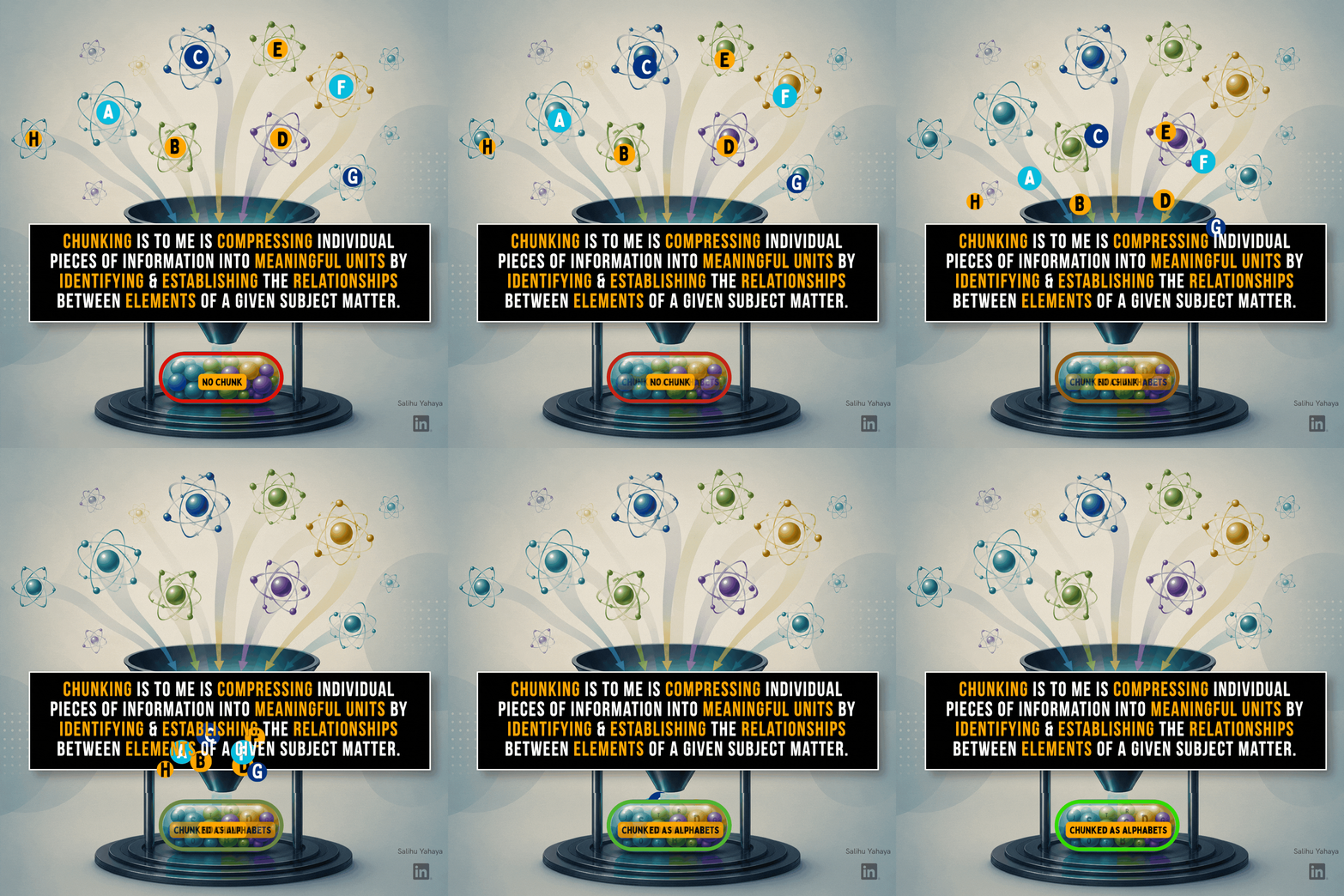
So Chunking to me is compressing individual pieces of information into meaningful units by identifying & establishing the relationships between elements of a given subject matter.
And so, a key ingredient for me, I’d say, is making it meaningful for the learner. And, this yet again, sparks the question Matthew Richter laid emphasis on in his cognitive load theory video, which was:
“Knowing our learners and what they already know.”
As this will help us chunk information in a way tailored to our learners’ prior knowledge, thus enabling our learners to process and remember more of what we present to them during and after their learning experience.
(Of course, there’s more to be done after chunking information properly for our learners.)
But chunking information is one of three ways we can help our learners manage the right mental work that results to learning. Which is where they should focus on.
In the mean time, please allow the gif attached to this post show you a visual summary demonstration of what chunking should be ...
Day 56 of Instructional Design
#InstructionalDesigner#LearningAndDevelopment#LearningExperienceDesign#LearningInPublic#BuildInPublic#SenseMakingNotes#MentalModels#TAWIQM#QuinnSeeds
In case you missed the Quinn Seed articles 👇
Quinn Seed #1- CLICK ME
Quinn Seed #2- CLICK ME
Quinn Seed #3- CLICK ME
Quinn Seed #4- CLICK ME
Where this comes from
- Check out "Learning Science" by Clark Quinn — If you design learning, teach, or train people, you need to understand what is actually happening when someone learns. Learning happens at the neural level, but we design for it at the cognitive level. There’s a lot more in Clark Quinn’s book that I can’t share because of **intellectual property**. Get the book and experience the learning yourself. 📚You Would Love It!
- Check out "40 L&D Stakeholder Challenges: Of L&D Leaders, Practitioners, Clients, and Learners" by Guy W. Wallace — This book shares the answers I got from my EPPI-PACT Guidance Bot. The free EPPI-PACT Guidance Bot is a digital, interactive knowledge-transfer resource designed to help Learning and Development (L&D) practitioners, performance consultants, and business leaders master and apply Guy W. Wallace’s Performance Improvement and Performance Based L&D methodologies.
- To Learn More Join the "Learning Development Accelerator" — Click the link to join the Amazing Learning Development Accelerator Group Where practice meets evidence