- Home
- Learning in public
- Sense-making notes
- Taking a Walk In Quinn's Mind
- Quinn Seeds
- Don’t Fill Working Memory. Equip It.
Don't simply reduce the amount of information learners encounter. Determine what they actually need to hold in their heads, what can remain in the environment, and which pieces of information should become meaningful wholes.
This Quinn Seed for me is very much tied to Cognitive Load Theory, given that Clark Quinn mentioned two exact words:
“necessary” & “information”
Because those were the roots of the primary learning improvement campaign our famous psychologist, John Sweller et al., ran indirectly through awareness creation around our very limited working memory capacity, and how eliminating unnecessary information & helping our learners focus on the “necessary information” can support learning.
Of course, there’s more to it, but you get the point.
And all of this happens because our working memory is the temporary mental workspace through which information we attend to is processed, and where it can interact with knowledge retrieved from long-term memory.
Our working memory can only hold a limited number of items at once, especially when those items are unfamiliar. And while older research by the Architect of cognitive load theory John Sweller popularised the idea of7±2when we are dealing with novel information in 1988.(Shout out to Sweller)
On the flip side ,Clark Quinn advised us to conservatively work with learners being able to hold around3±2 items (chunks)to give headspace to our learners.
:::::::::::::::::::::::::::::::::::::::::::::::::::::::::::::::::::::::::::::::::::::::::::::::::::::::::::::::::::::::::::::::::::::::::::::::::::::::::
Since we are to help our learners with chunking the necessary information, we wouldn’t be physically grouping things for them but cognitively making things belong together for them.
And a beautiful fact to hold will be that “a chunk made properly saves our working memory budget wasted on liabilities.”
Yes, a chunk can be called a cognitive asset used to build even more cognitive assets because it compounds.
And so when we meaningfully compress individual pieces of information into meaningful units, those units can become integrated knowledge structures in long-term memory referred to as a “Schema” as i learnt from Matt, and these schemas can later be retrieved as a whole when needed.

You may likely not make any meaning out of it depending on your pre-existing knowledge, and suppose i show you for only a few seconds and then took it out , it becomes even worse.
But then as a news-watching enthusiast, suppose I show you the same letters but rearranged in this order:
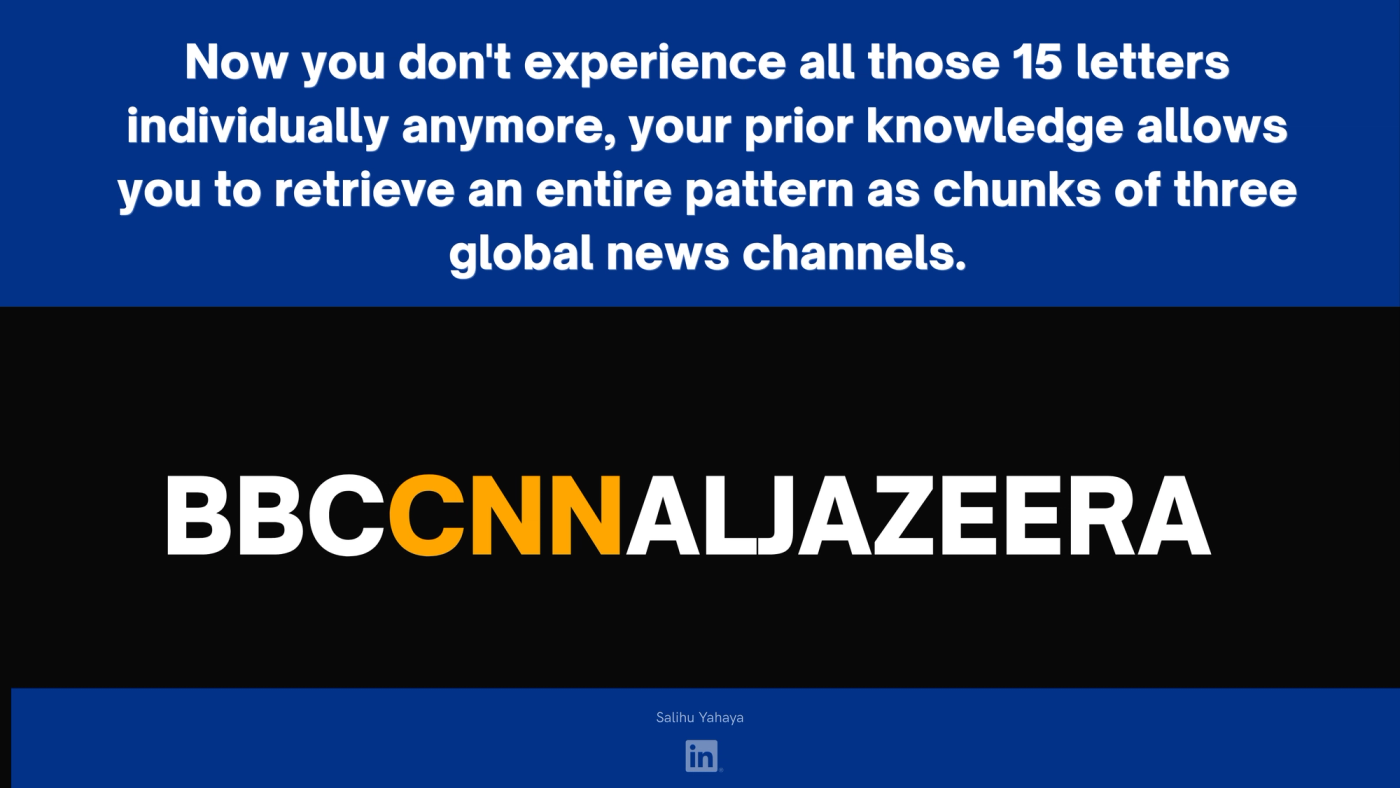
Now you don't experience all those 15 letters individually anymore. Your prior knowledge allows you to recognize an entire pattern as chunks of three global news channels.
So You see, this is a demonstration of how chunks (capsules) are like collections of information that can be retrieved from long-term memory as meaningful units.

And as instructional designers, helping learners become able to chunk the information we present to them is important.
The reason being that it can help a complete novice use their working memory budget spent on intrinsic load more effectively, while helping a veteran or expert retrieve and use existing knowledge structures(schemas) more efficiently, in conjunction with their previous knowledge.
Which brings me to the question:
How do I help my learners chunk information if I don't establish what needs to be chunked as a whole concept?
You see, the idea of not first establishing what needs to be chunked is pretty much like building a house without determining where the cement is actually needed, how much goes into the pillars, how much goes into the walls, and how much is needed elsewhere.

Because six slides containing five facts each doesn't necessarily mean 30 cognitive units. It may be a 10-element interconnection functioning as a single concept chunk.

This again also depends on what the learner already knows.
This is why the same material can feel:
simple → manageable → overwhelming
depending on the learner's prior knowledge.
Clark explicitly connects working memory with long-term memory: what enters working memory can interact with and trigger relevant knowledge structures from long-term memory. If the information isn't familiar, the learner has fewer existing structures to connect it to, which makes processing more demanding.
This explains why it was easier for my mentees back in the days when I always connected new concepts to familiar environments to help my learners encapsulate (chunk) a concept into a meaningful unit.
Like I always tell my students or mentees.
“We don't believe in pure memorization… we want to find the not-so-apparent relationship and interconnectivity between concepts to make it sticky.”
Because sensemaking is partly what allows information to become chunkable.
And so I'm essentially saying:
“Don't make learners memorize isolated pieces. Help them discover the relationships that allow those pieces to become a meaningful whole.”
Take, for example, we have pieces of information A-D
Information
A + B + C + D

To Help our learners, we need to help them discover the relationships that allow those pieces to become a meaningful whole.
For instance:
Show them how Information A relates to Information B
How Information B influences Information C, or even
How Information C explains Information D

Now ABCD does not become standalones of individual pieces of information but becomes one meaningful conceptual structure. And so in our learners' Working memory it becomes One useful unit instead of four disconnected pieces.
A practical example was when I helped my students chunk the processes of meiosis cell division through a relatable love story. (There's more to it, but chunking played a major role in successfully helping my learners chunk the concept.)
But then, to help our learners chunk information properly from the onset, we need to map out what needs to be chunked as a whole. From the very beginning.
And so, in helping our learners turn information into meaningful units, we may encounter a problem because guess what:
We can't teach them everything.
Because just imagine we're teaching someone how to navigate a city.
Do we then need to have them memorize every street, every landmark, every road number, every possible route?
Probably not.
That'll be so unnecessary.
Exactly !…
And this brings us to categorizing the information our learners interact with into two:
- The information that goes into the head.
- The information we can keep in the world.

“Being very clear about what has to be in the head, and what can be in the world,” is a very important distinction Clark points out to us.
If Google Maps will be available during performance, perhaps the map can remain in the world.
And so, how to interpret the map, choose a route, know what certain road signs mean, and how to respond when the route changes might actually be what needs to bein the head. Rather than have our learner memorize every street, every landmark, every road number, and every possible route.
A key note to keep in mind is:
Put the right things in the learner's head at the right moment.
And even more practically:
Don't fill working memory. Equip it.
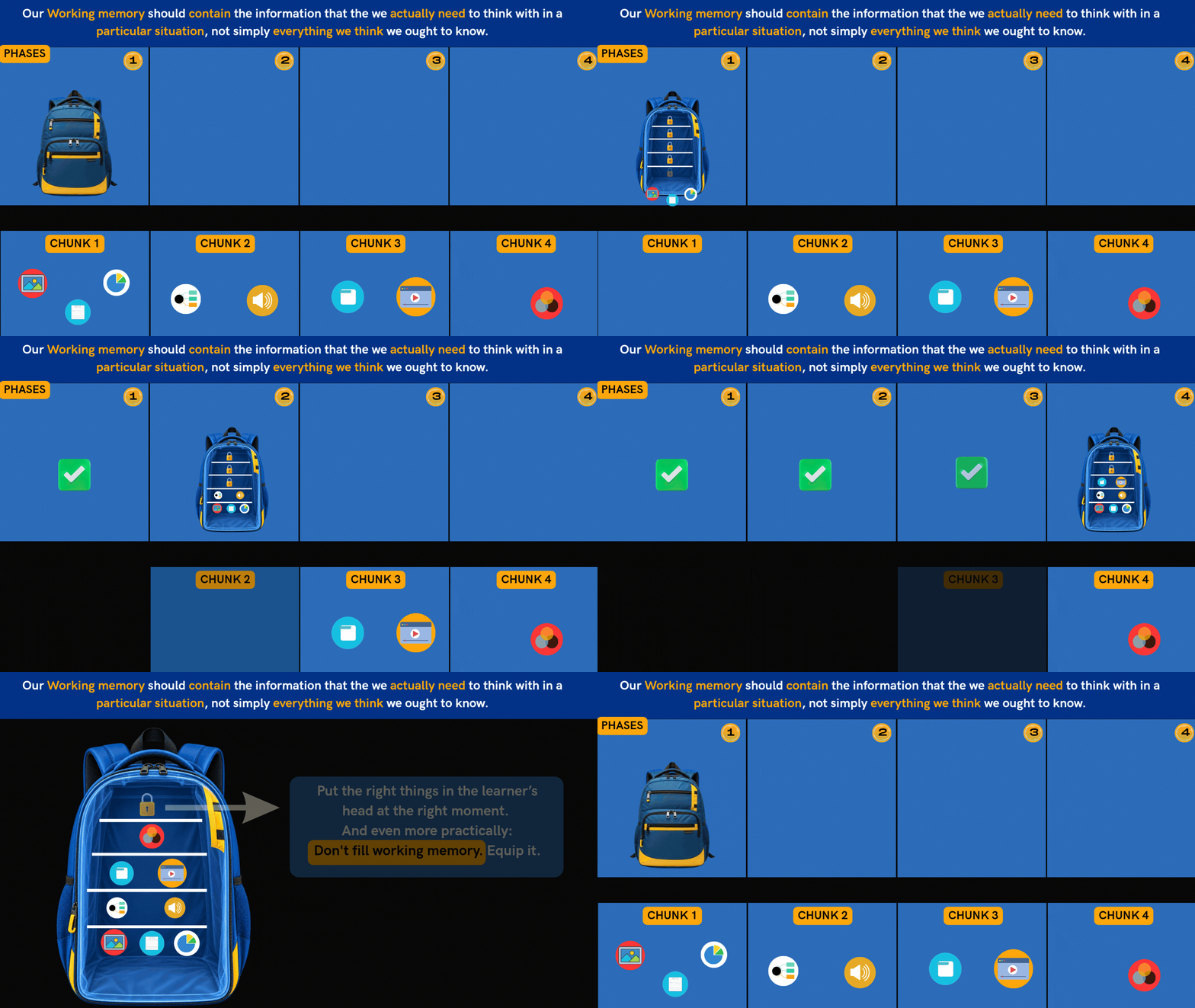
Our working memory should contain the information that we actually need to think with in a particular situation, not simply everything we think we ought to know.
So Think of our Working-Memory like a Backpack 🎒
Imagine working memory as a tiny backpack. We can only carry a few useful things at once. Conservatively, perhaps 2–4 meaningful chunks.
And so knowing where chunk 1, chunk 2, chunk 3, and chunk 4 need to go into our tiny bag matters, rather than having all chunks coming at our learners simply because we think they ought to know them all. Here is a visual demonstration.
I hope all that's being said clicks with this one :)
So as an instructional designer, don't ask:
“What information should I give my learners?”
Ask:
“What does my learner need to have in their backpack to perform this task?”
Everything else can potentially remain in the environment be it a checklist, diagram, calculator, reference guide, interface, etc.
The designer's 3-question filter
Before putting information in front of a learner, ask:
- Does this need to be in their head?
- Can some or all of it be represented as one meaningful chunk?
- Does this information help them perform the task in this context?
If the answer to #3 is no, it may be unnecessary cognitive baggage.
And notice Quinn's wording: “based on the context.”
A chunk isn't inherently useful just because it's a chunk. Its usefulness depends on what the learner is trying to accomplish. And so Quinn taught me that what reaches working memory interacts with long-term memory, triggering relevant chunks of prior knowledge.
Therefore, learning experience design should deliberately consider what needs to be mentally available and what can remain outside the learner's head. My Simple Chunking framework I will work with will be:


Day 59 of Instructional Design
#InstructionalDesigner#LearningAndDevelopment#LearningExperienceDesign#LearningInPublic#BuildInPublic#SenseMakingNotes#MentalModels#TAWIQM#QuinnSeeds
In case you missed the Quinn Seed articles 👇
Quinn Seed #1- CLICK ME
Quinn Seed #2- CLICK ME
Quinn Seed #3- CLICK ME
Quinn Seed #4- CLICK ME
Where this comes from
- Check out "Learning Science" by Clark Quinn — If you design learning, teach, or train people, you need to understand what is actually happening when someone learns. Learning happens at the neural level, but we design for it at the cognitive level. There’s a lot more in Clark Quinn’s book that I can’t share because of **intellectual property**. Get the book and experience the learning yourself. 📚You Would Love It!
- Check out "40 L&D Stakeholder Challenges: Of L&D Leaders, Practitioners, Clients, and Learners" by Guy W. Wallace — This book shares the answers I got from my EPPI-PACT Guidance Bot. The free EPPI-PACT Guidance Bot is a digital, interactive knowledge-transfer resource designed to help Learning and Development (L&D) practitioners, performance consultants, and business leaders master and apply Guy W. Wallace’s Performance Improvement and Performance Based L&D methodologies.
- To Learn More Join the "Learning Development Accelerator" — Click the link to join the Amazing Learning Development Accelerator Group Where practice meets evidence