- Home
- Learning in public
- Sense-making notes
- Taking a Walk In Quinn's Mind
- Elaboration: The Dot-Connecting Skill That Helps New Knowledge Stick
While some folks might think simply rehearsing information will get it into LTM (which is one of the most-used methods for students back in my Uni days),
I yet again learned the actual concept I applied back in my days of teaching and mentoring, which became the key that helped open the door that aided my students with transferring information into their Long-Term Memory.
And this is none other than “Elaboration” — in other words, “Dot Connection.”
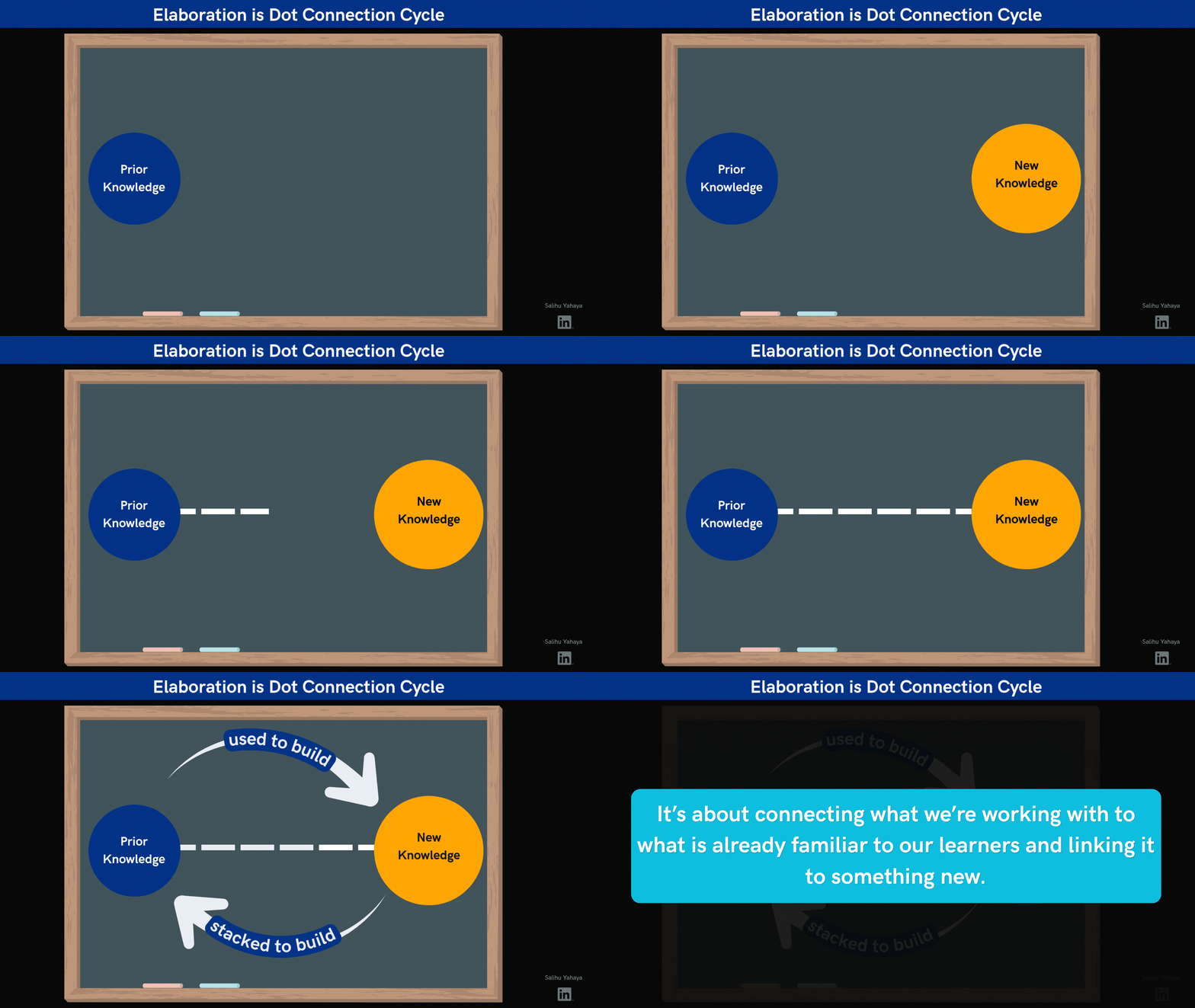
It’s about connecting what we’re working with to what is already familiar to our learners and linking it to something new.
It’s building new knowledge on previous knowledge, and using previous knowledge as a foundation to build new knowledge, which is more like putting new bricks on pre-existing bricks.
And so, the more we sit, process, and liaise with an idea, the better it sticks.
And so what we’re doing is like putting the new idea into a network connecting it to what we already know.
Elaboration is about connecting what we’re learning to our own experiences, relatable ideas, or even things happening around us.
And for me, two elements are interacting in the elaboration phase;
The prior knowledge and new knowledge of our learners.
And as an instructional designer, thinking outside the box to find relatable ideas, experiences, or things happening around our learners becomes a catalyst that helps build a mutual relationship between our learners' prior knowledge and the new knowledge we’d be presenting to them.
And while it can help explain previously misunderstood things to our learners from their past, the important thing I took from Clark Quinn on this is to use elaboration as a technique to develop and deepen our learners' networks of understanding by appropriately interconnecting ideas together.
Hence, this is an extra layer added to the slice of cake built with chunks.
To wrap up my reflection, I’d say Elaboration is a “Dot Connection Cycle centred around networks of prior and new knowledge.”
Day 61 of Instructional Design
#InstructionalDesigner#LearningAndDevelopment#LearningExperienceDesign#LearningInPublic#BuildInPublic#SenseMakingNotes#MentalModels#TAWIQM#QuinnSeeds
In case you missed the Quinn Seed articles 👇
Quinn Seed #1- CLICK ME
Quinn Seed #2- CLICK ME
Quinn Seed #3- CLICK ME
Quinn Seed #4- CLICK ME
Quinn Seed #5- CLICK ME
Where this comes from
- Check out "Learning Science" by Clark Quinn — If you design learning, teach, or train people, you need to understand what is actually happening when someone learns. Learning happens at the neural level, but we design for it at the cognitive level. There’s a lot more in Clark Quinn’s book that I can’t share because of **intellectual property**. Get the book and experience the learning yourself. 📚You Would Love It!
- Check out "40 L&D Stakeholder Challenges: Of L&D Leaders, Practitioners, Clients, and Learners" by Guy W. Wallace — This book shares the answers I got from my EPPI-PACT Guidance Bot. The free EPPI-PACT Guidance Bot is a digital, interactive knowledge-transfer resource designed to help Learning and Development (L&D) practitioners, performance consultants, and business leaders master and apply Guy W. Wallace’s Performance Improvement and Performance Based L&D methodologies.
- To Learn More Join the "Learning Development Accelerator" — Click the link to join the Amazing Learning Development Accelerator Group Where practice meets evidence