- Home
- Learning in public
- Sense-making notes
- Taking a Walk In Quinn's Mind
- Learning Sciences and Banks Have the Same Problem
Learning Sciences and Banks Have the Same Problem: Saving Means Nothing If You Can’t Withdraw
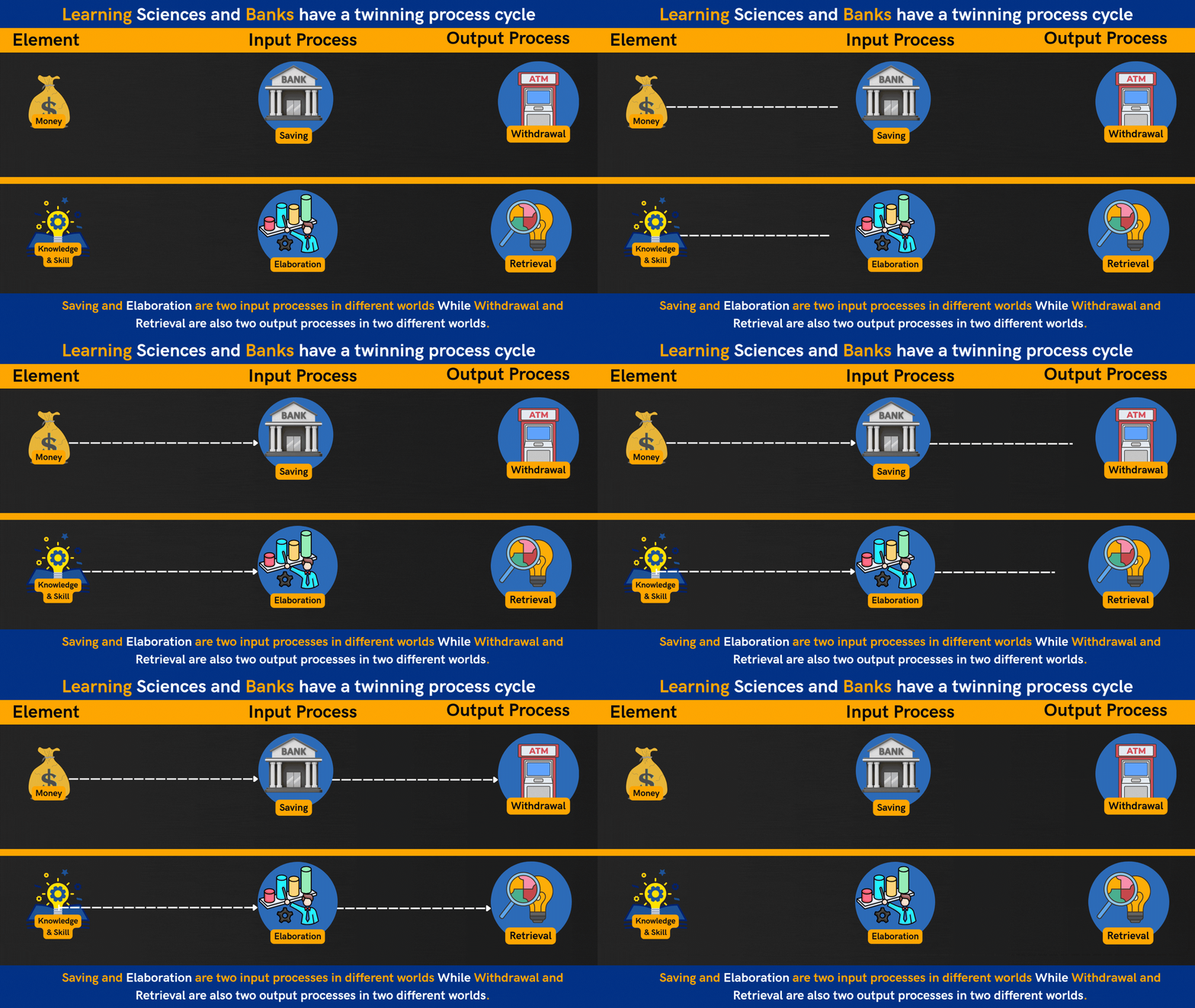
I’ve come to the realisation that Learning Sciences and Banks have a twinning process cycle that involves repeated input and output processes namely ;
Saving and Elaboration
&
Withdrawal and Retrieval.
Because it’ll only be weird if we save money in the bank for the sake of saving money and never to retrieve it in times of need to fulfil our needs and wants.
Same thing applies to knowledge and skills for our learners.
Why have them save knowledge in their Long Term Memory if the purpose isn’t to retrieve it at times of need and even want?
And just like money, how information is stored matters.
Hence, this may shake many tables, but “knowledge without application is entertainment.”
Therefore, one thing entertainment and lack of knowledge application share in common is that they both possess information that’s available during the experience but not necessarily after it.
In cognitive science, it’s called “inert knowledge.”
In my language, I’d call it “concert performance.” If the goal is learning.
If my learners can't activate the knowledge after the experience but all they can say is, “Wow, it was really engaging,” then something may have gone wrong.
Day 63 of Instructional Design
#InstructionalDesigner#LearningAndDevelopment#LearningExperienceDesign#LearningInPublic#BuildInPublic#SenseMakingNotes#MentalModels#TAWIQM#QuinnSeeds
In case you missed the Quinn Seed articles 👇
Quinn Seed #1- CLICK ME
Quinn Seed #2- CLICK ME
Quinn Seed #3- CLICK ME
Quinn Seed #4- CLICK ME
Quinn Seed #5- CLICK ME
Where this comes from
- Check out "Learning Science" by Clark Quinn — If you design learning, teach, or train people, you need to understand what is actually happening when someone learns. Learning happens at the neural level, but we design for it at the cognitive level. There’s a lot more in Clark Quinn’s book that I can’t share because of **intellectual property**. Get the book and experience the learning yourself. 📚You Would Love It!
- Check out "40 L&D Stakeholder Challenges: Of L&D Leaders, Practitioners, Clients, and Learners" by Guy W. Wallace — This book shares the answers I got from my EPPI-PACT Guidance Bot. The free EPPI-PACT Guidance Bot is a digital, interactive knowledge-transfer resource designed to help Learning and Development (L&D) practitioners, performance consultants, and business leaders master and apply Guy W. Wallace’s Performance Improvement and Performance Based L&D methodologies.
- To Learn More Join the "Learning Development Accelerator" — Click the link to join the Amazing Learning Development Accelerator Group Where practice meets evidence