- Home
- Learning in public
- Sense-making notes
- Taking a Walk In Quinn's Mind
- “I Know” vs. “I Can”: Why Different Knowledge May Need Different Learning Experiences
If different kinds of knowledge are represented differently, should we teach and practice them in the same way ?.
I suppose our anwser would be know, which is why it's imperative to know the classification of knowledge we have to help us tailor our design solutions.
And so we should think of memory as different kinds of things we can know.
And they can be looked at through the lens of two things;
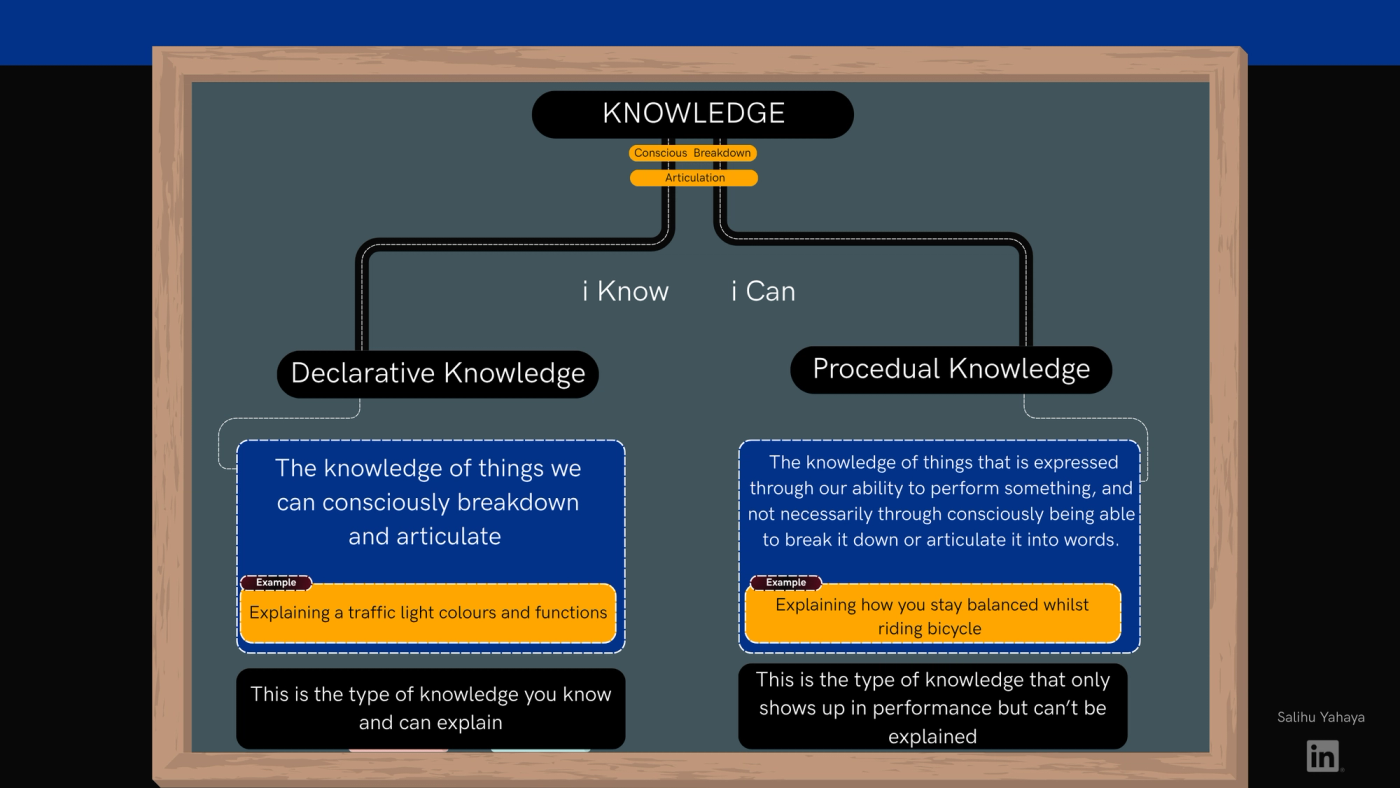
What we can consciously break down & What we can articulate.
And a simple encoding cue I’d use to keep this in mind would be that
There is the “I know - knowledge” and the “I can - knowledge”
and when these come together, it becomes the
“I Know I Can - Knowledge”
Starting with the first type of knowledge,
DECLARATIVE KNOWLEDGE
This is the type that's referred to as "Declarative Knowledge", also known as the “I know - knowledge” for me.
And in simple words, this is usually the type of knowledge we can tell someone about. This is knowledge that can be put into words, and can be consciously stated or explained.
For example:
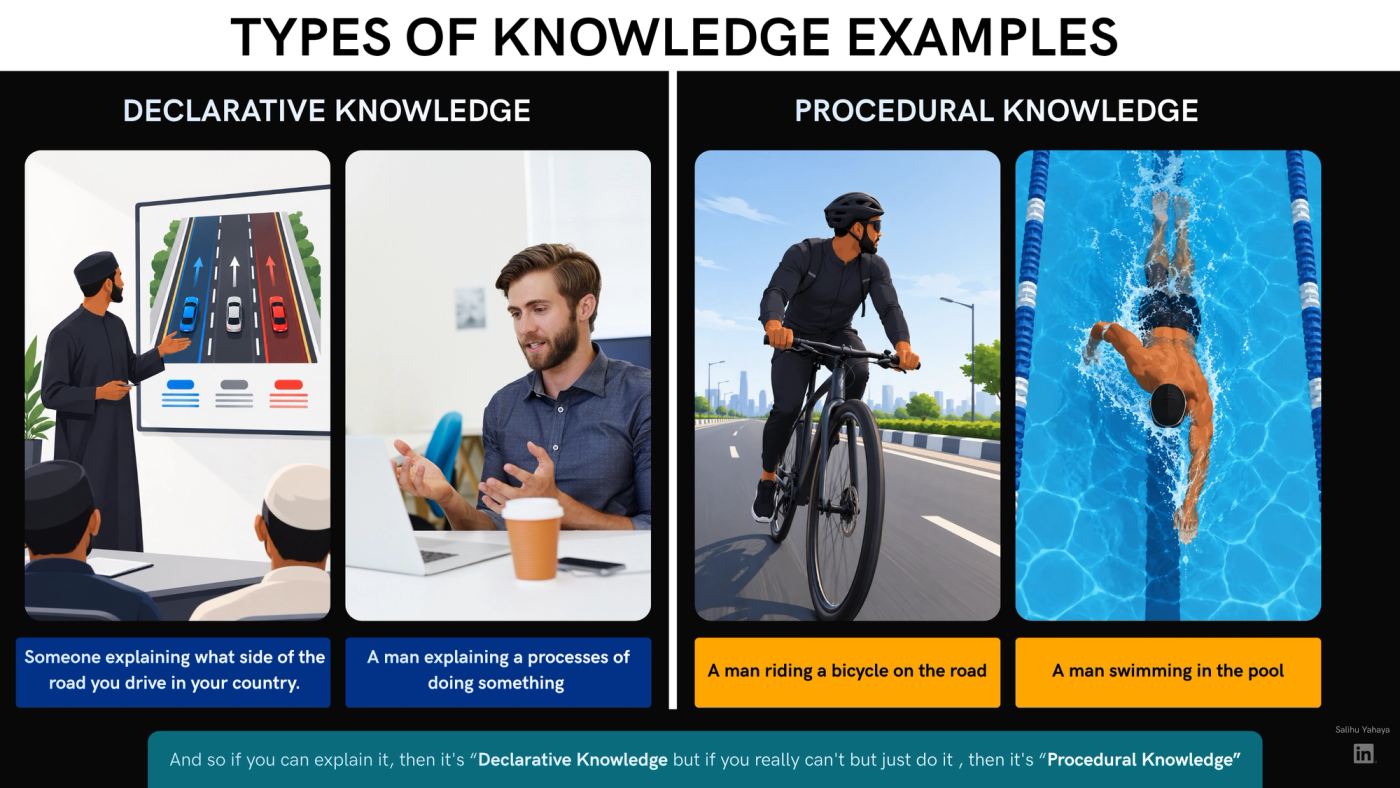
Explaining what side of the road you drive on in your country.
Explaining the processes of doing something.
On the other hand,
PROCEDURAL KNOWLEDGE
The second type of knowledge is what is referred to as “Procedural Knowledge”, which is different from declarative knowledge because it is knowledge that is expressed through our ability to perform something, and not necessarily through consciously being able to break it down or articulate it into words. This is the type that shows up in your performance, even when you cannot fully explain every step of how you do it.
For example :
🚲 Riding a bicycle
- You may not be able to explain exactly how you balance.
- But you can do it.
🏊 Swimming
- You might struggle to explain every movement your body makes.
- But your body knows how to perform the sequence.
And so, if you can consciously state or explain the knowledge, then it is declarative knowledge.
But if the knowledge is primarily demonstrated through your ability to perform something, then it is procedural knowledge.
Day 82 of Instructional Design
#InstructionalDesigner#LearningAndDevelopment#LearningExperienceDesign#LearningInPublic#BuildInPublic#SenseMakingNotes#MentalModels#TAWIQM#QuinnSeeds
In case you missed the Quinn Seed articles 👇
Quinn Seed #1- CLICK ME
Quinn Seed #2- CLICK ME
Quinn Seed #3- CLICK ME
Quinn Seed #4- CLICK ME
Quinn Seed #5- CLICK ME
Where this comes from
- Check out "Learning Science" by Clark Quinn — If you design learning, teach, or train people, you need to understand what is actually happening when someone learns. Learning happens at the neural level, but we design for it at the cognitive level. There’s a lot more in Clark Quinn’s book that I can’t share because of **intellectual property**. Get the book and experience the learning yourself. 📚You Would Love It!
- Check out "40 L&D Stakeholder Challenges: Of L&D Leaders, Practitioners, Clients, and Learners" by Guy W. Wallace — This book shares the answers I got from my EPPI-PACT Guidance Bot. The free EPPI-PACT Guidance Bot is a digital, interactive knowledge-transfer resource designed to help Learning and Development (L&D) practitioners, performance consultants, and business leaders master and apply Guy W. Wallace’s Performance Improvement and Performance Based L&D methodologies.
- Check out " 30 books made available as free PDFs" by Guy W. Wallace — Guy shares his Proven Resources for Adopting/Adapting to Improve Your Measurable Impact via Performance Based Enterprise Instruction – Performance Guides & Learning Experiences
- To Learn More Join the "Learning Development Accelerator" — Click the link to join the Amazing Learning Development Accelerator Group Where practice meets evidence