- Home
- Learning in public
- Sense-making notes
- Taking a Walk In Quinn's Mind
- Multiple-Choice Questions Taught Me the Difference Between Recognition and Recall
The distinction between recognition and recall gave me a second look at multiple-choice questions.
No wonder it’s no surprise that, as students, when we knew an exam would be multiple-choice back in my Uni days, how we approached reading for the course was different.
We just discussed in groups and didn’t focus much like when we knew we’d have to pen our thoughts down in either short (fill in the blanks) or long form (essay) exams.
Any assessment that prompts our learners to identify a correct response to a question rather than pull it out from their memory in the form of a long- or short-answer response is directing our learners towards “Recognition.”
The vice versa situation would be directing our learners towards “Recall.”
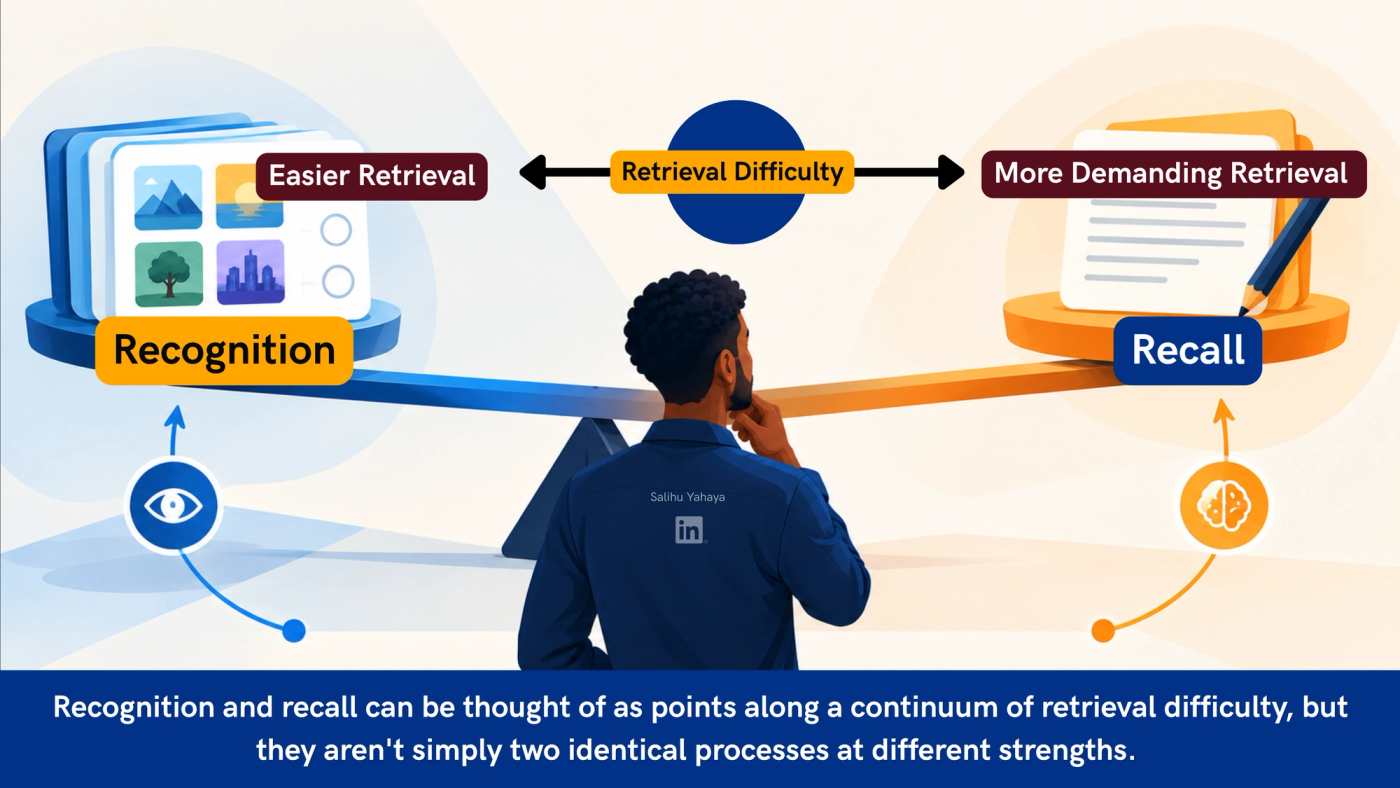
So, Recognition and recall can be thought of as points along a continuum of retrieval difficulty, but they aren't simply two identical processes at different strengths.
Recognition → the information is presented, and the learner identifies whether it is correct/familiar. “I know this when I see it.”
Recall → the learner has to generate the information without it being presented. “I can pull this from memory.”
So, broadly:
Recognition → easier retrieval → Recall → more demanding retrieval
Therefore, the more we tilt towards identification in our assessments, the more we’re drifting towards the “Recognition” end of the continuum, and the more we tilt towards answer generation(long or short answers), the more we’re drifting towards the “Recall” side of the continuum.
One is a simpler and different task than the other.
And this is where things go back to the drawing board, in other words,“The performance requirement.”
It is only right to use a recognition task if it’s in line with the requirements as i’ve learnt from Clark Quinn
Then it suffices for our learners.
Day 63 of Instructional Design
#InstructionalDesigner#LearningAndDevelopment#LearningExperienceDesign#LearningInPublic#BuildInPublic#SenseMakingNotes#MentalModels#TAWIQM#QuinnSeeds
In case you missed the Quinn Seed articles 👇
Quinn Seed #1- CLICK ME
Quinn Seed #2- CLICK ME
Quinn Seed #3- CLICK ME
Quinn Seed #4- CLICK ME
Quinn Seed #5- CLICK ME
Where this comes from
- Check out "Learning Science" by Clark Quinn — If you design learning, teach, or train people, you need to understand what is actually happening when someone learns. Learning happens at the neural level, but we design for it at the cognitive level. There’s a lot more in Clark Quinn’s book that I can’t share because of **intellectual property**. Get the book and experience the learning yourself. 📚You Would Love It!
- Check out "40 L&D Stakeholder Challenges: Of L&D Leaders, Practitioners, Clients, and Learners" by Guy W. Wallace — This book shares the answers I got from my EPPI-PACT Guidance Bot. The free EPPI-PACT Guidance Bot is a digital, interactive knowledge-transfer resource designed to help Learning and Development (L&D) practitioners, performance consultants, and business leaders master and apply Guy W. Wallace’s Performance Improvement and Performance Based L&D methodologies.
- To Learn More Join the "Learning Development Accelerator" — Click the link to join the Amazing Learning Development Accelerator Group Where practice meets evidence