- Home
- Learning in public
- Sense-making notes
- Taking a Walk In Quinn's Mind
- What’s the Point of Saving Knowledge If Learners Can’t Withdraw It?
As an Instructional designer if my goal is to have my learners pull, recall, and use information from their LTM, developing appropriate retrieval practice becomes paramount.
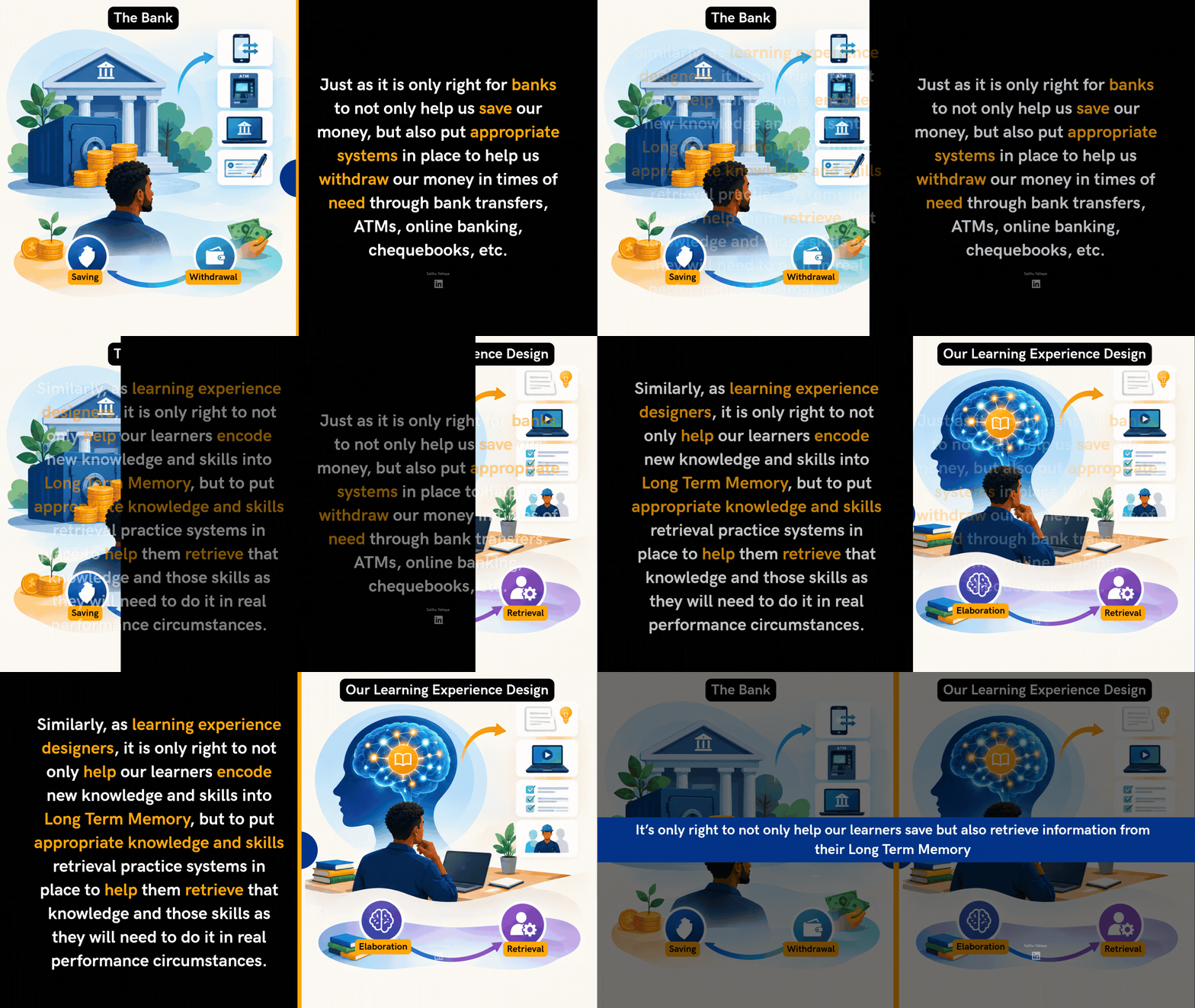
And similar to a bank, what sense would it make if a bank was built for us to save money, only for us to look at it and remember how much we have there—in other words, recognize it?
Exactly…
This is why it was only right for banks to not only help us save our money, but also put appropriate systems in place to help us withdraw our money in times of need through bank transfers, ATMs, online banking, cheque books, etc.
Their goal was simple: to help people save and keep their money safe while having it at their disposal at times of need and even want.
Similarly, as a learning experience designer, it is only right to not only help our learners encode new knowledge and skills into LTM, but to put appropriate knowledge and skills retrieval practice systems in place to help them retrieve that knowledge and those skills as they will need to do it in real performance circumstances.
Knowing how to swim is far from jumping into the pool to swim.
Day 63 of Instructional Design
#InstructionalDesigner#LearningAndDevelopment#LearningExperienceDesign#LearningInPublic#BuildInPublic#SenseMakingNotes#MentalModels#TAWIQM#QuinnSeeds
In case you missed the Quinn Seed articles 👇
Quinn Seed #1- CLICK ME
Quinn Seed #2- CLICK ME
Quinn Seed #3- CLICK ME
Quinn Seed #4- CLICK ME
Quinn Seed #5- CLICK ME
Where this comes from
- Check out "Learning Science" by Clark Quinn — If you design learning, teach, or train people, you need to understand what is actually happening when someone learns. Learning happens at the neural level, but we design for it at the cognitive level. There’s a lot more in Clark Quinn’s book that I can’t share because of **intellectual property**. Get the book and experience the learning yourself. 📚You Would Love It!
- Check out "40 L&D Stakeholder Challenges: Of L&D Leaders, Practitioners, Clients, and Learners" by Guy W. Wallace — This book shares the answers I got from my EPPI-PACT Guidance Bot. The free EPPI-PACT Guidance Bot is a digital, interactive knowledge-transfer resource designed to help Learning and Development (L&D) practitioners, performance consultants, and business leaders master and apply Guy W. Wallace’s Performance Improvement and Performance Based L&D methodologies.
- To Learn More Join the "Learning Development Accelerator" — Click the link to join the Amazing Learning Development Accelerator Group Where practice meets evidence