- Home
- Learning in public
- Sense-making notes
- Taking a Walk In Quinn's Mind
- Quinn Seeds
- Why Teaching the Knowledge Isn’t Enough: How Practice Turns “I Know” into “I Can”
The Relationship between Declarative knowledge and Procedural knowledge
Hey There, for Quinn Seed 7, I’d be walking you through this entire diagram, based on what I have come to understand.

Having understood what declarative and procedural knowledge are, I looked deeper after reflecting on Clark’s Quinn Seeds regarding how different practice is suited to different use-case outcomes, while bearing in mind the knowledge needed to support the acquisition of procedural skills.
In the end, you’ll see why declarative knowledge supports the early construction of procedural skill and how, once a level of automation is attained, it frees up space in our learners’ working memory to take in a higher level of scaffolding that can, yet again, support an extended procedural skill to be built on the previously automated one.
But let’s make it make sense.
Declarative Knowledge
In whatever job that starts and ends with our learners performing an action or doing something, the knowledge of what is needed to do or achieve that required goal is needed.
Let’s take, for example:
An onboarding session that puts our learners through how to classify internal and external event pictures to be used in their respective sections of the monthly report of the Corporate Communications Department.
The truth is, we all understand that our learners wouldn’t just jump into classifying and putting various pictures into the monthly report.
Rather, they will need knowledge about what types of events are being covered, the cues that help them determine whether a picture represents an internal or external event, the process for classifying and grouping the pictures, and lastly, where to put them in the monthly report.
All of these require knowledge, and that’s where declarative knowledge comes in.
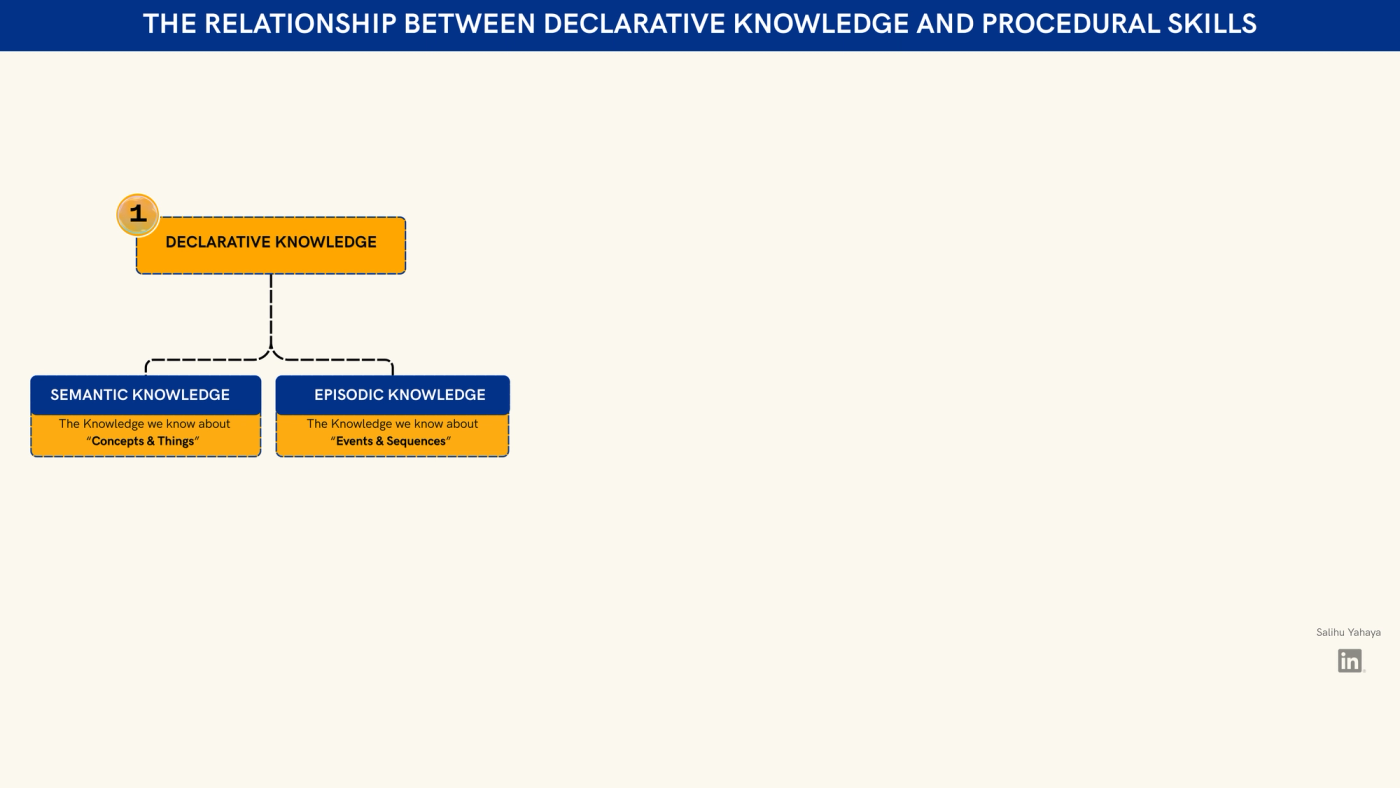
Declarative Knowlegde Then Supports Early Construction of Procedural Skills
And because declarative knowledge comprises semantic knowledge that covers knowledge about things and concepts, and episodic information that covers knowledge about events and sequences, most times our learners won’t be dealing with only one element but a network of interconnected, cascading elements.
For instance, in the case of our example, our employees won’t only be dealing with pictures as an element but will also be dealing with identification cues that help them know which pictures were taken at internal events and which pictures were taken at external events.
And so they’d be dealing with identification, classification and grouping.
Which are concepts of their own that can be connected through a sequence of actions.
So one may ask, how does this contribute to the buildup of procedural skills?
Well, one key thing to note about declarative knowledge is that it supports the early construction of the skill because, without the knowledge of the relevant concepts and the sequence involved, our learners wouldn’t have what they need to begin performing the task.

Practice
Also, one may think this is the end.
We’ve given our learners the declarative knowledge they need to perform the job.
Training over.
And unfortunately, that’s what happens in most trainings, at least for most of the ones I’ve taken myself (due to a lack of practice design).
But something very important is that, just like a boxing coach doesn’t simply show a recruit boxer how to punch once and then send him into the boxing ring, instead he provides sufficient practice opportunities where the recruited boxer trains using the punching bag, speed bag, and other forms of practice.
So should we, as learning experience designers, not only expose and teach our learners the concepts, things, events or sequences they’d need to perform the job, but also provide practice and feedback(Read More on feedback here) opportunities through our learning experience designs to set them up for skill development and, where appropriate, increasing automaticity.
Because, just as it’s only right that a single practice session isn’t enough for that recruit boxer to develop mastery of the skill, one practice session wouldn’t be enough to set up our learners for procedural skill development either.
And so, sufficient and appropriate practice sessions would be paramount so our learners can distinguish between concepts and apply what they know while getting feedback to help them refine their performance along the way until the goal is achieved. (Read more on feedback)
In our case:
Our learner being able to differentiate between internally taken pictures and externally taken pictures and correctly classify and group them.

Automation
With sufficient and appropriate practice, of course, given that the external source of feedback has been faded, parts of the performance can become increasingly automatic to our learners, making it easier to perform those parts without requiring as much conscious working-memory effort.
And when we get to this stage, performance can be executed with less conscious deliberation, which then frees up some of their working-memory capacity to work on other aspects of the task.
In the case of complex tasks,
This is why Clark mentioned going for mastery first, before scaffolding to a higher level. Because once a lower-level component has become sufficiently automated, it becomes easier for our learners to devote working-memory resources to the next level of the task.
Those next declarative chunks can then support the construction of a higher-level procedural skill through yet another cycle of practice and feedback. And as those higher-level components become increasingly automated, they can provide the foundation for yet another level of complexity.
It becomes something like this:
Declarative knowledge → Practice + Feedback → Increasing Automaticity → More Working-Memory Capacity → Higher-Level Performance → Practice + Feedback → Increasing Automaticity → Higher-Level Performance
And this is where the relationship between declarative and procedural knowledge really starts to make sense to me.
Declarative knowledge can provide some of the knowledge needed to begin performing a task. Practice and feedback help transform that knowledge into increasingly skilled performance. And as parts of the performance becomes more automatic, learners can use their limited working-memory capacity to deal with more complex aspects of the task.
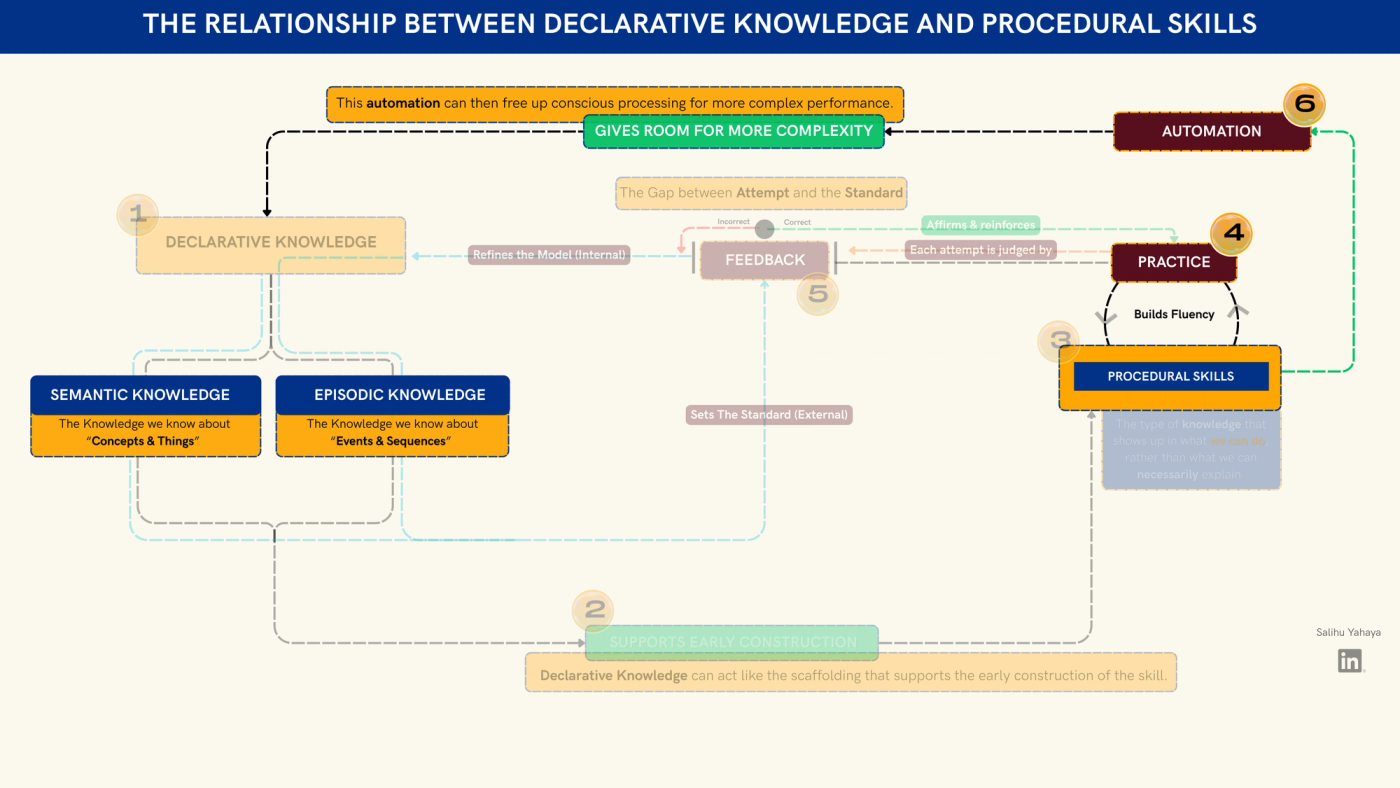
And the more our learners get to automate their performance, the easier it becomes for our learners working memory to learn and work with the next 2-4 declarative chunks(conservative prescription by Clark) that help build up a higher level of procedural skills through yet again another practice and feedback session.

Day 89 of Instructional Design
#InstructionalDesigner#LearningAndDevelopment#LearngExperienceDesign#LearningInPublic#BuildInPublic#SenseMakingNotes#MentalModels#TAWIQM#QuinnSeeds
In case you missed the Quinn Seed articles 👇
Quinn Seed #1- CLICK ME
Quinn Seed #2- CLICK ME
Quinn Seed #3- CLICK ME
Quinn Seed #4- CLICK ME
Quinn Seed #5- CLICK ME
Quinn Seed #6 CLICK ME
Where this comes from
- Check out "Learning Science" by Clark Quinn — If you design learning, teach, or train people, you need to understand what is actually happening when someone learns. Learning happens at the neural level, but we design for it at the cognitive level. There’s a lot more in Clark Quinn’s book that I can’t share because of **intellectual property**. Get the book and experience the learning yourself. 📚You Would Love It!
- Check out "Motivation Blueprint" by Matthew Richter — The Motivation Blueprint is a design and implementation manual for managers and leaders — a practical, evidence-informed guide for creating work environments where people genuinely want to contribute and are equipped to perform. Grounded in Self-Determination Theory, one of the most rigorously researched frameworks in motivational psychology
- Check out "40 L&D Stakeholder Challenges: Of L&D Leaders, Practitioners, Clients, and Learners" by Guy W. Wallace — This book shares the answers I got from my EPPI-PACT Guidance Bot. The free EPPI-PACT Guidance Bot is a digital, interactive knowledge-transfer resource designed to help Learning and Development (L&D) practitioners, performance consultants, and business leaders master and apply Guy W. Wallace’s Performance Improvement and Performance Based L&D methodologies.
- Check out " 30 books made available as free PDFs" by Guy W. Wallace — Guy shares his Proven Resources for Adopting/Adapting to Improve Your Measurable Impact via Performance Based Enterprise Instruction – Performance Guides & Learning Experiences
- To Learn More Join the "Learning Development Accelerator" — Click the link to join the Amazing Learning Development Accelerator Group Where practice meets evidence