- Home
- Learning in public
- Sense-making notes
- Taking a Walk In Quinn's Mind
- Good Feedback Doesn’t Just Correct Performance. It Teaches Learners to Correct Themselves.
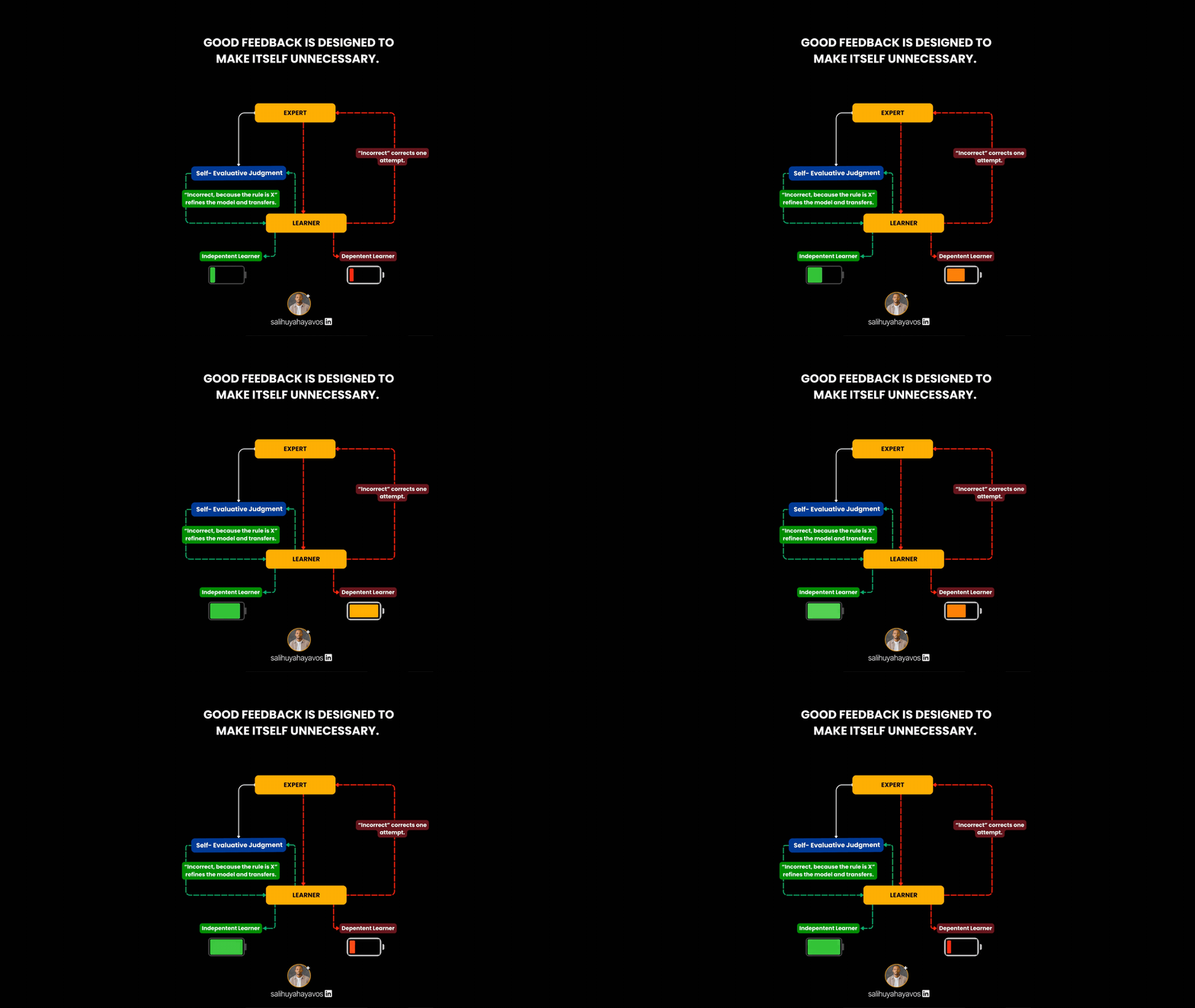
Good feedback is designed to make itself unnecessary. That’s the bridge i see to automation given that meaningful feedback is what's given to our learners.
The whole goal is to have our learners be able to monitor themselves, which in a way should make practice becomes self-correcting, chunks automating faster, and working memory opening up for complexity.
One thing i wouldn't do is equate automation to expertise because we could have our learners automate the wrong procedural skill process or processes, if our feedback doesn't "affirm and reinforce" an attempt that mirrors the standard (declarative knowledge) which in my own words will call "a matching attempt" or "correct and redirect" our learners, for "a mismatching attempt" to the standard.
And "Expert", here, in my infographic could translate to anyone, thing, sequence, concept, that's meant to be with our learners and should not remain in the environment (*this should be predefined from the onset).
It could be a declarative statement: a rule, a model of correct performance, a description of what good looks like, basically the source of feedback, held by the coach, the teacher, the rubric, the worked example etc.
A good feedback starts out external, but the end goal is to reside inside our learners, removing their sense of dependency on the external feedback.
I have many examples i could use but, I'd use my own most recent learning journey experience as an example which was my first attempt to explain my understanding about "The Relationship Between Declarative Knowledge and Procedural Knowledge".
Clark Quinn's feedback would have only corrected my first attempt towards making my graphics pass a more accurate information with a "seperate feedback from practice, and take it close to the declarative knowledge" alone as feedback, hence , keeping my dependency on him to make it accurate.
But no, he further built on it with a reason why, as he said ; "then a cycle between the declarative knowledge as the source of feedback(external to the learner), and back as the feedback refines the declarative knowledge (internally). Am I making sense?".
The reason he gave me equipped me with a description of what correct looked like. I mean, there's more to it but , it gave me all i needed to complete it on my own and now, i didn't have to refer back to him regarding it, because guess what ?, Notes Taken, and, my declarative knowledge had been refined ;).
That's good feedback for me, just as researchers like Royce Sadler framed it as "developing the learner’s own evaluative judgment so they can self-correct".
I hope you find the infographic useful, i think I'd create more like this that visualizes flows and relationships between learning science concepts.
Day 95 of Instructional Design
#InstructionalDesign #LearningAndDevelopment #LearningExperienceDesign #ELearningDesign #CurriculumDeveloper #LearningJourney #LearningInPublic #SenseMakingNotes #MentalModels #TAWIQM #QuinnSeeds
Day 95 of Instructional Design
#InstructionalDesigner#LearningAndDevelopment#LearningExperienceDesign#LearningInPublic#BuildInPublic#SenseMakingNotes#MentalModels#TAWIQM#QuinnSeeds
In case you missed the Quinn Seed articles 👇
Quinn Seed #1- CLICK ME
Quinn Seed #2- CLICK ME
Quinn Seed #3- CLICK ME
Quinn Seed #4- CLICK ME
Quinn Seed #5- CLICK ME
Quinn Seed #6 CLICK ME
Quinn Seed #7- CLICK ME
Where this comes from
- Check out "Learning Science" by Clark Quinn — If you design learning, teach, or train people, you need to understand what is actually happening when someone learns. Learning happens at the neural level, but we design for it at the cognitive level. There’s a lot more in Clark Quinn’s book that I can’t share because of **intellectual property**. Get the book and experience the learning yourself. 📚You Would Love It!
- Check out "40 L&D Stakeholder Challenges: Of L&D Leaders, Practitioners, Clients, and Learners" by Guy W. Wallace — This book shares the answers I got from my EPPI-PACT Guidance Bot. The free EPPI-PACT Guidance Bot is a digital, interactive knowledge-transfer resource designed to help Learning and Development (L&D) practitioners, performance consultants, and business leaders master and apply Guy W. Wallace’s Performance Improvement and Performance Based L&D methodologies.
- Check out " 30 books made available as free PDFs" by Guy W. Wallace — Guy shares his Proven Resources for Adopting/Adapting to Improve Your Measurable Impact via Performance Based Enterprise Instruction – Performance Guides & Learning Experiences
- To Learn More Join the "Learning Development Accelerator" — Click the link to join the Amazing Learning Development Accelerator Group Where practice meets evidence