- Home
- Learning in public
- Sense-making notes
- Taking a Walk In Quinn's Mind
- One Experience Can Teach a Pattern, But Multiple Experiences Teach You When It Applies
Declarative knowledge
In the last episode, we went through an introduction into the two types of knowledge we have where we explained Declarative Knowledge in simple words, as, the type of knowledge we can tell someone about, put into words, and can be consciously stated or explained.
Which in our own words we can also call the “I know - knowledge”.
Now we go a level deeper.
We can also Classify the knowledge “we know” into two categories namely;
- The Knowledge we know about “Concept & Things” which is referred to as “Semantic Knowledge” and
- The Knowledge we know about “Events & Sequences” which is referred to as “Episodic Knowledge”

And this is where Rumelhart, Minsky & Schank come in. So let’s talk about semantic knowledge. Rumelhart and Minsky were trying to explain how we represent knowledge about concepts and things.
but before I land on the point,
If I say the word house to you, you don’t simply associate a house as an isolated piece of information rather, the concept of a house to you will vary depending on types you’ve seen or even lived in.
And depending on your experience with a house, the concept of house may include
Doors 🚪, windows 🪟, walls , roof, garage , balcony , artic etc
Or simply just
Doors 🚪, windows 🪟, walls and roof

But this doesn’t change the fact that an individual part of the whole can exist as its own concept.
Example A Door cascading down to many other parts like handle, lock ,
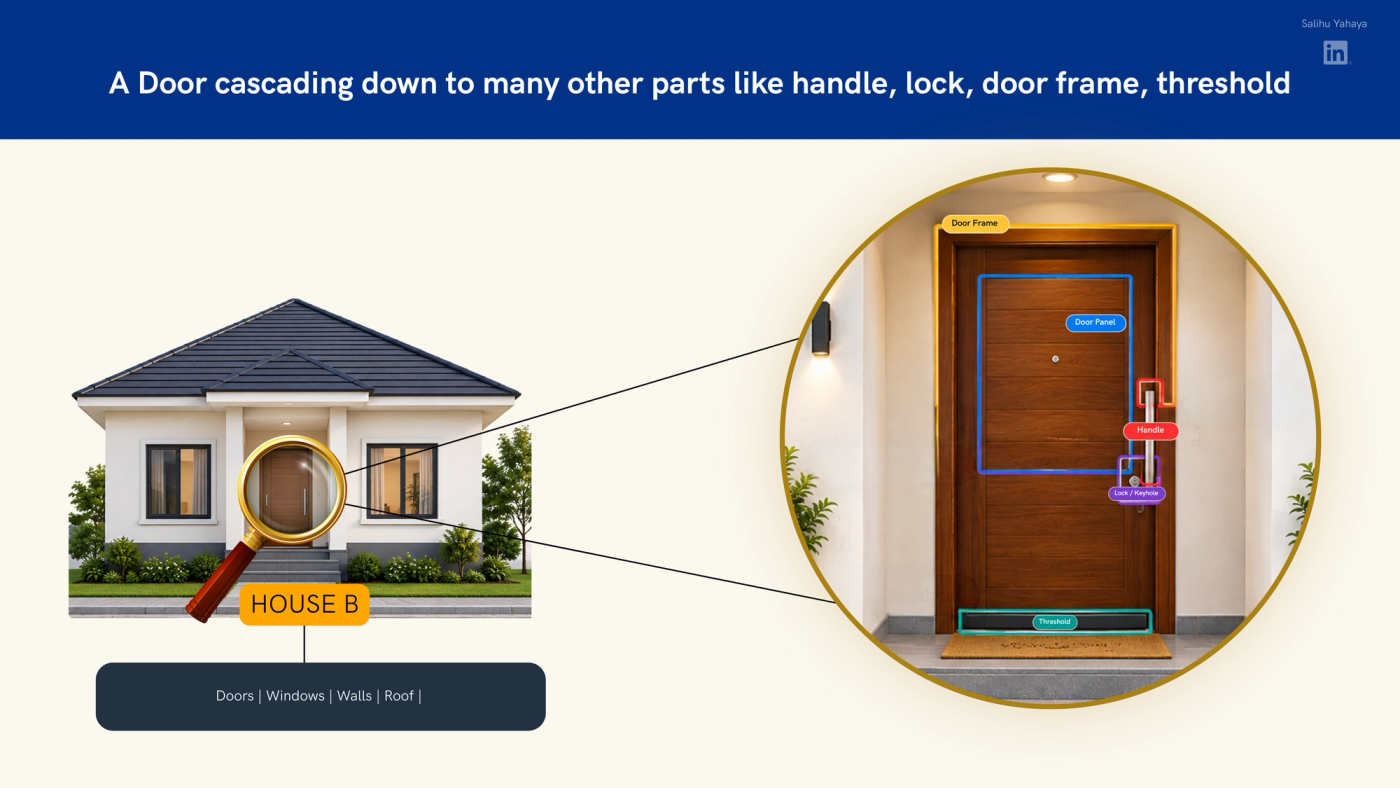
Window also cascading down to many other parts like

And so this ties beautifully to the idea of “dot connection cycle” i spoke about when explaining elaboration in EPISODE 45
Knowing this gives us another reason why the connections between our learner’s prior and new knowledge matter, because our knowledge isn't simply a collection of isolated facts but more like a network of connected concepts.
Hence a house that could be the resulting concept of smaller interconnected concepts can also be a smaller concept interconnecting with other concepts that’ll result in a bigger concept (Estate)

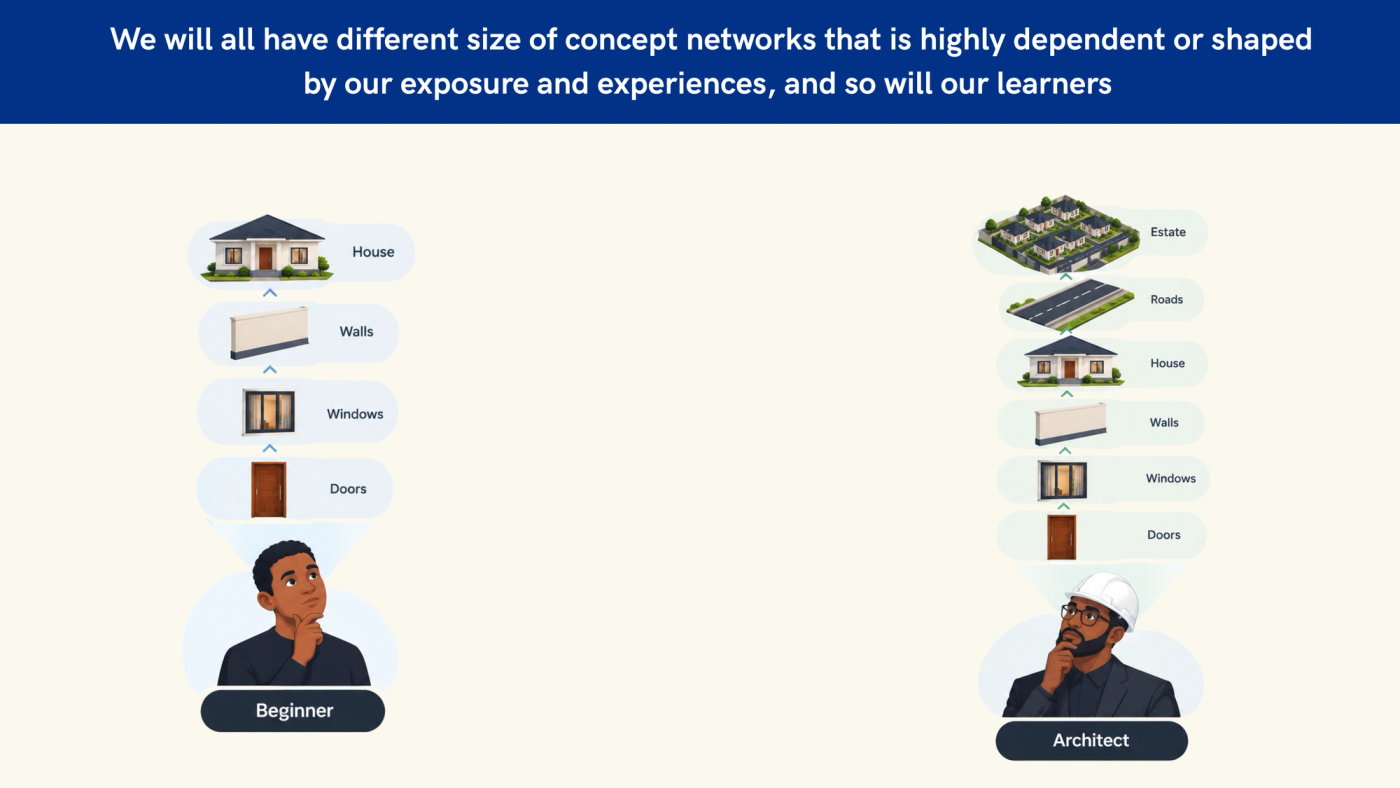
And due to the fact that we’ve all gone through different experiences and exposure at different times and places , we will all have different sized network which is dependent or shaped by our exposure and experiences
And so while a beginner is having a cascading network of concepts like
Doors- Windows - Walls - House Alone
An Architect may even be picking up from the resulting concept of the beginner which is a house to have
Doors- Windows - Walls - House - Roads - Estate
Or even different types of house
And a learning implication for me connects directly to elaboration from the previous note
“The richer the meaningful connections around an idea, the easier and more ways there is for that idea to become accessible.”
So when i design learning experiences
I won’t only be asking “What information should i give my learners “
But“ What existing knowledge can i connect this new idea to “
EPISODIC KNOWLEDGE
In episode 49 , we went through an introduction into the two types of knowledge we have where we explained Episodic Knowledge in simple words, as, the type of knowledge that is expressed through our ability to perform something, and not necessarily through consciously being able to break it down or articulate it into words.
Which in my our own words we’d also call the “I Can - knowledge”.
Hence, it usually answers the question “What Happened ?”. And while Rumelhart and Minsky focused on how we represent knowledge in concepts and things, Schank was looking at something slightly different.
“Knowledge about events and sequences.”
Lets go to the restaurant to sink this in.
When you go to any restaurant, and at least have intentions of eating there, you just don't know isolate facts
I believe you walk in, and then you take a seat expecting the waiter or waitress to come attend to you, by which you then take your order, and receive your food, you either pay before or after eating. depending on the terms and conditions of that restaurant.

That’s an expected sequence you have going on there. And so when you’ve make your order, something happens. Do you leave immediately or wait for your order to be brought to you ?.
If you chose the latter which is only right for you to do (unless you have a delivery plan), then the fact that you had to taken your order and eaten it had given you a clue about the expected structure of the next event which is of course “Paying for the meal”, and this becomes a script.
Scripts help us guess the missing parts of a situation because we already know how that situation usually goes. Hence it’s a familiar sequence that helps us fill in gaps. What this should highlight to us is how powerful stories can be. As evidence suggest, we humans are wired to stories as there are areas of our brain that responds to stories.
“A story gives an event structure rather than present disconnected facts.”
Clark notes that scripts can help us fill in information and make stories easier to remember and reconstruct. The fact that you waited for the waiter to bring your order shows how structured and sequenced the knowledge you had wasBut here’s one of my favourite takeaway from the episodic knowledge
“Stories are the best way to convey event information and so schemas and scripts are good”
However Event knowledge can be a double edge sword of Generalisation and Overgeneralisation or stereotyping
But Let’s make it make sense
If our experience tells us “this is how a restaurant works”, Then we may automatically fill missing information and that’s useful, but in the case of overgeneralisation, if the situation is different our existing structure can mislead us. A very simple example we can use would be learning how to drive
Imagine you’re learning to drive
And you then approach a particular junction
A car suddenly cuts in front of you
And you brake hard and avoid an accident
What your brain learns from this is
At junctions , cars can suddenly cut in"
And so for the useful side which is Generalization, the next time you approach a junction , you'd remember that experience and think "i should slow down and watch carefully "
and that becomes useful because one experience shapes your applied lessons to similar situations.
Experience → Pattern → New situation
However the dangerous sides of things which is overgeneralisation then becomes, "Junctions are dangerous. cars always cut in". So now even at a quiet junction with no traffic, you become excessively cautious. The original experience was real but we may often turn a
"Thus can happen situation" into a " This will always happen situation"
and this is unfortunately the sharp edge of the sword

And so what i pick from this when connecting it back to learning experience design is that;
“One scenario shouldn't be enough for our learners”
and so if i teach coaching using only;
Here is what happened in this coaching conversation then we risk the chances of a learner overgeneralising all scenarios to that one conversation thinking thats how it always work. So instead giving them different scenarios will help them see what stays the same, what changes and when the principle or a ruling applies
and a simple takeaway from me will be;
Experience gives us patterns . Multiple experiences help us know when those patterns actually apply.
Day 82 of Instructional Design
#InstructionalDesigner#LearningAndDevelopment#LearningExperienceDesign#LearningInPublic#BuildInPublic#SenseMakingNotes#MentalModels#TAWIQM#QuinnSeeds
In case you missed the Quinn Seed articles 👇
Quinn Seed #1- CLICK ME
Quinn Seed #2- CLICK ME
Quinn Seed #3- CLICK ME
Quinn Seed #4- CLICK ME
Quinn Seed #5- CLICK ME
Where this comes from
- Check out "Learning Science" by Clark Quinn — If you design learning, teach, or train people, you need to understand what is actually happening when someone learns. Learning happens at the neural level, but we design for it at the cognitive level. There’s a lot more in Clark Quinn’s book that I can’t share because of **intellectual property**. Get the book and experience the learning yourself. 📚You Would Love It!
- Check out "40 L&D Stakeholder Challenges: Of L&D Leaders, Practitioners, Clients, and Learners" by Guy W. Wallace — This book shares the answers I got from my EPPI-PACT Guidance Bot. The free EPPI-PACT Guidance Bot is a digital, interactive knowledge-transfer resource designed to help Learning and Development (L&D) practitioners, performance consultants, and business leaders master and apply Guy W. Wallace’s Performance Improvement and Performance Based L&D methodologies.
- Check out " 30 books made available as free PDFs" by Guy W. Wallace — Guy shares his Proven Resources for Adopting/Adapting to Improve Your Measurable Impact via Performance Based Enterprise Instruction – Performance Guides & Learning Experiences
- To Learn More Join the "Learning Development Accelerator" — Click the link to join the Amazing Learning Development Accelerator Group Where practice meets evidence